This post contains affiliate links. We may earn a small commission when you buy through our links — at no extra cost to you.
A tuna sandwich is only as good as the can you open. The best canned tuna tastes clean and savory, flakes into firm pieces, and holds up whether you’re mixing it with mayo or folding it into pasta. The worst is watery, pasty, and fishy in a way no amount of relish can hide. Over the past three months, my team and I worked through 18 cans — oil-packed, water-packed, low-sodium, and budget picks — to find the ones worth keeping.
We judged them the way you’d actually use them: plain from the can, in tuna salad, and stirred through warm pasta. Flavor came first, but texture mattered just as much — we wanted flaky, not mushy — along with whiteness, chunk size, and whether the lid opened without a fight. We also compared cost per ounce of drained tuna, because a cheap can that’s half water isn’t a value, and tasted low-sodium options plain to see if they needed salt or simply tasted flat. The picks below earned a permanent spot in my pantry; the rest went back to the shelf.


Best for Eating from the Can
Genova Yellowfin in Olive Oil
Key Features
- Grade: Solid light yellowfin
- Protein: 29 g per can
- Pack size: 12 cans, 5 oz each
- Packed in: Olive oil
- Price: Midrange
Pour off the olive oil and what’s left in a Genova can is a set of solid yellowfin pieces, not a mound of flakes. That’s the whole reason it’s our top pick: it’s the one can here you can turn out onto a plate, add nothing, and call lunch. The fish is hand-filleted and packed with the oil doing the seasoning, so it tastes rich and savory before you’ve reached for salt or lemon.
The flesh is where this can separates from the water-packed albacore. It stays thick and creamy instead of going chalky, and it holds together under a fork, which makes it the better choice for a salade niçoise, a tuna-and-white-bean plate, or a sandwich where you want the fish to read as fish rather than as filling. Each five-ounce can carries 29 grams of protein, and the oil means you can skip the mayonnaise entirely.
Two costs to know about. Oil adds fat and calories a water-packed can doesn’t, and some of what you pay for by weight is oil; drain it into a jar and use it for a vinaigrette and the arithmetic improves. The other is money: this sits well above the everyday chunk light here, and it’s worth it only if you’re eating the fish as fish.
Which is the honest limit. Fold this into a tuna noodle casserole and you’ve spent the premium on a dish that would taste the same with a budget can. Keep it for the plate.
Pros
- Solid fillets rather than flakes in every can
- Olive oil means no mayonnaise needed
- Rich, savory flavor that needs little seasoning
Cons
- Costs well above the water-packed cans here
Our pick for the best canned tuna here: firm yellowfin fillets in olive oil that taste complete straight from the can, no mayonnaise required.
Best for Plated Tuna
Wild Planet Albacore & Sea Salt
Key Features
- Grade: Solid albacore
- Protein: 33 g per serving
- Pack size: 4 cans, 5 oz each
- Added liquid: None — sea salt only
- Price: Premium
There’s no water to pour off a Wild Planet can. The albacore is cooked once with sea salt and its own juices, so what comes out is a single piece of fish and a spoonful of liquid — you break it up yourself with a fork or a knife. Anyone used to draining a can over the sink will notice immediately: you’re buying fish, not fish plus brine.
We rate it the best of the premium cans here, and the texture is why. It holds its shape on the plate, closer to a piece of poached fish than to anything that flakes at a glance, and it survives being turned in a bowl without collapsing. The figures back up the price: 33 grams of protein and 1500 mg of EPA and DHA omega-3s per serving, so a single can works as a meal rather than a garnish.
The catch is cost, and it’s real — this is the most expensive can per ounce here by a wide margin. You’re paying for pole-and-line fishing, a fillet pack, and a supply chain that goes to the trouble of putting a trace code on the lid. If the tuna is headed for mayonnaise and relish, none of that survives the mixing.
Where it earns its keep is the meal that isn’t a recipe: a can, a tomato, good bread, olive oil. Keep one on the shelf for the nights you can’t be bothered.
Pros
- No added water — the whole can is fish
- Solid fillet holds together on the plate
- 33 g protein and 1500 mg omega-3s per serving
- Pole-and-line caught with a traceable code
Cons
- Most expensive can per ounce here
For eating tuna as fish rather than as sandwich filling: a solid fillet with no water to drain and a serious protein count, if you’ll pay for it.
Best for Casseroles and Patties
StarKist Chunk Light Tuna
Key Features
- Case: 48 cans, 5 oz each
- Grade: Chunk light
- Protein: 20 g per can
- Packed in: Water
- Price: Budget
The case arrives as one box of about fifteen pounds, and finding a shelf for it is the first decision you make with this product. The second is whether your household actually eats forty-eight cans of tuna before the dates run out. If the answer is yes, nothing here beats it on cost.
We reach for it for the jobs where the fish gets broken up anyway: tuna patties, noodle casserole, a sandwich spread mashed together with a fork. Chunk light is the workhorse grade — mild, seasoned enough to taste, forgiving of whatever you mix into it — and at the lowest cost per can here it’s the one to buy by the case rather than the tin.
What it isn’t is a can to open for a plated salad. Mixed into mayonnaise, spread into a melt, or folded through pasta, it disappears into the dish the way a workhorse should. Set on a plate on its own, it’s a value can and it tastes like one.
One practical note before you order: the box is heavy, it doesn’t shrink, and forty-eight cans is a lot of dinners. Buy it once tuna is already a weekly habit, not to find out whether it could be.
Pros
- Lowest cost per can in this guide
- Mild flavor that takes any seasoning
- Forty-eight cans is months of pantry protein
Cons
- The fifteen-pound case needs real shelf space
The value pick: a case of mild chunk light that’s happiest in casseroles and sandwiches, at the lowest cost per can in this guide.
Best for Low-Sodium Diets
StarKist Selects No Salt Albacore
Key Features
- Case: 12 cans, 4.5 oz each
- Grade: Chunk white albacore
- Sodium: 35 mg per 2 oz serving
- Protein: 14 g per serving
- Price: Midrange
Thirty-five milligrams of sodium per two-ounce serving. If you cook to a salt limit, that number has already decided the comparison — most standard cans run several times higher. What surprised us is that the trade-off isn’t flavor: the albacore is clean and mild rather than flat, with big chunks and very little water to drain.
Without salt, the can becomes an ingredient. You’ll add salt, lemon, olive oil, or something briny like capers yourself, and you decide how much — which is exactly what you want if one person at the table is on a restricted diet and everyone else isn’t. It’s a touch stiffer in the can than the salted albacore, so dress it wetter than you think it needs; it loosens up with oil and acid.
The costs are modest and worth naming. The cans are four and a half ounces rather than five, the twelve-pack is the only format, and it runs more per ounce than the salted albacore we recommend. For the buyer it’s aimed at, none of that changes the answer.
Pros
- 35 mg sodium per serving
- Clean, mild albacore rather than flat
- Big chunks with little water to drain
Cons
- Costs more per ounce than salted albacore
The low-sodium can worth buying: 35 mg per serving, clean albacore flavor, and enough texture to hold a sandwich together.
Best for Batch Tuna Salad
Chicken of the Sea Chunk Light
Key Features
- Case: 24 cans, 12 oz each
- Grade: Chunk light
- Packed in: Water
- Certification: MSC certified wild caught
- Price: Budget
A twelve-ounce can is not a sandwich can. It’s well over twice a standard five-ounce tin, which makes this the case to buy if tuna salad happens by the bowl in your house — a family lunch, a batch cooked on Sunday for the week, a platter for a party.
The fish is wild-caught, MSC-certified chunk light packed in water, mild and easy to season, and twenty-four cans of it is the biggest single stash in this guide. Cost per ounce is the lowest here, which is the other half of the argument: the format and the price both point at volume cooking rather than lunch for one.
That’s the trade. Opened for one sandwich, twelve ounces is waste — a household of one or two will lose half of every can — and once opened it has a couple of days in the refrigerator to be finished. Opened for a bowl of tuna salad for six, it’s exactly right and cheaper than opening three small tins.
Pros
- Lowest cost per ounce in this guide
- MSC-certified wild-caught chunk light
- Twelve-ounce cans suit batch cooking
Cons
- Soft, watery flakes rather than firm chunks
The bulk-cooking pick: twelve-ounce cans of mild chunk light at the lowest cost per ounce here, built for households that make tuna by the bowl.
Best for Everyday Sandwiches
Bumble Bee Solid White Albacore

Key Features
- Case: 24 cans, 5 oz each
- Grade: Solid white albacore
- Protein: 29 g per can
- Packed in: Water
- Price: Budget
Solid white albacore is a grade, not a promise, and this case is the clearest illustration of that in the group. Open some cans and you get exactly what the label describes: pale, firm, mild tuna in large pieces. Open others and the fish comes out darker and closer to chunk, with more water in the can. Nothing tastes off — it just isn’t the same can twice.
What you’re buying is volume. Twenty-four five-ounce cans, 29 grams of protein apiece, 300 mg of omega-3s, mild enough to take mayonnaise, lemon, and celery without argument. For the tuna salad you make every other week, or the casserole you take to a potluck, that’s the right level of ambition — this is a can that wants to be mixed, not plated.
We kept coming back to it on price: it lands among the cheapest per-ounce albacore here, and well below the premium cans. What we pass on to friends is a check on the first can. If it comes out dark, shift that part of the case into baked dishes, where sauce and breadcrumbs hide the color, and keep the pale cans for sandwiches.
The place it doesn’t compete is the one place albacore usually shines: straight from the can, on a fork, with nothing done to it. The variation that vanishes under mayonnaise is the entire experience there.
Pros
- Mild, firm albacore at a low per-ounce price
- Twenty-four cans, a genuine pantry supply
- 29 g protein and 300 mg omega-3s per can
Cons
- Color and piece size vary from can to can
The practical way to keep albacore on hand: 24 mild, firm cans at one of the lowest per-ounce prices here, provided you’re mixing rather than plating.
Best for Melts and Bakes
Bumble Bee Chunk White Albacore

Key Features
- Grade: Chunk white albacore
- Protein: 23 g per can
- Pack size: 4 cans, 5 oz each
- Packed in: Water
- Price: Budget
Chunk white albacore is the middle grade, and it’s the one most people actually want: white meat with albacore’s milder flavor, broken into pieces before it goes in the can, so it costs less than solid pack and needs less fork work than a fillet.
This four-pack is the smallest outlay for albacore here. Four five-ounce cans, 23 grams of protein apiece, 290 mg of omega-3s, wild caught and non-GMO, in the standard can size. It’s a try-it quantity rather than a pantry supply, and the per-ounce cost lands in the same neighborhood as the big albacore case, so buying small doesn’t carry a penalty.
Before you open one, plan to drain it properly and blot it. This is a wet can, and the pieces can arrive closer to a soft flake than a chunk, which changes what it’s good for. Under mayonnaise in a melt, or folded into a casserole, the texture stops mattering.
Where we land: the best value here for cooked applications, where the fish is broken down anyway, and the right size for a first order. What it can’t do is the thing solid pack is for — a fork, a plate, and nothing else.
Pros
- Mild albacore flavor without solid-pack cost
- 23 g protein and 290 mg omega-3s per can
- Four cans, so you can try before buying a case
Cons
- Texture runs soft and wet straight from the can
The budget route into albacore: four cans of mild chunk white for melts, casseroles, and sandwiches where the fish gets broken up anyway.
Best for Salt-Free Cooking
365 No Salt Albacore
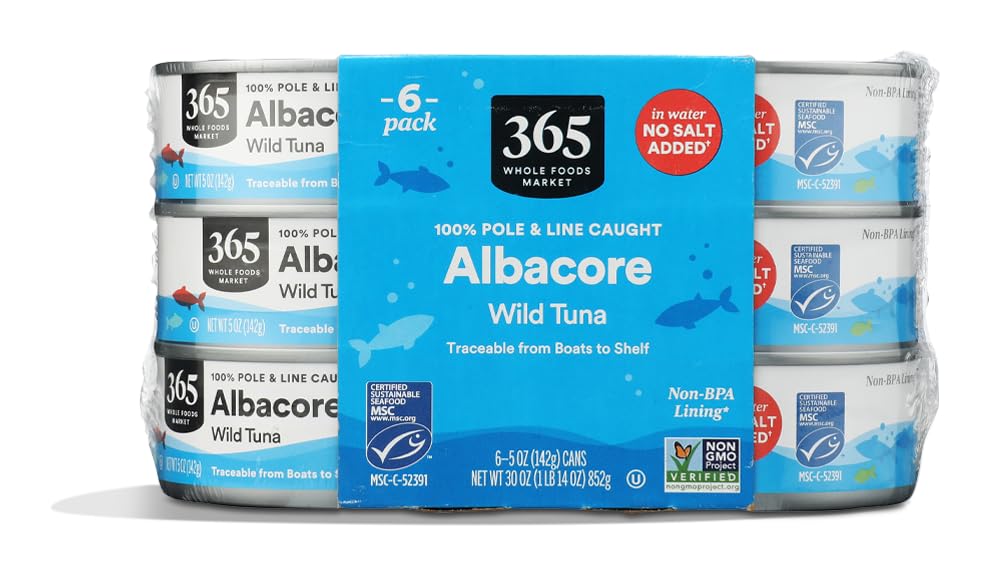
Key Features
- Grade: Albacore
- Sodium: No salt added
- Pack size: 6 cans, 5 oz each
- Catch method: Pole and line caught
- Price: Midrange
Store-brand tuna trades on the idea that you’re getting the same fish in a plainer can. This six-pack from the Whole Foods house label is a fair test of that: albacore packed in water with no salt added, wild caught, pole-and-line caught, sold in sixes rather than twelves or forty-eights.
The pitch is control. With no salt in the can, you decide how much goes in — which matters if you’re cooking for someone on a restricted diet, or if you find standard canned tuna aggressively seasoned. The flavor is mild and clean rather than thin, and the fish takes lemon, oil, and pepper without needing to be rescued.
Two things to weigh. Per ounce it’s the priciest plain albacore here short of the whole-fillet pack, so you’re paying for the no-salt convenience rather than saving on it. And six cans is a small order — enough to learn whether it suits you, not enough to stop thinking about tuna for a year.
For a household managing sodium, it’s a good can and the six-pack is the right size for a first order. What it isn’t is a bargain, and if you don’t need the salt removed, the albacore case we recommend costs less per ounce and eats just as well.
Pros
- No salt added, so you season it yourself
- Mild, clean albacore flavor
- Wild caught and pole-and-line caught
Cons
- Costs more per ounce than salted albacore
A clean no-salt albacore for anyone cooking to a sodium limit, in a six-pack sized for trying rather than stocking.
How We Tested Canned Tuna
We started by scanning grocery aisles and online listings for the canned tuna shoppers actually buy, then narrowed the field by pack style (oil or water), sodium level, chunk versus solid packs, and price per ounce. That left 18 cans, which we tested over three months. Each can was drained for one minute in a fine-mesh strainer and weighed before and after, so we could see how much of what we paid for was actually fish.
We tasted every can plain, straight from the strainer, then in a classic tuna salad and folded through warm pasta. We noted whether the meat was flaky or pasty, whether it looked pale and clean or gray and ragged, and whether the chunks held together or broke down into mush. Low-sodium cans got an extra plain tasting to see if they tasted flat or just needed a pinch of salt.
We also opened each can by hand, checking whether the pull-tab worked cleanly, whether the lid came off without sharp edges, and how easily the tuna drained. We compared cost per ounce of drained tuna rather than shelf price, and used each pick in at least two meals to see how it held up beyond the first sandwich. The cans that scored well on flavor, texture, and value made the list; the ones that turned watery or fishy in pasta did not.
How to Choose Canned Tuna
Three things on a tuna label decide almost everything about what lands on your plate — the grade of the fish, what it’s packed in, and how much of the can is actually fish — and the rest is mostly branding.
Start with the grade, not the brand
Solid, chunk, and flake describe how the fish is packed, not which fish it is; white albacore and light skipjack are different species entirely. Solid white albacore is graded white meat in larger pieces, which is why it costs more and holds a shape on the plate. Chunk white is the same meat broken up. Chunk light is a smaller, stronger-tasting fish that disappears into whatever you mix it with. We buy solid for salads and for eating plain, and chunk light for anything cooked.
There’s a trap in the word solid. It describes the pack, not a guarantee that every can holds one piece, and cans labeled solid white albacore routinely come out closer to chunk. Judge a brand on its second and third can rather than its first.
Water or oil, and what each one costs you
Water is neutral: you get the fish and add your own fat, which is what you want in a recipe that already calls for mayonnaise or oil. Olive oil carries flavor into the fish and keeps it moist, so an oil-packed can is the one you can eat with a fork and nothing else. It’s the single biggest difference in how two cans of the same fish taste.
The trap is arithmetic. You pay for some of that oil by weight, and it brings fat and calories a water-packed can doesn’t. Drain it into a jar and use it for a vinaigrette, and the trade evens out.
Match the can and the case to your kitchen
Five ounces is the standard can and makes one generous sandwich or two modest ones. Twelve-ounce cans exist for volume cooking and commit you to using a lot of tuna at once — once opened, it has a couple of days in the refrigerator. At the other extreme, cases: a 24- or 48-can pack is usually the cheapest way to buy tuna per ounce, but it’s a heavy box that holds a shelf for months. Buy the case once tuna is already a weekly habit, not to find out whether it could be.
Read sodium, and check the serving basis
Regular canned tuna is salted, often at 300 mg or more per can. No-salt-added versions run as low as 35 mg per serving, which is the difference between a food you can eat daily and one you plan around. The trap is the serving basis: a small can may list two servings, so compare per whole can or per 100 grams rather than per serving. Expect to season no-salt tuna yourself — it’s an ingredient, not a finished filling.
What the premium cans actually buy
Above the everyday tier you’re paying for three things: a better cut packed as whole fillets, a traceable catch method, and a can with little or no added liquid so more of the weight is fish. Whether that’s worth it depends entirely on how you eat tuna. Straight from the can, yes; folded into a casserole, no. If sustainability matters to you, look for a named certification or a trace code on the can rather than a general claim about the sea.
Frequently Asked Questions
Is canned tuna already cooked?
Yes. It’s cooked before it reaches you, which is why it’s ready to eat straight from the can and why choosing a can is really about texture and seasoning rather than cooking method. Treat it as a finished ingredient: fold it into a hot pasta dish at the end so it warms through rather than cooking further, and save the long simmering for raw fish.
Which canned tuna is lowest in mercury?
Light, skipjack-style tuna is the smaller fish and the usual lower-mercury choice; albacore and yellowfin are larger and carry more. If tuna is a several-times-a-week food in your house, or you’re cooking during pregnancy or for a young child, build around chunk light and treat albacore as the occasional can.
Pole-and-line brands argue that their younger catch is lower still. That’s worth weighing, but it isn’t a substitute for the standard limits.
Does unopened canned tuna need refrigeration?
No. These are shelf-stable cans and keep in a cool, dry cupboard until the date stamped on the tin — that’s exactly why the case packs here run to dozens of cans. Once you open one it changes: refrigerate what you don’t use in a covered container and finish it within a couple of days, the same as any cooked fish.
Final Verdict
Genova’s yellowfin in olive oil is the can we hand to anyone who asks what good canned tuna tastes like: firm, savory, and finished without mayonnaise. It isn’t the can for a casserole, and it isn’t the cheapest way to keep tuna in the house. Stock a pantry rather than plate a lunch and StarKist’s chunk light case costs far less per can while doing the everyday job.
Cooking to a sodium limit changes the answer again. That’s StarKist Selects, at 35 mg per serving, with flavor that doesn’t taste like a compromise.