This post contains affiliate links. We may earn a small commission when you buy through our links — at no extra cost to you.
A gas grill is what turns an ordinary Tuesday into a cookout: thirty minutes, no charcoal chimney, no waiting around. What it really fixes is dinner for six without heating up the kitchen. But a mediocre one finds ways to ruin the evening anyway — the igniter clicks and nothing catches, one side of the grates runs far hotter than the other, and by August the grease tray has become a science project. The difference between a grill you love and one you resent rarely shows up under showroom lighting; it lives in the build quality, the heat output, and how honestly the thing was assembled.
My team and I have spent the past eight months cooking on seven gas grills, from two-burner compact models to wide four-burner rigs with side shelves and side burners. Assembly, build quality, size, and portability all got judged with real dinners on the line, not just a spec sheet. One thing I will say up front: a bigger BTU number does not mean more heat where it counts — a leaky lid gives plenty of that away. The picks below earned their patio space.



Best for All-Round Backyard
Monument Mesa II 410FBZ
Key Features
- Main burners: 4
- Side shelves: Foldable
- Burner warranty: 8 years
- Total cooking area: 525 sq. in.
- Price: Midrange
Five hundred and twenty-five square inches of total grilling area, four main burners and a cart a shade over 50 inches wide — the Mesa II is the grill here whose numbers land where a normal backyard needs them. Two of those burners work as a broil zone, concentrating heat for a steak sear while the rest of the grate stays cooler for chicken and corn. That is the arrangement we want in a default grill: one impatient corner and one patient one, both running at once.
Heat is where it holds its place. Monument rates the grill at 500°F within five minutes of a cold start, and warm-up speed is not a vanity figure — a grill that takes fifteen minutes to come to temperature is one you skip on a weeknight. Four independently controlled burners under a double-layered lid give you zones that behave like zones, which is the whole reason to buy a four-burner instead of a three.
The practical details are thought through. Both side shelves fold down, the difference between parking it against a wall and leaving it in the middle of the walkway, and there is a built-in tank holder, large wheels, and a funnel-style grease system that drains into a removable stainless pan. The one niggle we found is the drip tray, which needs a firm push to seat fully in its channel before you light the burners.
Then there is the coverage, which is where this grill separates itself: two years on the body, eight on the 304 stainless burners, one on the electrical. Against the three months on the cheapest three-burner here, that is a real part of what you are buying. Monument says assembly can run as little as half an hour, the shortest build claimed by any four-burner in this group.
Pros
- Four burners with a dedicated broil zone
- Foldable side shelves squeeze into narrow patios
- Eight-year limited warranty on the burners
- 525 sq. in. total with a flip-up warming rack
Cons
- 525 sq. in. counts the flip-up warming rack
We point most people to the Mesa II: four burners, a real sear zone, folding shelves and the longest burner coverage here, in a cart that fits a normal patio.
Best for Big Cookouts
Charbroil Pro Series 4-Burner
Key Features
- Weight: 178.2 lb
- Cooking area: 802.9 sq. in.
- Main burners: 4 plus side burner
- Cooking system: Infrared
- Price: Premium
Flare-ups are the reason infrared grills exist. Instead of flame licking straight up through the grates, the Amplifire system puts an emitter between the burner and the food, so dripping fat turns into heat rather than a fireball. On a grill this size that matters more than it does on a two-burner cart: 802.9 square inches across four main burners and a side burner is a lot of hot metal sitting under a lot of dripping fat.
Capacity is the other half of the pitch, and it is the largest here by a wide margin. You get room for two searing zones and a cooler end at the same time, which is what cooking for a dozen people actually requires. It also runs as a three-in-one: gas on the grates, a griddle insert in the box for bacon and eggs, and charcoal cooking when you want smoke.
Where we hesitate is the cart. At 178.2 pounds this is the heaviest grill in the set by a distance, and that is a two-person job to move, to level, and to shift when you want at the deck underneath. Assembly is a couple of hours of work, so plan an afternoon and a helper rather than a solo evening. What you get for it is a painted-steel cabinet that swallows the tank and a set of tools, plus a ten-year burner warranty that is the longest coverage on this page.
Give it a look over before you sign for the delivery. A grill this big is miserable to repack, and the cabinet and lid are the parts a drop in transit shows up on.
Pros
- 802.9 sq. in., the largest cooking area here
- Infrared emitter keeps flare-ups down
- Griddle insert comes in the box
- Ten-year burner, three-year firebox coverage
Cons
- 178.2-pound cart takes two people to move
- Assembly runs a couple of hours
For a crowd, this is the grill to choose: 802.9 square inches of infrared grate, a griddle insert in the box and ten years of burner coverage.
Best for Small Patios
Electactic 4-Burner Stainless
Key Features
- Cooking area: 383 sq. in.
- Main burners: 4 plus side burner
- Side shelves: Fold-down
- Body material: Stainless steel
- Price: Midrange
Four burners on 383 square inches is the number to straighten out first. You are not buying acreage here; you are buying four separately controlled heat zones in a cart about 51 inches wide, which for a lot of cooks is the more useful thing. A steak sears on one end while vegetables sit low on the other, and nothing waits.
The material is what earns this one its place with us. Body, frame, side trays and handles are stainless rather than painted steel, and that is the version of a gas grill you can leave out in the weather with less to worry about. The trays fold down flat against the cart, which is how a four-burner survives a balcony, and the flush cabinet door hides the tank and keeps a chimney starter out of the rain.
Heat is straightforward: 32,000 BTU across the four main burners and another 10,000 on the side burner, with a built-in thermometer that reads to 1000°F so you can see what is happening without lifting the lid and losing the heat you paid for. Three porcelain-enameled grids lift out for cleaning, and the bottle opener and paper-towel holder on the cart are the sort of small thing you notice every cook.
Where it gives ground is cooking area. It has the smallest grate of the four-burners here, so if you regularly feed six or more, our top pick gives you more room for roughly the same money. Cook for two to four and want a cart that still looks like something in three years, and this is the one we point to.
Pros
- Stainless body, frame and side trays
- Side trays fold down flat
- 32,000 BTU main burners plus a 10,000 BTU side burner
- Thermometer reads to 1000°F
Cons
- Smallest grate of the four-burners here
We recommend it to anyone who wants stainless everywhere and shelves that fold away; 383 square inches is the trade, so measure your guest list.
Best for Tidy Deck Setups
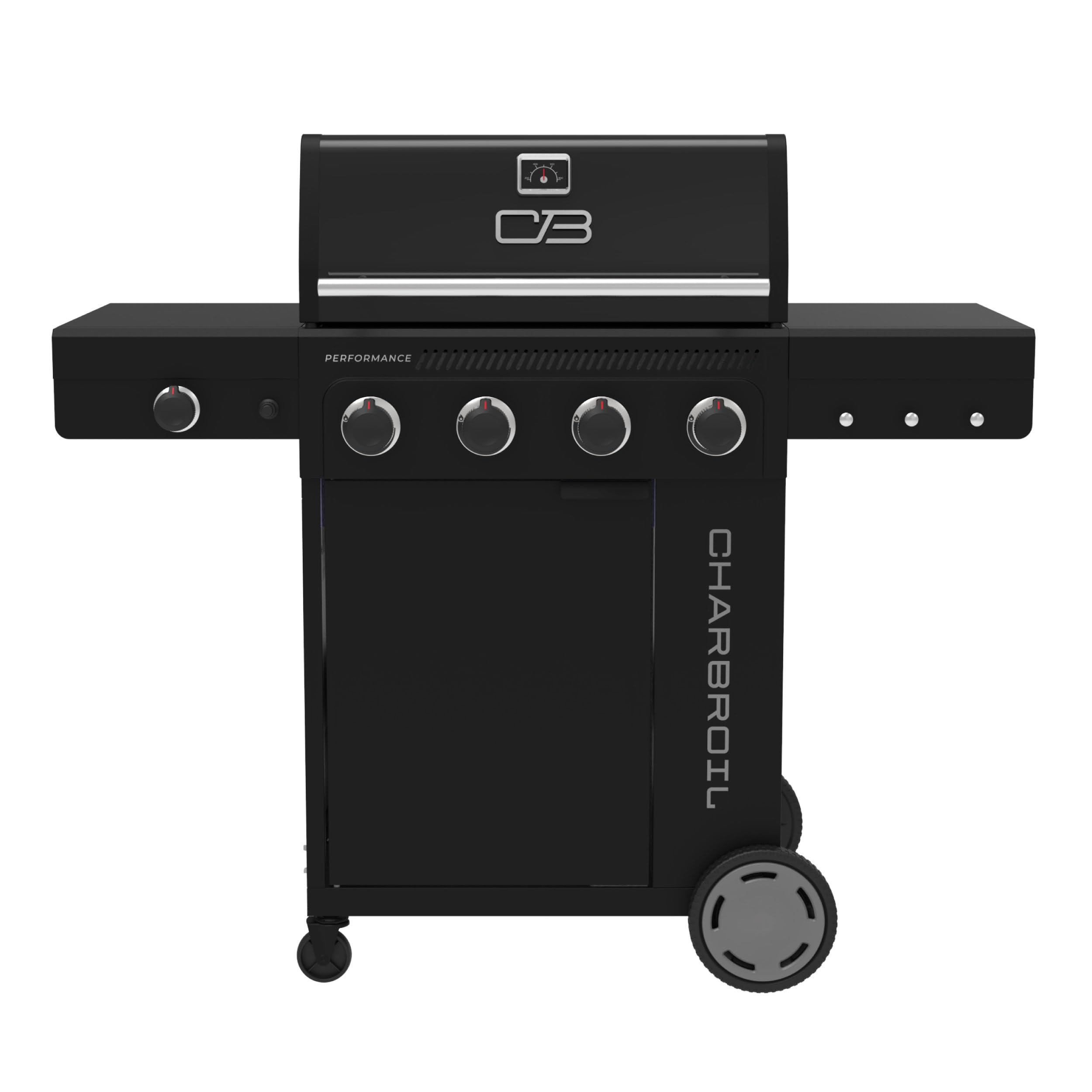
Charbroil Performance 4-Burner
Key Features
- Storage: Enclosed cabinet
- Warranty: 2 years
- Cooking area: 435 sq. in.
- Main burners: 4 plus side burner
- Price: Midrange
The case for this grill is the cabinet. Four hundred and thirty-five square inches of grate, four main burners, a side burner, and doors that close over the tank and whatever else you keep outside — that combination is rarer than it sounds in a midrange cart, and it is the reason this one made the list.
It also starts plain and upgrades. Charbroil’s griddle and charcoal accessories drop into the same firebox later, so the gas grill you buy today can become a breakfast flat-top when you find yourself cooking outside on a Sunday morning.
Cooking is honest without being remarkable. The burners come up to temperature quickly and hold a steady mid-range, which is what chicken, sausage and a batch of burgers actually ask for, and the side burner is the underrated part — a pot of beans or a pan sauce without walking back inside.
Where we land: this is a good grill that our top pick beats on grate area and warranty coverage, and the only things you give up by choosing the Monument instead are the doors and the side burner. If those two are on your list — and for plenty of people they are, because a cabinet keeps the deck tidy and a side burner keeps the kitchen out of it — this is the sensible buy.
Pros
- Enclosed cabinet hides the tank and tools
- Side burner keeps pots off the main grate
- Accepts griddle and charcoal accessories later
- 435 sq. in. across four main burners
Cons
- Griddle insert and charcoal tray sold separately
- Two-year coverage with no long burner term
Our pick when cabinet doors and a side burner matter more than grate area: it hides the tank, keeps pots off the main grate, and takes Charbroil’s add-ons later.
Best for Tailgates and Rvs
Cuisinart CGG-306
Key Features
- Weight: 22 lb
- Burners: 2
- Warranty: 3 years
- Cooking area: 275 sq. in.
- Price: Midrange
Not everyone wants a cart. If your cooking happens on a balcony, in a tailgate lot or beside a camper, a 22-pound tabletop that is ready in ten minutes is worth more than 500 square inches you cannot move. The CGG-306 is the grill here built around that trade, and it makes the trade well.
Two 10,000 BTU stainless burners sit under 275 square inches of stainless grate — enough for a dozen burgers, which is the honest capacity for a family of four plus the neighbors. The lid locks shut, the legs fold, and the whole thing carries like a suitcase. Electronic ignition, a built-in thermometer and a knob for each burner give you two zones on a surface most portables treat as one.
Heat control is the thing to know going in. Two burners this size do not have a gentle low end, so the gap between a hard sear and a slow cook is narrow; the fix is to run one burner and work the cooler half of the grate, which is how this grill behaves most like a big one. Do that and it puts a real crust on a steak without turning chicken into charcoal.
As a second grill it makes a lot of sense, and that is the role we see for it: one on the patio, one in the RV, with a three-year limited warranty covering more of it than most portables manage. Just do not expect it to replace a full-size cart — it is the grill you take with you.
Pros
- 22 pounds, with a locking lid and carry handle
- 275 sq. in. holds about a dozen burgers
- Three-year limited warranty
Cons
- Burners and deflectors rust first
- Uneven heat across the grate
For tailgates, balconies and RVs, this is the portable we choose: 275 square inches, 22 pounds, and a lid that locks for carrying.
Best for Tight Storage
Megamaster 3-Burner

Key Features
- Weight: 44 lb
- Burners: 3
- Cooking area: 434 sq. in.
- Side shelves: Foldable
- Price: Budget
Fold-down side shelves are the reason we kept this one on the list. Up, they give you 434 square inches of grate plus prep space on both sides; down, the cart narrows enough to roll against a wall, which most three-burners at this width cannot manage. For a patio that doubles as a walkway, that is the feature you use every week.
Cooking is adequate rather than exciting. Three 10,000 BTU burners total 30,000 BTU — enough for burgers, chicken thighs and a batch of sausages, not enough for a steakhouse crust. The porcelain-coated firebox holds heat once it is up, the porcelain-coated grates lift out for cleaning, and there is a warming rack and a built-in thermometer. The low end runs hotter than the dial suggests, so manage temperature by moving food to the cooler side rather than by backing off the knobs.
Setup is the pleasant surprise: assembly is straightforward, the 44-pound cart is light enough to shift alone, and the push-and-turn ignition and stainless control panel keep the front easy to wipe down. For a patio that has to stay a patio, it is a lot of grill in a small footprint.
Pros
- Fold-down shelves narrow the cart for storage
- 434 sq. in. of grate plus a warming rack
- Easy assembly and a 44-pound cart
Cons
- Thin cart panels and shelf brackets
- One-year warranty only
A sensible three-burner for a small patio if you accept a budget cart: the fold-down shelves are genuinely useful and the panels are thin.
Best for First-Time Buyers
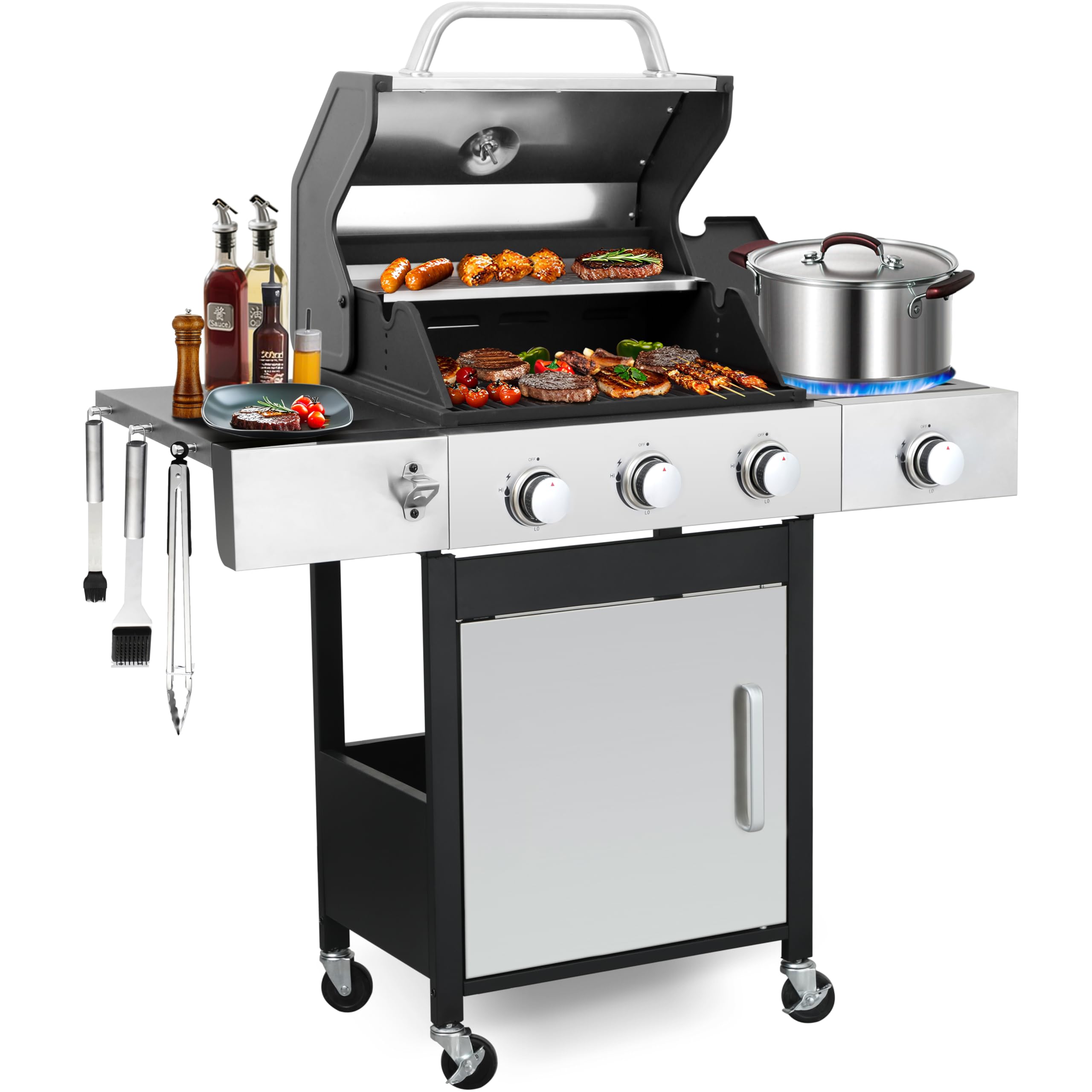
cookit 3-Burner with Side Burner
Key Features
- Grates: Cast iron
- Warranty: 3 months
- Cooking area: 372 sq. in.
- Main burners: 3 plus side burner
- Price: Budget
Three months. That is the warranty on this grill, and it is the first thing we mention because it is the shortest coverage in this set by a wide margin — the other budget carts here run a year, and our top pick covers its burners for eight. In practice it means that if a burner or an igniter quits next spring, you are buying the part.
Set that aside and there is real value in the hardware. Three main burners sit under a 372 square inch cast iron cooking surface — cast iron, not the porcelain-coated steel that usually shows up at this level, and it holds heat the way a skillet does. There is a side burner for a pot of beans, a double-wall stainless lid with a thermometer in it, a side table with tool hooks, and a slide-out grease tray with a removable cup that makes cleanup quick.
Two things to plan for. Assembly is more of a sorting exercise than it should be, because not every fastener is lettered or numbered, so budget an evening rather than half an hour. And cast iron wants a wipe of oil after each cook to stay black and slick, thirty seconds of work that is the difference between grates that last and grates that rust.
Pros
- Cast iron grates hold heat like a skillet
- Three main burners plus a side burner
- Slide-out grease tray with removable cup
Cons
- Three-month warranty
- 372 sq. in. is tight for three burners
The least expensive route here to three burners and a side burner, with cast iron grates worth having — but three months of warranty is the catch.
Best for Couples and Balconies
Feasto GS201 2-Burner

Key Features
- Weight: 34 lb
- Burners: 2
- Warranty: 1 year
- Total cooking area: 418 sq. in.
- Price: Budget
Two burners and a 34-pound cart. If you are cooking for two most nights and four on weekends, that is the whole grill you need, and the Feasto is the least expensive way into it here while still getting a proper lid and two side tables.
Feasto advertises 418 square inches, and that breaks down as 290 square inches of grate and 128 square inches of warming rack. So it is a two-person grill that stretches to four, not a family grill that stretches to six. The flat stainless burners spread flame wider than the tube burners usually found at this size, and 26,500 BTU is enough for a fast weeknight cook.
The all-porcelain-enamel body and lid are rated to 1700°F, which is less about cooking heat than about not rusting through, and that is the right call on a grill this inexpensive. Two side tables give you somewhere to put a plate, and at 34 pounds one person can move it under cover before a storm.
Where it lands: we like it for exactly what it is — a small, light, inexpensive grill for a small deck, and one that can be put away when the season ends, which none of the big carts here can do.
Pros
- Two side tables and a porcelain-enamel body
- 34 pounds, easy for one person to move
- 290 sq. in. of grate plus a warming rack
Cons
- Light panels flex when you move it
For a couple with a small deck, this two-burner is enough grill and no more: light, inexpensive and easy to put away for winter.
How We Tested These Gas Grills
We started by pulling together roughly 40 gas grills from brands with a track record for parts and warranty support, then narrowed the field by burner count, cooking area, price, and how well each one fit a normal-size patio. Seven made the cut, and we cooked on each for eight months, starting in spring and running through the first cold snaps. Every grill arrived in a box and went together in my driveway using only what came in the crate.
Assembly came first: I timed each build solo and noted where the instructions went vague, which hardware was mislabeled, and whether the lid lined up without a fight. Then we lit them — ten cold starts in a row, plus a few after a rainstorm — and logged which igniters caught on the first click and which needed two or three tries. Heat output got checked with an infrared thermometer swept across the grates and with a tray of biscuits, the fastest way to see whether a grill’s hot zone is where the manufacturer claims it is.
Cooks ran from weeknight burgers to a pork shoulder for twelve, and after each session I pulled the grease tray to see whether it caught the drips or sent them onto the deck. We wheeled every grill across grass and up a trailer ramp, folded and unfolded the side shelves, and lifted the lids one-handed to feel for hinge slop. At the end of the eight months we inspected each firebox for rust and flaking. Value came last: what a grill cost relative to how it cooked and how well it held up.
How to Choose a Gas Grill
Every gas grill in this set will light and cook a burger; what separates them is where the heat lands, how much grate you actually get, and what the cart looks like after two winters outside.
Grate area, not the headline number
Total cooking area is the figure on the box, and it usually includes the warming rack. Two picks here show why that matters: the Feasto’s 418 square inches is 290 square inches of grate plus 128 of warming rack, and the Monument’s 525 counts a flip-up rack as well. Budget about 100 square inches of actual grate per two adults, more if you like leftovers, and read the specifications until they separate primary grate from warming area.
Burners, BTU and the sear question
BTU on its own tells you very little. BTU spread across the grate tells you more, and even that only describes how hard the grill can push, not how evenly. The Electactic’s 32,000 main-burner BTU over 383 square inches is a hotter density than the Megamaster’s 30,000 over 434, which is part of why the four-burner sears harder on a smaller surface. Look for a dedicated sear or broil zone, an infrared emitter, or at minimum independent knobs so you can build a hot side and a cool side.
Steel is what you live with
Stainless bodies and cart panels cost more and stay presentable longer, which matters most within a mile or two of salt water. Painted and enameled steel is fine inland if the grill sits under a cover. The firebox and grates matter more than the lid: porcelain-coated steel and cast iron both hold up, and cast iron sears harder while wanting a wipe of oil after each cook. Read the warranty’s burner term, because cheap steel announces itself there first.
Cart, cabinet or tabletop
Where the grill lives decides the shape. A cabinet hides the tank and the tools and looks tidier on a finished patio; an open cart with folding shelves costs less and squeezes into a narrower gap. A tabletop like the 22-pound Cuisinart trades capacity for a trunk-sized footprint — sensible with no permanent outdoor space, frustrating if you cook for eight. Measure the run of wall or railing you have, then leave yourself a working arm’s length on the shelf side.
Assembly, warranty and the fine print
Assume an hour of assembly as a baseline and two for a cabinet model, and plan on a helper for anything over 100 pounds — the big Charbroil is 178. Warranty structure matters more than the headline length: look for a separate burner term, since burners fail first, and check whether the firebox and cart are covered. One grill here carries three months and another covers its burners for eight years, which is a more useful comparison than either number alone.
Frequently Asked Questions
Can I convert a propane grill to natural gas?
Only with a conversion kit the manufacturer sells for that exact model, and not every model has one. A conversion changes the orifices and the regulator, so a kit built for a different grill is not a substitute, and a home-brew swap can void the warranty and put gas where the burner was never designed to take it. If natural gas is the plan, confirm the kit exists before you order the grill.
Can I leave my gas grill outside all winter?
Yes, and most carts at this level are happier under a cover than in a shed. Close the tank valve and disconnect the tank, empty the grease tray and cup, and wipe out the firebox so drippings do not sit for months. Check in spring for standing water in the firebox and rust on the burners; replacing a burner is a small job, replacing a rusted-out firebox is not.
How do I check a gas grill for leaks?
Mix dish soap with water, brush it on the hose, the regulator and the connection at the tank, then open the tank valve with the burner knobs off. Bubbles that keep growing mean gas is escaping; tighten the fitting and test again, and replace the hose if it keeps bubbling. Never test with a flame, and run the check before the first cook of the season and after every tank swap.
Final Verdict
The Monument Mesa II is the grill we send most people to, because it handles a Tuesday night and a backyard birthday with the same cart: four burners, a broil zone that genuinely sears, shelves that fold out of the way, and eight years of coverage on the burners.
If your guest list outgrew your patio, the Charbroil Pro Series earns its 178 pounds with 802.9 square inches and infrared burners that keep a full grate of steaks from flaring. And if you have no permanent outdoor space at all, the 22-pound Cuisinart is the one you carry instead.