This post contains affiliate links. We may earn a small commission when you buy through our links — at no extra cost to you.
Warping is the most common reason bakers replace nonstick sheet pans, even among highly rated models. A pan that buckles at 400°F can cause grease to pool on one side and cookies to slide off-center, turning a simple sheet pan dinner into a frustrating experience.
The root cause is thin steel and unrolled edges. Pans with thicker gauge and reinforced rims resist distortion far longer, but that durability often comes with a trade-off in size or number of pans. The best choice depends on whether you need two identical sheets for high-volume baking or a single large pan for roasts.
This guide focuses on pans that deliver on their nonstick promise without warping out of shape, matching each option to how you actually cook and how long you expect them to last. We prioritize consistent heat distribution and easy cleanup, because a sheet pan should be a dependable workhorse, not a disposable tool.




Best for Frequent Baking
Circulon 2-Pack
Key Features
- Material Gauge: Heavy-gauge alloy steel
- Set Sizes: Two 10×15 sheets
- Max Oven Temp: 450°F
- Price: $$
The Circulon 2-pack keeps its shape where other pans buckle. Reinforced rolled edges and heavy-gauge alloy steel prevent warping even at 450°F, so cookies bake evenly and roasting pans sit level. The nonstick coating releases baked goods without sticking — a noticeable upgrade from budget sheets that need parchment liner every time.
The raised circle pattern aids nonstick release but can trap small crumbs in the grooves. A brief soak before scrubbing handles this without much extra effort. Cleaning otherwise is simple: most residue wipes away, and the pans are heavy enough to feel substantial without being cumbersome to handle.
This set suits serious home bakers who bake multiple batches weekly and want pans that hold up. The two identical 10×15 sheets are ideal for cookies, sheet cakes, and roasting vegetables — not for those who need varied pan sizes or a single large half-sheet. Buyers who prioritize warp resistance over size flexibility will be satisfied here.
Pros
- Reinforced edges keep pans flat even at high heat
- Nonstick surface releases food without sticking or tearing
- Heavy-duty build with easy cleaning and even heat distribution
Cons
- Raised circle pattern can trap crumbs in grooves, requiring extra attention to clean thoroughly
For frequent bakers tired of warped sheet pans, these two sheets deliver lasting flatness and reliable nonstick performance at a fair price.
Best for Everyday Baking
USA Pan Half Sheet
Key Features
- Material Gauge: Heavy-gauge aluminized steel
- Coating Type: Silicone-based nonstick
- Set Sizes: Single half sheet
- Max Oven Temp: 450°F
- Price: $$
Even heat distribution and a silicone-based nonstick coating make this half-sheet a workhorse for everyday baking and sheet pan dinners. Unlike the top pick’s reinforced edges, this pan uses a simpler construction that can warp at temperatures above 400°F — but for moderate-heat roasting and cookies, it performs admirably. Best for bakers who want a single, heavy pan and are willing to hand-wash to keep the coating intact.
Pros
- Heavy-gauge aluminized steel promotes even baking and resists dents.
- Silicone-based nonstick releases baked goods with minimal effort.
- Quick wipe-down cleaning after use.
Cons
- Some pans may develop a slight warp at oven temperatures above 400°F.
A dependable half-sheet for moderate-heat baking and roasting. Hand-wash to extend the nonstick life.
Best for Multi-Size Baking
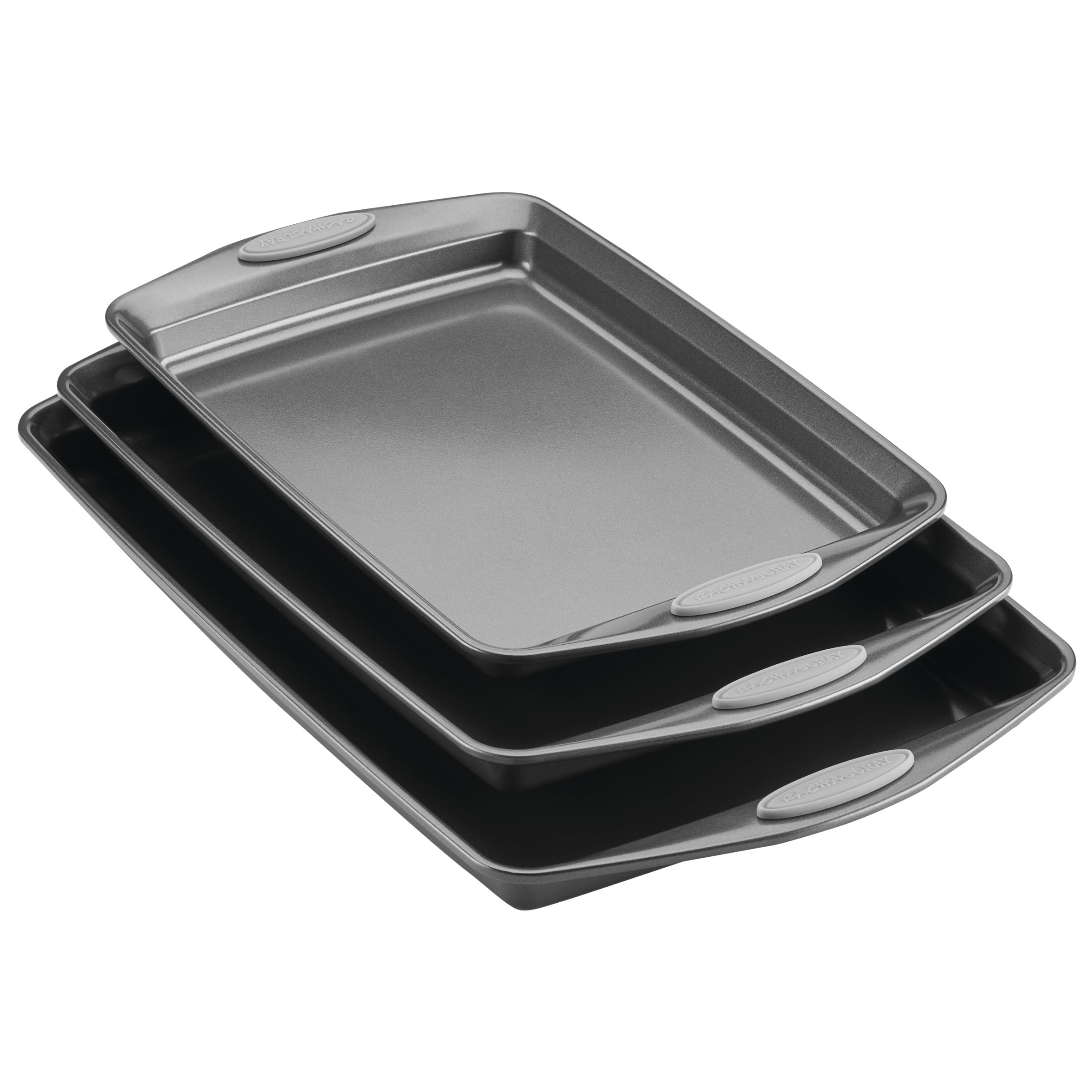
Rachael Ray 3-Piece Set
Key Features
- Material Gauge: Alloy steel
- Set Sizes: 9×13, 10×15, 11×17
- Max Oven Temp: 500°F
- Price: $$
The Rachael Ray 3-Piece Set offers three sizes with comfortable silicone handles and a nonstick surface that cleans up with minimal effort. It’s best suited for home bakers who bake at moderate temperatures (under 400°F) and want easy cleanup across multiple pan sizes. Unlike the top pick’s reinforced edges, these pans can warp above 400°F – steer clear of high-heat roasting.
Pros
- Nonstick surface releases baked goods cleanly, making cleanup easy.
- Three sizes (9×13, 10×15, 11×17) cover most baking needs.
- Silicone-wrapped handles stay cool during handling.
Cons
- Coating can peel and rust may develop along rolled edges over time.
For moderate-temperature bakers who value multiple sizes and easy cleanup, this set offers a practical balance of features and price – just keep the oven under 400°F.
Best for Non-Toxic Baking
Caraway Ceramic
Key Features
- Material Gauge: Aluminum, ceramic coat
- Coating Type: Ceramic (PTFE/PFOA free)
- Set Sizes: 10×15 single
- Max Oven Temp: 550°F
- Price: $$$
The Caraway baking sheet’s non-toxic ceramic coating releases food easily and wipes clean without scrubbing, making it a standout for bakers who avoid PTFE and PFAS. Unlike the Circulon’s warp-resistant rolled edges, this pan can deform at 400°F — a tradeoff acceptable for those who bake infrequently and at moderate oven temperatures.
Pros
- Non-toxic ceramic coating with strong nonstick performance
- Wipes clean easily — little scrubbing needed
- Attractive navy finish that stays looking new over time
Cons
- Premium price for a single pan, especially when warping is a possibility
- Can warp at 400°F, which affects baking evenness
Ideal for eco-conscious bakers who bake infrequently and at low heat — look to the Circulon if you roast regularly above 400°F.
Best for Budget Large Sheet
GoodCook BestBake
Key Features
- Material Gauge: Carbon steel
- Coating Type: Textured nonstick
- Set Sizes: 11×17 single
- Price: $
Unlike pricier warp-resistant pans, this GoodCook BestBake sheet uses a textured diamond surface to distribute heat evenly and release food easily — all for under $10. The carbon steel build resists warping better than most budget options, making it a solid choice for moderate-temperature baking.
The main tradeoff: rust can develop along edges if the pan isn’t dried thoroughly after washing, especially in humid kitchens. This is a single 11×17 sheet, so it best suits bakers who need one large pan for cookies, sheet cakes, or roasting and are willing to hand dry it to extend its life.
Pros
- Budget-friendly with strong nonstick release for easy cleanup
- Textured surface promotes consistent browning across the pan
- Resists warping better than similarly priced baking sheets
Cons
- Edges may rust over time if not dried thoroughly after each wash
A smart single-pan option for budget buyers who don’t mind hand drying — it delivers even baking and nonstick performance well above its price tag.
Best for Large Batch Roasting
USA Pan Extra Large
Key Features
- Material Gauge: Aluminized steel
- Coating Type: Silicone-based nonstick
- Set Sizes: 21×15 single
- Max Oven Temp: 450°F
- Price: $$
The USA Pan Extra Large gives you 21×15 inches of aluminized steel – enough surface to roast two whole chickens or bake a full recipe of cookies at once. It’s a step up from the standard half-sheet size, offering more capacity for large batches without needing multiple pans.
Best for cooks who regularly need one oversized pan rather than multiple small sheets. The large footprint may not fit smaller ovens, and the pan can warp when exposed to temperatures above 425°F – a tradeoff worth noting for high-heat roasting.
Pros
- Extra-large 21×15 surface fits large roasts and full cookie batches.
- Heavy-gauge aluminized steel resists warping better than many thinner pans.
- Silicone-based nonstick releases food easily and is PTFE/PFOA-free.
Cons
- 21×15 size may not fit standard home ovens – measure before buying.
- At high heat (425°F+), the pan may warp – moderate-temperature baking is fine.
Ideal for large-batch bakers and roast lovers who have oven space and keep temperatures moderate – the extra capacity justifies the tradeoffs.
Best for Bacon & Cooling Rack
USA Pan Pan+Rack

Key Features
- Material Gauge: Aluminized steel
- Coating Type: Silicone nonstick
- Set Sizes: Half sheet + rack
- Max Oven Temp: 450°F
- Price: $$
This set pairs a sturdy aluminized steel half sheet pan with a matching bakeable nonstick rack, a combination that excels for bacon and cooling tasks. The pan provides good heat retention and is easy to clean, while the rack allows fat to drip away for crispier results. However, the rack’s nonstick coating may peel over time, and the pan can warp at temperatures above 400°F. For those who primarily use a rack for bacon or cooling and can accept these limits, this set offers convenient matching pieces. The coating durability and potential warp keep it from a top recommendation for all-purpose use.
Pros
- Sturdy pan with good heat retention
- Bakeable rack works well for bacon and cooling
Cons
- Rack coating may scratch or peel over time, requiring careful handling
Best for bacon enthusiasts and frequent cooling rack users who don’t mind the rack coating’s longevity.
Best for Aesthetic Occasional Use
HONGBAKE Diamond 3

Key Features
- Material Gauge: 0.8mm carbon steel
- Coating Type: Whitford nonstick
- Set Sizes: 13×9, 15×10, 17.5×12
- Max Oven Temp: 450°F
- Price: $$
This three-piece set offers an attractive champagne gold diamond pattern across three sizes at a mid-range price. The pans feel heavy-duty with decent nonstick for light baking. However, rust can develop along edges, and the nonstick effectiveness may fade with use, limiting their lifespan to occasional low-temperature baking.
Pros
- Attractive champagne gold color and diamond pattern
- Good value for a set of three varied sizes
Cons
- Pans may warp at moderate oven temperatures, which can cause uneven baking
This set suits bakers who prioritize appearance over longevity and limit use to low-heat cookies and light roasting.
Best for Small Batch Baking
KitchenAid 9×13

Key Features
- Material Gauge: Aluminized steel
- Set Sizes: 9×13 single
- Max Oven Temp: 450°F
- Price: $
The KitchenAid 9×13 delivers even baking and extended handles for easy transport, making it a convenient option for small batches of cookies or sheet cakes. However, the nonstick coating can stain with certain foods and may peel over time even with hand washing, so this pan is best reserved for non-messy baking rather than high-heat roasting or sticky ingredients.
Pros
- Even baking performance for single-pan recipes.
- Comfortable extended handles make transport easy.
Cons
- Coating may stain with certain foods and can peel over time, even with gentle washing.
Best for occasional, low-mess baking where you want a trusted brand name at a budget price, but not for roasted meats or heavily staining ingredients.
Best for Disposable Budget Set
GoodCook 3-Pack

Key Features
- Material Gauge: Alloy steel
- Coating Type: Scratch-resistant nonstick
- Set Sizes: 13×9, 15×10, 17×11
- Price: $
The GoodCook set delivers three useful sizes at a budget-friendly price, with nonstick performance that works for light baking. However, rust can develop along the rolled edges and pans may warp under heat, making this a short-term option. Treat these as disposable and they offer decent value for infrequent use.
Pros
- Three useful sizes in one affordable set
- Good value for money
Cons
- Rust can develop along rolled edges if not dried thoroughly
This set works best for occasional bakers who need multiple sizes and are comfortable replacing pans within a year.
How to Choose
Warping is the single most common reason sheet pans get replaced, so prioritize thick steel or reinforced rims over brand names.
Material Gauge & Warp Resistance
Sheet pan warping happens when thin steel expands unevenly under heat. A pan with a gauge of 0.8mm or thicker, or one with rolled edges that act like a stiffening frame, will stay flat much longer. Thinner pans often buckle at 350°F–400°F, causing spilled grease and uneven baking.
If you roast at high temperatures or do multiple batches, look for pans specifically described as "heavy-gauge" or "reinforced rim." Budget pans often skip this reinforcement, making them a poor choice for regular roasting.
Nonstick Coating Type & Longevity
Most nonstick sheet pans use a PTFE-based coating, which releases food well but can degrade above 500°F or from metal utensils. Silicone-based coatings (PTFE/PFOA-free) are common in mid-range pans and tend to last longer if hand-washed. Ceramic coatings are another option, but they are more prone to chipping and warping.
Regardless of type, dishwasher use accelerates coating failure. The high heat and abrasive detergent break down the surface, leading to peeling and sticking. Hand washing with a soft sponge preserves the nonstick finish for years.
Size & Set Configuration
A half-sheet (roughly 18×13 inches) is the most versatile size for cookies, sheet pan dinners, and roasting. If you bake frequently, two identical half-sheets are better than a set of different sizes—you can rotate batches without adjusting times. For large roasts or multiple cookie sheets at once, an extra-large 21×15 pan is ideal but check oven width.
Sets with three different sizes can be handy for occasional bakers who want options for small and large pans, but the smallest size often goes unused. Focus on the sizes you actually use week to week.
Max Oven Temp
The oven-safe temperature rating sets a hard ceiling for roasting. Most nonstick pans are rated to 450°F, which works for standard baking and roasting. If you frequently cook at 425°F or higher, a higher-rated pan (500°F–550°F) gives a safety margin, though the coating itself may still degrade faster at those extremes.
Pans rated lower than 450°F, especially budget models, should not be used for high-heat roasting. Pushing the limit accelerates warping and coating breakdown, shortening the pan’s life.
FAQ
Why do my nonstick baking sheets warp in the oven?
Warping happens when thin steel expands unevenly under heat. Pans with thicker gauge (0.8mm+) or reinforced rolled edges resist distortion far better. Avoid cheap, lightweight pans if you bake above 400°F regularly.
Can I put nonstick cookie sheets in the dishwasher?
You can, but it will significantly shorten their life. The high heat and harsh detergents cause the coating to peel and edges to rust. Hand washing with a soft sponge and drying immediately is the best way to keep nonstick pans performing well for years.
How do I keep my baking sheets from rusting under the rim?
Rust forms when moisture gets trapped under the rolled edge. After washing, dry the pan thoroughly, paying extra attention to the rim. Avoid soaking pans for long periods, and never leave them wet in the sink. Some pans with sealed rolled edges are less prone to rust.
Are ceramic baking sheets better than traditional nonstick?
Ceramic coatings are free of PTFE and PFOA, making them a safer choice for families concerned about chemicals. However, they are more fragile—they chip and warp more easily than good-quality traditional nonstick. For occasional, low-heat baking, ceramic is fine; for daily use, a heavy-duty silicone-based nonstick pan is more durable.