This post contains affiliate links. We may earn a small commission when you buy through our links — at no extra cost to you.
Plenty of kitchen torches stop sparking after a handful of uses. Ignition failure is the most common complaint, leaving you with a can of butane and no flame.
The real decision comes down to fuel type. Butane torches offer precision for crème brûlée and pastries but struggle to sustain high heat for meat. Propane torches deliver the power needed for sous vide searing and charcoal lighting, but their broad flames can overwhelm delicate work.
A reliable igniter matters more than any temperature spec. A torch that lights every time, paired with the right fuel for your tasks, will outperform a cheaper model that sputters out after a month.


Best for Sous Vide Searing
Bernzomatic TS8000
Key Features
- Fuel Type: Propane / MAP-Pro
- Ignition Type: Trigger start, lock-on
- Flame Adjustability: Yes
- Max Temp: ~2800°F
- Price: $$$
The TS8000 lights with a trigger pull and locks into continuous flame—no need to hold the switch. It sears a sous vide steak in under a minute and starts charcoal with the same head.
This is a good fit for cooks who want one tool for searing, soldering, and outdoor fire-starting. The flame stays broad even at the minimum setting, so precise dessert caramelization is better handled by a butane torch. Occasional light users may find the propane tank setup more than they need.
Pros
- Trigger ignition with lock-on for one-handed continuous flame
- High heat output sears steaks and lights charcoal quickly
- Sturdy metal construction that holds up over years of use
Cons
- Flame is broad at its minimum setting, making delicate sugar work less controlled
- Requires a separate propane canister, adding setup time and ongoing fuel cost compared to refillable butane torches
For heavy-duty kitchen and outdoor tasks, this torch provides consistent power and instant ignition. Keep a butane torch nearby if you finish crème brûlée regularly.
Best for Crème Brûlée
Iwatani PRO2
Key Features
- Fuel Type: Butane
- Ignition Type: Piezo
- Flame Adjustability: Yes
- Max Temp: ~2700°F
- Price: $$
The PRO2’s adjustable flame spread allows pinpoint caramelization and delicate browning, a clear advantage over broader propane torches for pastry work. Japanese build quality gives it a solid, premium feel. However, its butane flame may be underpowered for searing thick steaks; this torch suits those who prioritize precision over brute force in the kitchen.
Pros
- Adjustable flame from pinpoint to wide for precise control
- High-quality Japanese construction feels durable
Cons
- Flame can struggle with heavy searing tasks; better for light finishing
Best for dessert lovers and pastry chefs who value control over power.
Best for Sous Vide Searing
SearPro Propane
Key Features
- Fuel Type: Propane / MAP-Pro
- Ignition Type: Piezo trigger
- Max Temp: ~1800°F
- Price: $$$$
The SearPro delivers a massive flame that sears a steak in seconds and lights charcoal under a minute – ideal for outdoor cooking and sous vide finishing. As a propane torch, it requires a separate tank (not included) and produces a broad flame that can overpower delicate tasks like crème brûlée. Best for cooks who prioritize searing speed over precision, and who are comfortable using a backup lighter if the piezo igniter stops sparking.
Pros
- Sears thick steaks and roasts in seconds with high heat output.
- Lights charcoal and campfires in under a minute, saving time.
Cons
- Piezo igniter may cease sparking after moderate use, requiring a manual lighter.
For sous vide enthusiasts and charcoal grillers who want maximum heat and don’t mind occasional manual ignition, the SearPro is a powerful tool – just keep a backup flame source nearby.
Best for Light Dessert Work
Kollea Butane Torch
Key Features
- Fuel Type: Butane
- Ignition Type: Piezo trigger
- Flame Adjustability: Yes
- Max Temp: ~2500°F
- Price: $
The Kollea torch fills easily, ignites with a single trigger pull, and offers a dial to adjust flame size — fine for caramelizing sugar on crème brûlée or torching meringue. At this price point, it keeps light dessert tasks simple and accessible.
Where it shows its limits is long-term consistency. Some units may develop intermittent ignition after several refills, so this torch suits the home baker who uses it occasionally and doesn’t mind accepting unit variance. Avoid daily heavy use or searing thick cuts — that’s a different tool’s job.
Pros
- Low entry cost with one‑hand operation
- Adjustable flame for precise caramelization
- Safety lock prevents accidental ignition
Cons
- Ignition may become inconsistent after several refills in some units
For the occasional crème brûlée or meringue touch‑up, this torch delivers adequate performance at the lowest price — just be prepared to work around possible ignition hiccups.
Best for Starting Fires
Bernzomatic TS4000
Key Features
- Fuel Type: Propane / MAP-Pro
- Ignition Type: Trigger start
- Flame Adjustability: No
- Max Temp: ~2860°F
- Price: $$
The Bernzomatic TS4000 combines a cast-aluminum body that withstands years of pounding with instant trigger ignition — no striker needed. At a lower price than the adjustable TS8000, it delivers the same propane heat for rough searing, fire starting, or soldering. The flame is fixed and broad, making it unsuitable for precise caramelizing or crème brûlée. This torch fits buyers who want a tough, no-frills tool for heavy-duty kitchen or outdoor tasks and can skip delicate dessert finishing.
Pros
- Cast-aluminum body takes heavy use without bending or cracking.
- Trigger start fires immediately, no fumbling with lighters.
- Lower price than the adjustable model, yet same fuel compatibility.
Cons
- Fixed, broad flame — too large for sugar work and delicate searing, with no adjustment option.
This torch suits those who value durability and instant ignition over flame adjustability — a budget-friendly workhorse for rugged tasks like lighting charcoal or searing steaks.
Best for Occasional Use
TBTeek Butane

Key Features
- Fuel Type: Butane
- Ignition Type: Piezo
- Flame Adjustability: Yes
- Max Temp: ~2500°F
- Price: $
The TBTeek butane torch offers a safety lock and simple one-hand operation at a budget-friendly price. The piezo ignition can stop sparking after a short period, leaving gas flow without flame — a limitation that suits occasional crafting projects or backup duty rather than daily dessert finishing.
Pros
- Good value for money – affordable and performs well when it sparks.
- Easy to fill and operate – one-handed use with a safety lock.
Cons
- Ignition may stop sparking after limited use, allowing gas flow without flame.
A reasonable pick for occasional crafting or as a backup tool, provided you can accept the possibility of igniter failure.
Best for Art Resin
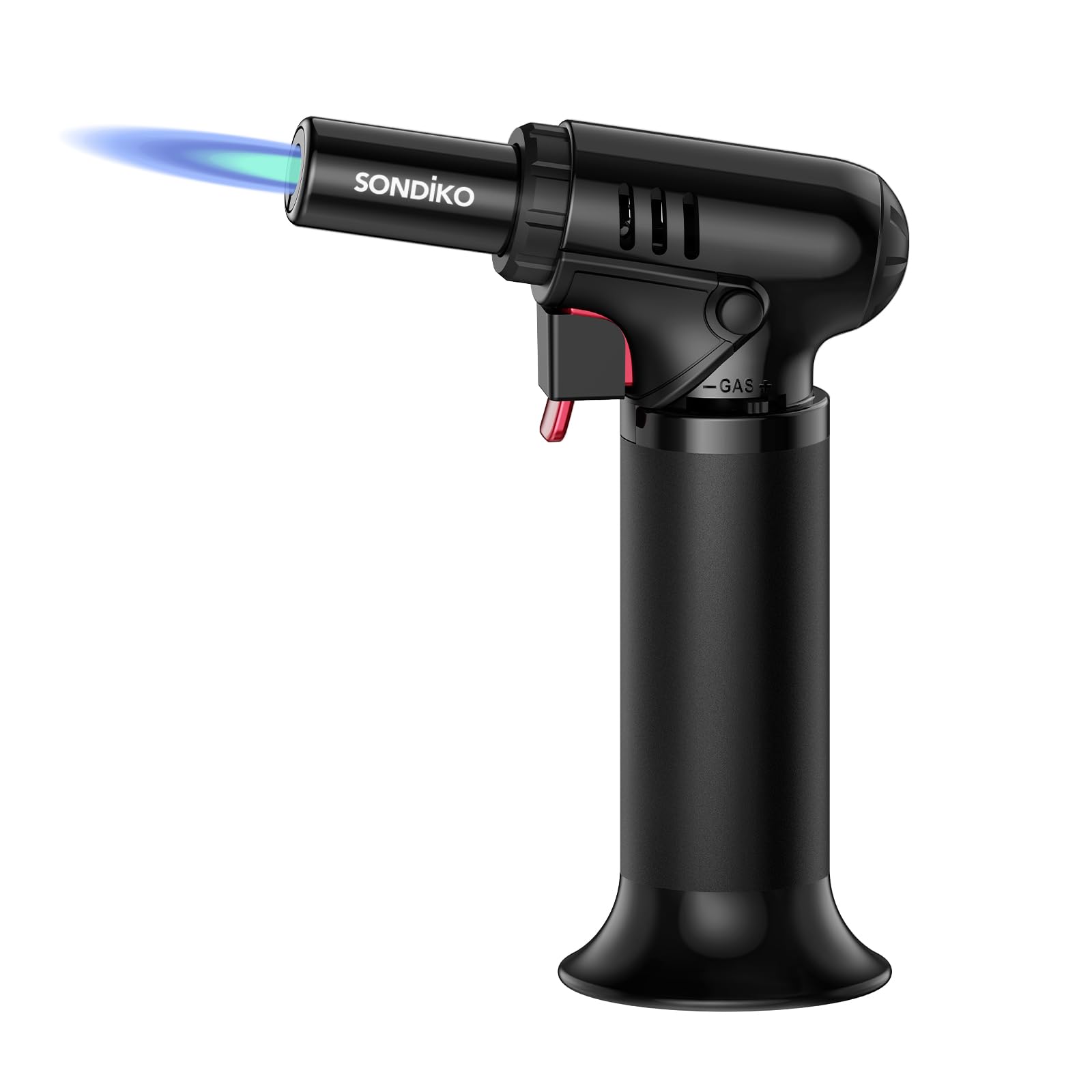
Sondiko S907
Key Features
- Fuel Type: Butane
- Ignition Type: Piezo trigger
- Flame Adjustability: Yes
- Max Temp: ~2370°F
- Price: $
The visible fuel gauge makes it easy to track butane levels, and the ergonomic shape is comfortable for one-handed use. However, the piezo ignition can be inconsistent, and some units may develop issues over time. This is a reasonable choice for occasional kitchen tasks or art resin if you’re prepared for potential replacement.
Pros
- Visible fuel window lets you monitor butane level at a glance
- Comfortable one-hand operation with lightweight, ergonomic grip
Cons
- Piezo ignition can require multiple attempts to light
Best suited for occasional crème brûlée, caramelizing, or craft projects where the risk of needing a replacement is acceptable.
Best for Occasional Baking
Tencoz Butane Torch

Key Features
- Fuel Type: Butane
- Ignition Type: Piezo
- Flame Adjustability: Yes
- Max Temp: ~2370°F
- Price: $
The Tencoz Blow Torch provides a comfortable grip and safety lock that make it easy for beginners to handle. It handles crème brûlée, light browning, and craft soldering adequately. However, the flame can sputter or run too large for precise caramelizing, which limits its use for delicate dessert work. For a few dollars more, torches with steadier performance are available.
Pros
- Comfortable grip with a safety lock that beginners find easy to use
- Suitable for both food prep and light craft projects
Cons
- Flame may sputter or be too broad for delicate sugar work
Best for novice bakers or crafters who need an inexpensive tool for occasional use, but not ideal for precise dessert finishing.
Best for Occasional Crème Brûlée
Sondiko S901

Key Features
- Fuel Type: Butane
- Ignition Type: Piezo
- Flame Adjustability: Yes
- Max Temp: ~2370°F
- Price: $
The Sondiko S901 offers the lowest price point in the lineup and easy refilling. However, the piezo igniter can stop sparking after a handful of uses, making it a viable option only for one-off crème brûlée or craft projects.
Pros
- Low price with basic functionality for the occasional job
- Simple to fill and operate one-handed
Cons
- Igniter can stop sparking after a few uses – best suited for single-task scenarios
Fine for a single crème brûlée batch or craft project where you can accept an igniter that may not last beyond that.
Best for Very Light Use
TBTeek T907

Key Features
- Fuel Type: Butane
- Ignition Type: Piezo
- Flame Adjustability: Yes
- Max Temp: ~2500°F
- Price: $
The fuel gauge is a helpful addition for tracking butane levels, and the flame adjusts well for small jobs. However, the continuous-flame lock can become less dependable over time, and the flame output may be underwhelming for tasks like caramelizing sugar or browning. This torch suits very light, occasional use where fuel visibility matters most.
Pros
- Fuel gauge lets you see butane level at a glance.
- Flame adjusts smoothly for light tasks like melting or warming.
Cons
- Lock for continuous flame may stop holding over time, requiring you to hold the trigger.
Worth considering only if you need a cheap torch for rare, small jobs and want the fuel gauge—otherwise, a more dependable option like the Bernzomatic TS8000 avoids these compromises.
Best for Outdoor Cooking
Sondiko L8010

Key Features
- Fuel Type: Propane
- Ignition Type: Piezo trigger
- Flame Adjustability: Yes
- Max Temp: ~3270°F
- Price: $$
This propane torch produces a massive flame that lights charcoal in under a minute and sears steaks quickly — a strong value for the heat output. The tradeoff is that ignition may require manual lighting after moderate use, and some units have handle or valve issues that can lead to gas leaks. This suits occasional outdoor cooking where raw power matters more than long-term durability, but it’s not the right tool for precise kitchen finishing or daily use.
Pros
- Powerful flame lights charcoal and sears meat rapidly.
- Good value for a high-heat propane torch.
Cons
- Durability concerns: handle cracks or valve malfunctions may cause gas leaks in some units.
A suitable pick for budget-conscious cooks who prioritize raw searing power over ignition convenience and primarily use it for charcoal or campfires.
Best for Light Searing
TBTeek Propane

Key Features
- Fuel Type: Propane / MAP
- Ignition Type: Piezo
- Max Temp: ~2500°F
- Price: $$
The TBTeek offers a lightweight, easy-to-handle propane torch for budget-minded cooks who need occasional searing power at a good value. Its piezo igniter may stop sparking after some use, meaning you’ll likely rely on an external lighter over time — a tradeoff that makes it less suited for daily kitchen finishing but acceptable for intermittent outdoor jobs.
Pros
- Lightweight and easy to handle for extended use
- Good value for a propane torch
Cons
- Piezo igniter may stop working after limited use, requiring an external lighter
Fine as an occasional-use backup for outdoor searing or charcoal lighting, but not the one to reach for dessert work or daily cooking.
Best for Outdoor Fire Starting
KOACKL Propane

Key Features
- Fuel Type: Propane
- Ignition Type: Piezo
- Flame Adjustability: Yes
- Max Temp: ~2460°F
- Price: $$$
This propane torch fires up campfires, lights charcoal, and handles outdoor searing without fuss. Flame can burst from the handle in some units, making it a poor fit for precise caramelizing or browning – better left to a butane torch designed for the kitchen.
Pros
- Reliably starts fires and supports camp cooking outdoors.
- Fun to use and makes an appreciated gift for grill enthusiasts.
Cons
- Flame may burst from the handle, making it unsafe for controlled kitchen tasks.
For outdoor fire-starting and camp cooking where a large, powerful flame is welcome, this torch works – but for caramelizing crème brûlée or browning meringue, choose a butane torch with consistent ignition.
How to Choose
The most important decision is choosing between butane and propane fuel — it determines whether your torch excels at desserts or searing.
Fuel Type
Butane torches run on disposable cans and produce a narrower, more controlled flame ideal for caramelizing sugar and browning meringue. Propane torches connect to larger refillable tanks and burn hotter, making them better for searing meat and lighting charcoal.
The trade-off: butane flames cool down faster and can struggle to maintain heat for thick steaks. Propane flames can easily scorch delicate desserts if not dialed back. Choose based on your primary use — precision or power.
Flame Adjustability
Adjustable torches let you vary the flame width and intensity, which matters when switching between tasks. A narrow flame concentrates heat for crème brûlée; a wider spread covers more area for toasting or searing.
Fixed-flame torches like the Bernzomatic TS4000 are simpler but limit you to one heat pattern. If you only need a torch for starting fires or rough searing, a fixed flame works fine. For multi-use kitchens, adjustability is worth the extra cost.
Ignition Reliability
Piezo ignition is common on butane torches and budget propane models. It generates a spark when you squeeze the trigger, but the mechanism can wear out or get clogged with butane residue. Trigger-start torches with a lock feature tend to last longer because the spark contact is more robust.
A torch that fails to ignite after a few refills is useless. Prioritize models with documented ignition consistency — the Bernzomatic TS8000 and Iwatani PRO2 are examples of reliable starters. Cheap igniters are the number one reason budget torches end up in the trash.
Max Temperature
Higher maximum temperatures (above 2500°F) enable faster searing and quicker fire starting. But raw temperature number alone doesn’t guarantee even heat distribution — flame consistency matters more for cooking results.
For sous vide searing, look for a torch that maintains high heat over several seconds without flickering. For desserts, a lower temperature with adjustable flame spread prevents burning the sugar before it caramelizes evenly.
FAQ
Why does my kitchen torch stop working after a few uses?
The most common cause is air trapped in the fuel line after refilling. Purge the torch by releasing all gas and butane before refilling, and always use high-quality butane. If the igniter fails, the spark mechanism may be clogged or worn out — cleaning the nozzle and contact point sometimes helps, but replacement is usually needed.
Can I use a propane torch for crème brûlée?
Yes, but with caution. Propane flames are larger and hotter than butane, so you risk burning the sugar before it caramelizes. Choose a propane torch with adjustable flame control and use a low, broad flame. For frequent dessert work, a butane torch like the Iwatani PRO2 is safer and easier to control.
How do I refill a butane torch without it leaking?
First, purge any remaining gas by pressing the valve with a tool until nothing escapes. Then hold the butane can upright, press the nozzle firmly into the torch’s fill valve, and inject in short bursts. Stop when you see liquid butane starting to spill. Overfilling causes leaks; most torches need only a few seconds of filling.
What’s the best torch for sous vide searing – butane or propane?
Propane torches are better for sous vide searing because they sustain higher heat output for longer, producing a crust quickly without overcooking the interior. Butane torches often lack the thermal mass to get a good sear on thick steaks. The SearPro or Bernzomatic TS8000 are strong propane options for this task.