This post contains affiliate links. We may earn a small commission when you buy through our links — at no extra cost to you.
Most food mills look alike, but small differences in leg span, disc edge, and crank angle determine whether you’ll enjoy using it or stash it in a drawer. A mill that wobbles on your pot or traps food in its holes will slow down every batch.
The solution isn’t spending more—it’s knowing which specs matter. Stainless steel bodies resist tomato acid, interchangeable discs give you texture control, and a stable hook or leg system keeps the mill from tipping mid-crank.
The right mill turns a messy job into a one-hand operation. This guide focuses on the models that stay put, clean up fast, and deliver consistent purees without the rust or crank friction that derail a canning session.


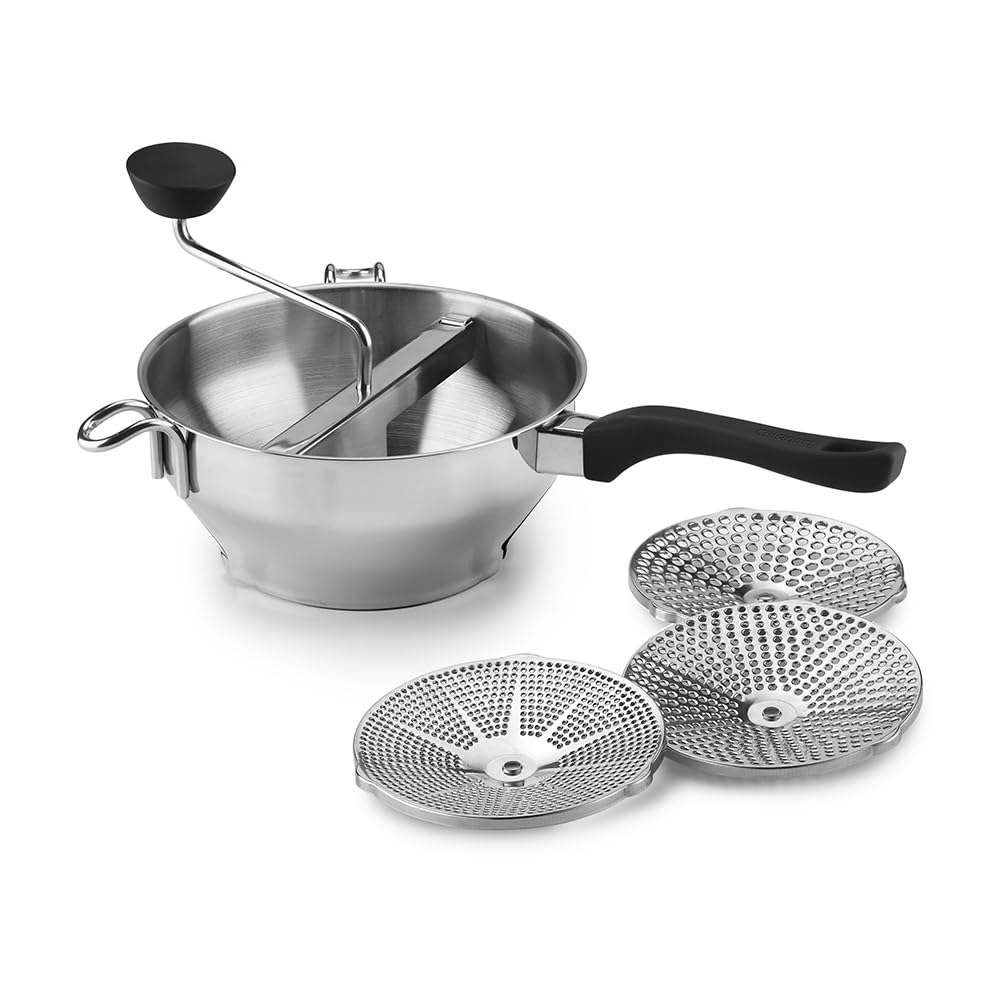

Best for Sauces & Purees
Hungry Artisan 3-Disc
Key Features
- Disc Options: 3 fine, medium, coarse
- Material: Stainless steel
- Ease of Cleaning: Dishwasher safe
- Stability: Varies by pot
- Crank Design: Rotary crank
- Price: $$
The Hungry Artisan food mill snaps together without tools and rinses clean in seconds — no food bits trapped in crevices. Its three stainless steel discs (fine, medium, coarse) handle soft cooked fruits and vegetables with minimal effort. The crank may require a slight back-and-forth motion on some units, but the overall rotation is smooth enough for batch processing. The stainless body shows no signs of rust or warping after repeated use.
This mill suits home cooks who regularly make tomato sauce, applesauce, or baby food and want a single tool that does it all without fuss. It fits standard pot rims well, though narrow or oversized bowls may cause the unit to shift during cranking. For those who need an ultra-fine puree for specific recipes, the 4-disc upgrade offers that extra option — but for most everyday milling, this three-disc set covers the range.
Pros
- Snaps together and rinses clean with no food residue
- Three discs (fine, medium, coarse) cover tomato sauce, applesauce, and soft purees
- Stainless steel construction resists rust and holds up to regular use
Cons
- Some units need a gentle back-and-forth crank motion to keep food moving
- May not sit securely on narrow or oversized pot rims
For home canners and baby food makers who want a reliable manual mill without overpaying, this three-disc model delivers consistent results and easy cleanup.
Best for Reliable Canning
OXO Good Grips
Key Features
- Disc Options: 3 fine, medium, coarse
- Material: Stainless + plastic handle
- Ease of Cleaning: Dishwasher safe
- Stability: Non-slip legs
- Crank Design: Standard crank
- Price: $$
OXO’s food mill anchors itself with non-slip legs that stay put on countertops and wide pot rims, and a disc-change lever simplifies swapping textures. The stainless steel bowl and three discs deliver smooth purees for sauces, mashed potatoes, and canning. However, the plastic exterior can show discoloration after contact with acidic foods like tomatoes, and the leg grip may slip on narrower or taller pots. This mill suits brand-conscious cooks who mill often and want OXO’s ergonomic design and easy cleaning — not a budget-first choice.
Pros
- Snap-together assembly and dishwasher-safe parts cut cleanup time.
- Non-slip legs keep the mill planted on counter or wide pot rims.
- Three discs handle fine to coarse textures for sauces, purees, and canning.
Cons
- Plastic exterior may discolor with prolonged contact with acidic foods.
- On narrow pot rims, the legs may not grip as securely — works best with standard wide-rimmed pots.
For millers who want a stable, easy-to-clean mill and value OXO’s ergonomic design, this is a capable upgrade over basic models.
Best for Budget Stainless Mill
Gemfino Orange 3-Disc
Key Features
- Disc Options: 3 fine, medium, coarse
- Material: Stainless steel
- Ease of Cleaning: Dishwasher safe
- Stability: Dual-hook stable
- Crank Design: Silicone grip crank
- Price: $
The dual-hook system keeps this mill stable on various bowl sizes, and the included spoon adds convenience for transferring purees. Performance is solid for tomato sauces, applesauce, and jams, and assembly and cleaning are straightforward. Some units may require a back-and-forth cranking motion due to inconsistent blade tension – a minor annoyance for occasional users. The handle’s silicone grip is comfortable for shorter sessions but may feel fatiguing during prolonged cranking. This mill suits budget-conscious cooks who want a full-featured stainless steel option for small-batch canning or periodic use. If you need consistent, smooth operation for heavy daily work, the top pick absorbs that variance better.
Pros
- Stable on bowls of different sizes thanks to sturdy dual-hook design
- Three interchangeable discs (fine, medium, coarse) cover most milling textures
- Easy to take apart and clean by hand or in dishwasher
Cons
- Blade tension can be inconsistent; some units need a back-and-forth motion to run smoothly
- Handle may be uncomfortable for extended cranking sessions
A capable, low-cost stainless mill for weekend projects – the blade tension gamble is tolerable given the price.
Best for Premium Puree Maker
GEFU Flotte Lotte
Key Features
- Disc Options: 2 fine, medium
- Material: 18/10 stainless steel
- Ease of Cleaning: Dishwasher safe
- Stability: Stable on bowls
- Crank Design: Smooth crank
- Price: $$$
The GEFU Flotte Lotte’s 18/10 stainless steel body and smooth crank mechanism make pureeing and straining feel effortless. The mill disassembles fully for easy cleaning, and the non-reactive construction won’t discolor with acidic foods like tomatoes. This is a premium tool best for cooks who prioritize build quality and longevity over having multiple texture options—only two discs (2.0 mm and 3.0 mm) are included, and the fine disc may allow very small seeds to pass through.
Pros
- All-stainless 18/10 construction resists rust and corrosion for decades of use.
- Smooth, easy cranking with no wobble or binding during operation.
- Completely disassembles for thorough cleaning, including dishwasher safe.
Cons
- Only two discs (fine and medium) are included; the fine disc may let small seeds pass through.
For serious home cooks who want a mill that will outlast every other kitchen gadget, the Flotte Lotte delivers unmatched build quality—just accept the limited disc selection.
Best for Small-Batch Canner
Cuisinart 3-Disc
Key Features
- Disc Options: 3 fine, medium, coarse
- Material: Stainless steel
- Ease of Cleaning: Dishwasher safe
- Stability: Unstable on some pots
- Crank Design: Standard crank
- Price: $
The Cuisinart Food Mill combines stainless steel construction with three disc options (fine, medium, coarse) at a budget-friendly price. Compared to the top pick, it’s more affordable but may shift on some bowl rims during use—a quirk that matters less for small-batch canning or occasional sauce making. Large-volume processors will find the cranking slow for big pots, so this is best suited for those who value brand recognition and a lower cost over rock-solid stability.
Pros
- Three stainless steel discs (fine, medium, coarse) cover most texture needs
- Effectively purees tomatoes, apples, and soft fruits cleanly
- Dishwasher-safe parts simplify cleanup
Cons
- Processing large batches can be slower than expected
- May shift on some pot sizes during use—check fit before starting
A capable entry-level mill for small-batch cooks who want a stainless build from a familiar kitchen brand without spending much.
Best for Texture Enthusiast
Hungry Artisan 4-Disc
Key Features
- Disc Options: 4 ultra-fine to coarse
- Material: Stainless steel
- Ease of Cleaning: Dishwasher safe
- Stability: Varies by pot
- Crank Design: Ergonomic rotary
- Price: $$
The Hungry Artisan 4-Disc adds an ultra-fine disc to the standard three, letting you make silky smooth purees and sauces without seed fragments. Best for canning enthusiasts and texture cooks who want the finest results from their mill. However, the wide handle can cause hand fatigue during long cranking sessions—a tradeoff for the extra disc options.
Pros
- Four discs provide a wide texture range including ultra-fine
- Sturdy stainless steel build with smooth operation
- Easy to assemble, use, and clean
Cons
- Wide handle may cause discomfort during extended cranking sessions
The 4-Disc is the right choice if you regularly need ultra-fine purees—otherwise the 3-Disc top pick offers better ergonomics and value.
Best for Texture Control
Küchenprofi 4-Disc

Key Features
- Disc Options: 4 (1.3–5 mm)
- Material: 18/10 stainless steel
- Ease of Cleaning: Easy disassembly
- Price: $$$
Built with 18/10 stainless steel and four discs (1.3 mm to 5 mm), this mill offers uncommon texture range for sauces, purees, and canning. The spring mechanism can shift if overfilled with chunky mixtures — working in smaller batches avoids this. Occasional users may find better value elsewhere.
Pros
- Four discs (1.3–5 mm) allow precise control from extra-fine puree to coarse chunky textures.
- Full 18/10 stainless steel construction resists corrosion and cleans up without hassle.
Cons
- When processing heavy batches of chunky apples or tomatoes, the spring can allow the disc to shift — work in smaller loads to keep it steady.
Best for canners and texture enthusiasts who need fine or extra-coarse results and don’t mind moderating batch size for the sake of disc stability.
Best for Design Piece
Rösle 2-Disc Premium

Key Features
- Disc Options: 2 fine, coarse
- Material: 18/10 stainless steel
- Ease of Cleaning: Dishwasher safe
- Stability: Stable on bowls
- Crank Design: Smooth crank
- Price: $$$$
The Rösle’s one-piece stainless body and smooth crank make it a pleasure to handle and easy to clean. But at more than twice the price of capable alternatives, it ships with only fine and coarse discs — no medium or extra-fine option. Cooks who need those intermediate textures will have to look elsewhere; those who value a heirloom-quality tool for basic tomato or apple processing may find the cost acceptable.
Pros
- Seamless 18/10 stainless construction resists corrosion and looks elegant on the counter.
- Smooth crank and tool-free disc changes make operation and cleanup fast.
Cons
- Only two discs (fine and coarse) — cooks needing medium or extra-fine textures will need a different mill.
A good fit for design-focused cooks who prioritize aesthetics and only require two texture settings for occasional batches of applesauce or tomato sauce.
Best for Ultra-Budget Occasional
ExcelSteel 3-Disc

Key Features
- Disc Options: 3 fine, medium, coarse
- Material: Stainless steel
- Price: $
This three-disc stainless mill from ExcelSteel costs less than most alternatives and handles tomato sauce and seed removal well. The discs swap easily and cleaning is simple. But some units may not survive the first use — durability varies, making this a budget option best suited for occasional canning rather than regular heavy milling.
Pros
- Very affordable for a stainless steel mill
- Works well for tomato sauce and separating seeds
Cons
- Some units may break on first use — durability can vary between samples
Fine for the occasional batch of tomato sauce on a tight budget, but not a mill to count on for regular canning seasons.
Best for Nostalgic Choice
Mirro Foley 2-Qt

Key Features
- Disc Options: 3 standard
- Material: Stainless steel
- Ease of Cleaning: Not dishwasher safe
- Crank Design: Standard crank
- Price: $
This Foley food mill offers the traditional applesauce and tomato sauce experience nostalgic cooks want, with easy cleaning. Food can get trapped inside the basin, requiring scraping, and the handle may break under stress—making it a fit for occasional use rather than regular canning, especially when more durable alternatives are available at the same price.
Pros
- Classic design ideal for making applesauce and tomato sauce.
- Easy to disassemble for thorough cleaning.
Cons
- Food can get trapped inside the basin, requiring scraping during use.
Best for occasional applesauce batches or nostalgic cooks who don’t mind a little scraping and handle risk.
Best for Baby Food Travel
OXO Tot Baby Mill

Key Features
- Material: Plastic + SS blade
- Ease of Cleaning: Dishwasher safe
- Crank Design: Small crank
- Price: $
Lightweight and packable, this mill fits a diaper bag for mashing baby portions on the go. Simple to use and clean for single servings. It processes only very soft foods like banana and cooked vegetables; firmer ingredients require pre-cooking or an alternative tool. Not suited for general food milling tasks such as tomatoes, apples, or berries.
Pros
- Compact and easy to bring to restaurants or on trips for baby food prep
- Simple to use and clean after single servings of soft foods
Cons
- Grinder handles only very soft items; firmer foods need pre-cooking or a different tool
Best for parents who want a no-power solution for mashing banana, avocado, or cooked veggies on the go — not a substitute for a countertop food mill.
Best for Budget with Extras
Gemfino Blue 3-Disc

Key Features
- Disc Options: 3 fine, medium, coarse
- Material: Stainless steel
- Ease of Cleaning: Dishwasher safe
- Stability: Dual-hook stable
- Crank Design: Silicone grip
- Price: $
This blue Gemfino comes with a funnel, spoon, and measuring spoon, turning a basic mill into a full kit for budget-minded canners. Its three discs handle tomato sauce and soft foods effectively, though the disc openings can let small seeds pass through — something to note if you need strictly seedless results. Functionally identical to the orange version, it’s a good value for occasional use.
Pros
- Includes a multifunctional spoon, funnel, and measuring spoon — more than just the mill itself.
- Mills tomatoes and soft foods smoothly for sauces, jams, and purees.
Cons
- Disc openings can allow small seeds to pass through, limiting precision for seedless recipes.
Best for budget buyers who want a complete accessory set and can accept occasional seed passage — fine for most sauce-making but not for fussy seed-free results.
Best for Portable Baby Mill
Green Sprouts Baby Mill

Key Features
- Material: Plastic
- Ease of Cleaning: Dishwasher safe
- Crank Design: Small crank
- Price: $
The Green Sprouts Baby Mill is genuinely compact and lightweight enough to toss in a diaper bag for restaurant trips or travel. Its manual operation means you don’t need an outlet or batteries. However, liquid can leak out of the bottom during use, creating a mess, and the crank is difficult to turn for anything firmer than avocado or banana. These limitations make it unsuitable for regular home kitchen use, but for the occasional on-the-go mash, it gets the job done.
Pros
- Compact and portable for travel or restaurant use
- Manual operation – no power needed
Cons
- Liquid can leak out of the bottom during use, making a mess
Works well enough for mashing soft fruits like banana or avocado on the go – but leave it at home for any real pureeing.
How to Choose
The biggest difference between a food mill you’ll reach for and one you’ll avoid comes down to three things: the number of discs, the material, and how well it stays put on your pots.
Number and Size of Interchangeable Discs
More discs give you finer control: a coarse disc for chunky applesauce, a fine one for seedless jams. But most home cooks rarely need more than two settings—fine and medium. The extra discs add cost and storage clutter without much real-world benefit.
The trade-off is that a fine disc will let smaller seeds (like raspberry) pass through regardless of hole size. If you’re after perfectly seedless purees, a mill with an ultra-fine disc (below 2 mm) is worth the extra money. For tomato sauce and applesauce, a standard fine disc works fine.
Material: Stainless Steel vs. Plastic
Stainless steel is non-reactive with acidic foods like tomatoes, won’t rust, and cleans up without staining. Plastic models are lighter and cheaper, but they can discolor from tomato acids and are more prone to cracking under the pressure of cranking through fibrous foods.
The hidden cost of plastic is that you might need to replace it after a few seasons. A stainless steel mill, even at a higher upfront price, will outlast several plastic ones and won’t leach any flavors into your food.
Ease of Cleaning and Dishwasher Safety
Dishwasher-safe doesn’t mean the disc holes clean themselves. Tiny food particles get wedged into the perforations, and a rinse cycle won’t dislodge them. You’ll still need a small brush or a toothpick to clear the holes after milling sticky foods like potatoes or jam.
The easiest mills to clean are those that fully disassemble into flat pieces—no crevices where pulp hides. Models with a snap-together design or a single-piece bowl are faster to hand-rinse than those with multiple interlocking parts.
Stability on Pots and Bowls
A food mill that wobbles or tips while you crank is frustrating and can spill hot sauce. Legs that hook over the pot rim need to be wide enough to fit your largest pot, yet narrow enough to sit on a small bowl. Non-slip silicone feet or a clamp mechanism add security.
Check the leg span of the mill against your go-to stockpot. Many mills list the rim diameter they fit (usually 8–12 inches). If you use a wide canning pot, look for a model with adjustable hooks or a broad base.
Ergonomic Crank Design
The crank is where you feel any manufacturing shortcuts. A crank that catches or requires back-and-forth motion will turn a quick batch into a workout. Smooth, continuous rotation comes from well-meshed gears and a balanced handle length.
Handle material matters: silicone or rubber grips reduce hand fatigue during long canning sessions, while bare metal handles can get slippery from food residue. A wider handle provides more leverage but may feel awkward for smaller hands.
FAQ
Why does my food mill crank catch and not turn smoothly?
A catching crank is usually caused by food buildup under the blade or a misaligned disc. Stop cranking, lift the mill off the bowl, and check that the disc is seated flat on the spring mechanism. If the problem persists on a new mill, it’s a manufacturing defect—return it. On older models, dried food residue inside the hub can also cause grinding.
How do I clean the tiny holes in a food mill disc?
After rinsing, use a stiff nylon brush (a dedicated bottle brush or a toothbrush) to scrub both sides of the disc under warm water. For stubborn bits, soak the disc in hot soapy water for 10 minutes, then brush. Avoid metal scouring pads—they can scratch the stainless steel and create rough edges that hold more food.
Can I use a food mill for making baby food?
Yes, as long as the mill has a fine disc that purees cooked fruits and vegetables to a smooth consistency. Avoid plastic baby-food-specific mills that leak or struggle with firmer foods—a standard stainless steel mill with a fine disc will outperform them and last longer. Just reserve one disc for baby food to avoid cross-contamination.
Is a food mill better than a food processor for tomato sauce?
For smooth, seedless sauce without a metallic taste, a food mill is better because it separates skins and seeds while pureeing the flesh. A food processor just chops everything together, leaving bits of skin and crushed seeds that create bitterness. Use a food mill for sauce; keep the processor for chopping or blending.