This post contains affiliate links. We may earn a small commission when you buy through our links — at no extra cost to you.
The first batch of sauerkraut I ever made grew a fur coat by day five, and I stood over the jar trying to figure out where I’d gone wrong. That’s the real fear with home fermentation — not that it fails loudly, but that it fails quietly. A good kit holds the vegetables under the brine, vents carbon dioxide, and keeps oxygen out.
What separates one kit from another rarely shows up in a product photo. The airlock might be a waterless one-way valve or a bubbler you fill with water, the weights might be glass, ceramic, or missing entirely, and some kits come with jars while others only fit wide- or small-mouth sizes. We’ve spent five months with 14 kits to sort that out.
The winner isn’t the one with the most pieces. It’s the one whose seal you still trust after a month on the counter, and whose recipe card gives salt in grams instead of "to taste." The picks below cover lids-only sets, full jar setups, and everything in between.


Best for Kraut and Kimchi
Masontops Complete Fermentation Kit
Key Features
- Guide: Instruction book with photos
- Jar Mouth: Wide mouth
- Set Contents: 4 lids, 4 weights, 1 packer
- Jars Included: No
- Price: Premium
Nine pieces arrive in a box that assumes one thing: you already have wide-mouth mason jars. Inside are four Pickle Pipe airlock lids, four Pickle Pebble glass weights, an acacia packing pounder, and a step-by-step booklet with pictures. The pounder is the piece most shoppers skim past, and it’s the one that decides whether you can make dry-salted kraut — shredded cabbage, salt, no added water — rather than only brined pickles. Tamping cabbage hard enough to release its own brine is miserable with a spoon.
That completeness is why this is our overall pick. Four lids and four weights mean four ferments running at once, so a new batch goes in the day the old one comes out. The silicone valves vent gas on their own — no water to top up, no daily burping, no jar popping its lid on the counter. We were also struck by how much of the method lives in the booklet instead of being taken for granted.
One fit note worth acting on: some wide-mouth jars run wide enough that a Pebble rides up against the shoulder instead of lying flat, and a weight that tips lets cabbage float. Press one into an empty jar before you pack a full batch, and if it slops around, cut a round of outer cabbage leaf to sit between the weight and the vegetables.
Nothing here is single-use, which is the quiet advantage of a kit this size: the pounder works through a whole season of kraut, the weights move jar to jar, and the booklet stays useful long after you’ve stopped needing it.
Pros
- Airlock lids vent without burping or water
- Packing pounder makes dry-salted kraut practical
- Four ferments running at once
- Booklet covers the whole method
Cons
- Jars not included
- Highest-priced kit in this group
The most complete vegetable-fermenting kit here, and the one we reach for first — as long as you own wide-mouth mason jars and don’t mind paying for the polish.
Best for Large Batches
Kilner Fermentation Set
Key Features
- Guide: Recipe booklet included
- Weights: Ceramic stones
- Capacity: 3 liters
- Jars Included: Yes, one 3 L jar
- Price: Premium
Three liters is the number that decides this one: a single fill takes a serious quantity of shredded cabbage, and the wide body swallows whole cucumber spears and outer leaves that a quart jar makes you chop. If you ferment in volume and resent checking jars daily, this is where we point you. The airlock sits in the lid and vents gas continuously, so a batch can sit for weeks without being opened.
The weights are ceramic stones rather than glass discs, which we prefer here: they’re dense, they stack, and they don’t chip at the rim the way glass can when it slips on the way in. The jar is heavy, stable glass that doesn’t wander when you press the stones down, and the set arrives with a recipe and instruction booklet. It’s dishwasher safe and clearly built to live on a shelf between batches.
Two things to know. It’s one vessel, so one ferment at a time — when the kraut is ready you decant it into jars and start over, which some people find restful and others find limiting. And the seal depends on the bung sitting fully home: press it in firmly, check it after the first day, and keep the fill below the shoulder. Warm brine rather than boiling, too — sudden heat is how these jars crack.
Pros
- Three-liter batch suits serious kraut making
- Ceramic weights resist chipping
- Airlock vents without daily checking
- Recipe booklet included
Cons
- One batch at a time
- No spare bung or seal in the box
One big jar, ceramic weights, and an airlock you can ignore for weeks — the pick for anyone who thinks in gallons of kraut rather than pints.
Best for First-Time Setup
IceFun 4-Pack Fermentation Kit
Key Features
- Weights: Glass, 4 included
- Capacity: 32 ounces each
- Jars Included: Yes, four jars
- Mouth Opening: 3.4 inches
- Price: Midrange
Four 32-ounce jars, four glass weights, four airlocks, four plastic lids with silicone rings, and a set of labels on a rope. The jars are the point: most kits here are lids and weights only, and expect you to already own the glass.
For a first ferment, that matters. Thirty-two ounces is the size we point most beginners to — small enough that a failed batch costs you one cabbage, big enough to be worth the wait — and four of them let you run kraut, pickles, carrots, and a hot sauce side by side. Plastic lids are the right call too, since brined ferments are hard on metal canning lids and these won’t rust shut. The glass weights sit inside the mouth and hold shredded vegetables under the brine.
The lids are where this kit asks the most of you. The silicone ring has to sit flat in the cap or the jar draws air and the top of the ferment molds, so seat it deliberately and check before you walk away. Nothing in the box tells you how long to leave things, either — no booklet, no recipe card — so line up a method before the jars arrive. Neither is a dealbreaker; together they’re the difference between a smooth first batch and a science experiment.
Pros
- Jars, weights, and airlocks all in one box
- 32-ounce jars suit small batches and fridge shelves
- Plastic lids won’t rust
- Labels included for dating batches
Cons
- No recipe guide in the box
- Silicone ring must seat or the jar leaks air
A genuine everything-in-the-box kit — four jars, four weights, four airlocks — and where we send beginners who own nothing and want to start tonight.
Best for Jars Already Owned
VSAPRDT Fermentation Kit
Key Features
- Spares: Gaskets and grommets
- Set Contents: 4 lids, 4 weights, 4 airlocks
- Jars Included: No
- Weight Stones: 7 oz each
- Price: Budget
Four stainless steel lids, four airlocks, four seven-ounce glass weights, five silicone gaskets, and five grommets — no jars, no booklet, no filler. If you already own wide-mouth mason jars, this is the least expensive kit here that includes both lids and weights, and the lids are the reason it’s our value pick rather than just a cheap one: 304 stainless doesn’t rust in brine, and each lid takes a silicone stopper once the airlock comes out, so the same lid goes straight into storage.
Seven ounces of glass per jar is enough to hold shredded cabbage down, and the discs are wide enough to lie flat in a standard wide-mouth opening instead of wobbling. The grommets — the silicone collars the airlock pushes through — are the part that wears, and this kit ships spares for both grommets and lid gaskets, which is more than most here do.
What you give up is guidance. There’s no recipe book, and what instructions arrive are thin, so know your salt ratio before the box lands. If you want a kit that teaches you the method, spend the extra on the Masontops; if you’ve fermented before and just need hardware, this is the sensible buy.
Pros
- Stainless lids double as storage lids
- Four 7-oz glass weights included
- Spare gaskets and grommets in the box
Cons
- No jars included
- Bare-bones instructions, no recipes
The best-value way to turn jars you already own into four fermenters: stainless lids, glass weights, airlocks, and spares in the box.
Best for Regular-Mouth Jars
Masontops Pickle Pipes
Key Features
- Valve: One-way waterless
- Jar Mouth: Regular mouth
- Set Contents: 4 silicone lids
- Jars Included: No
- Price: Budget
These fit regular-mouth jars — the narrow ones — and that single fact decides the purchase. There’s no adapter and no ring to buy: the cap sits over the rim of a standard small-mouth Ball or Kerr jar, and that’s the entire installation.
Inside is a one-way silicone valve. Gas pushes out, air doesn’t come back in, and you never top up water or crack the lid — the step that makes people quit fermenting in the first week. The caps are low-profile enough that jars stack in a cupboard, and they rinse clean in seconds, though brine pushes flecks of cabbage or peppercorn up into the valve and you’ll want to run water through it after every batch.
We like these best for side projects: a pint of hot sauce, a jar of garlic honey, one experimental kimchi you’re not sure about. For a serious kraut habit you want weights as well, and these don’t include any — pair them with glass discs, or move up to the Masontops kit and buy once.
Pros
- Fits regular-mouth jars
- One-way valve ends daily burping
- Low profile so jars stack
Cons
- Won’t fit wide-mouth jars
- Ferment odors escape into the room
If your cupboard is full of regular-mouth jars, four silicone caps turn them into no-burp fermenters without a single extra part.
Best for Bulk Pickles
Qianfenie 1-Gallon Fermentation Jars

Key Features
- Airlocks: 3 included
- Capacity: 1 gallon each
- Jars Included: Yes, two 1 gal jars
- Mouth Opening: 4.3 inches
- Price: Midrange
A gallon of cabbage is a lot of cabbage. Two of these jars side by side take a whole market haul of cucumbers, and the 4.3-inch opening is wide enough to get a hand inside for cleaning — which is the difference between a jar you use and a jar you dread.
In the box: two jars, three airlocks, two screw lids with grommeted holes, spare silicone gaskets, spare grommets, and chalkboard labels. Fill lines are molded up the side, so you can see how much brine you’re adding without reaching for a measuring cup.
What isn’t in the box is a weight, and for vegetables that’s not a small omission. Something has to hold the veg under the brine, so budget for glass weights or plan on the cabbage-leaf-and-small-jar trick. These are also the jars that get sold for mead, cider, and kombucha, and the design leans that way: the volume and the wide mouth suit whole pickles and leaf ferments far more than a small, tightly packed batch of kraut.
We rate them for bulk and nothing smaller. One big vessel that holds a season’s cucumbers is worth having, and if you’ve outgrown pint jars this scales you up for less than four more small kits.
Pros
- Gallon jars suit whole cucumbers and leaves
- Wide mouth is easy to fill and clean
- Spare airlock, gaskets, and labels included
- Molded fill lines on the glass
Cons
- No weights included
- Designed and marketed for brewing
Two gallon jars with airlocks for big, whole-vegetable ferments — half-sour pickles, cabbage leaves, hot sauce by the batch — but the weights are on you.
Best for Cheap Lids
Mfacoy Airlock Fermentation Lids
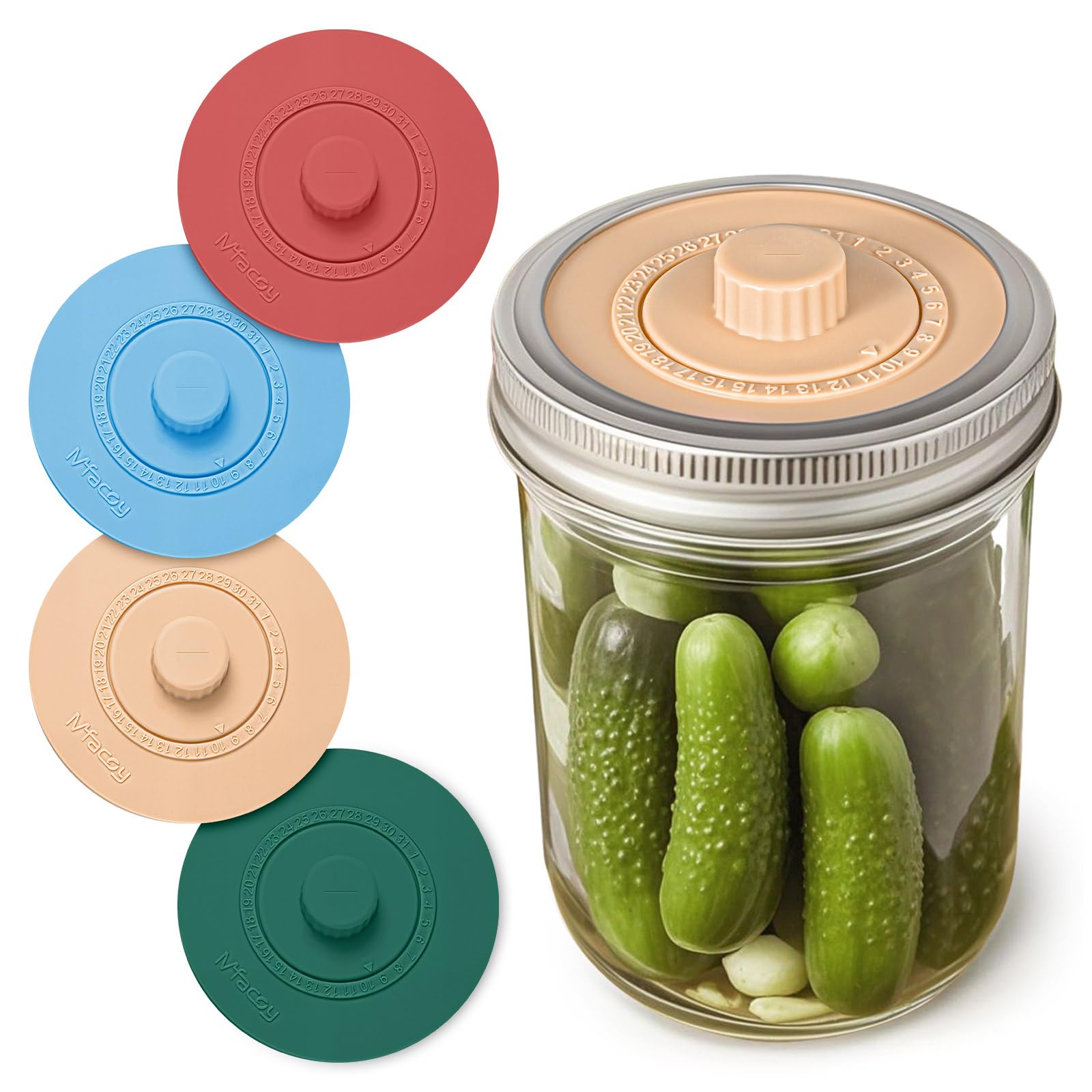
Key Features
- Extras: Date dial
- Jar Mouth: Wide mouth
- Set Contents: 4 silicone lids
- Jars Included: No
- Price: Budget
There’s a rotating date ring around the edge of each cap, and it’s the detail that sold us. Turn it to the day you packed the jar and you’ll never again stand over a ferment trying to remember whether it went in Monday or Thursday.
The valve is the same self-venting silicone design as the Pickle Pipes, just sized for wide-mouth jars: gas escapes, nothing comes back in, no water to top up. They’re dishwasher safe, they stack flat in a drawer, and four of them make this the least expensive way to try airlock fermentation here.
The catch is fit. Wide mouth isn’t one standard in practice, and some wide jars have threads these caps don’t grip cleanly — press one onto an empty jar and give it a tug before you commit a batch. There are no weights and no jars in the package either, so this is a lid purchase, not a starter kit.
Pros
- Date dial tracks each batch
- Self-venting, no water or burping
- Dishwasher safe and low profile
Cons
- No weights or jars included
The cheapest sane way to try airlock fermentation: four wide-mouth caps with a date dial, so you stop guessing when a batch started.
Best for Running Six Jars
Klemon 6-Set Fermentation Lids

Key Features
- Jar Mouth: Wide mouth
- Lid Material: 18/8 stainless steel
- Set Contents: 6 lids, 6 airlocks
- Jars Included: No
- Price: Budget
Six lids, six airlocks, nine grommets. If the problem is that you want six jars going at once and every other kit here tops out at four, this solves it for the least money per jar.
The lids are 18/8 stainless with silicone rings, so nothing rusts. The airlocks are the classic three-piece water type rather than a silicone valve: fill them halfway and they bubble as CO2 escapes, which gives you a visible sign a ferment is alive that a silicone cap can’t match. They also come apart into three pieces, so cleaning is a small brush and a few seconds.
The trade is attention. A water airlock needs its level checked, and a jar left to go dry in a warm kitchen stops venting; the silicone caps elsewhere on this page ask nothing of you. The grommets are the part that tears, which is why nine ship for six lids — keep the spares in a drawer, not the trash.
It’s the lowest-rated set on this page, so we treat it as a volume buy: fill one jar, watch it for a week, then commit the other five. For someone already fermenting who wants more jars in rotation, that’s a fair trade; for a first batch, start smaller.
Pros
- Six complete lid-and-airlock sets
- 18/8 stainless lids won’t rust
- Three spare grommets included
Cons
- No jars, weights, or instructions in the box
Six stainless lids and six water airlocks for someone who wants more jars in rotation — not the set to learn on.
How We Tested the Best Fermentation Kits, Batch by Batch
We started by sorting the listings into three buckets: lids and airlocks only, kits that add weights, and complete setups with jars. Anything without a true one-way valve was out, and so was anything that needed daily burping. That left 14 kits, which we used in a home kitchen over five months.
Every kit got the same first job: two pounds of shredded cabbage and salt, packed tight and weighted down on the counter. For the first two weeks we checked each jar every morning — pressing the vegetables back under the brine, noting how much effort each lid took to seat flat, and watching how quickly the airlock started to bubble. Weights got their own look, since we noted whether glass and ceramic ones stayed put as the cabbage settled or tipped sideways and let the vegetables float up. Lids and grommets went through repeated washing, by hand and in the dishwasher, and we checked for warping, cracking, and seals that stopped seating.
Recipe booklets were graded on whether they gave salt by weight or left us guessing, and whether the batch sizes matched the jars actually in the box. We tasted each ferment at one, two, and four weeks so we could tell a healthy sour from a stalled one. Value came down to the cost of a jar actually set up, since a lid-only set is a bargain until you buy the jars. Five months in, we looked at what had yellowed, warped, or lost its grip.
The kits still in rotation are the ones whose seals held, whose weights stayed down, and whose instructions a first-timer could follow at 10 p.m. on a Tuesday.
How to Choose a Fermentation Kit
The first decision isn’t which kit — it’s which jars are already in your cupboard, because almost every kit here is built around one jar size or ships its own glass.
Start With the Jars You Already Own
Mason jars come in two openings: regular mouth, roughly 2¾ inches across, and wide mouth, roughly 3⅜. A lid set built for one will not seal on the other, and no adapter fixes that. Measure the jar you plan to use before you shop — the Pickle Pipes only fit regular-mouth jars, while the Masontops, VSAPRDT, and Mfacoy sets are cut for wide mouth.
Wide mouth isn’t quite a single standard in practice, either. Threads vary a little between brands, so seat a new lid on an empty jar and give it a tug before you trust a batch to it. Two minutes of checking beats losing three weeks of kraut.
Silicone Valves vs. Water Airlocks
A silicone one-way valve is the low-effort option: nothing to fill, nothing to top up, and a low profile that lets jars stack in a cupboard. A three-piece water airlock — what the Klemon and Qianfenie kits use — needs its water level watched and comes apart for cleaning, but it bubbles visibly, which tells you at a glance that a ferment is working.
We take silicone for jars that live out of sight and water airlocks for a big jar you walk past every day. Both beat a plain lid, which has to be burped and will eventually blow.
Weights Are the Part That Decides Your Batch
Vegetables have to stay under the brine; anything above the surface is where mold begins. Plenty of pickle kits skip weights entirely — the Qianfenie jars and the lid-only sets here don’t include one — so check the contents list rather than the photos.
Fit matters as much as material. A weight slightly narrower than the jar rides up against the shoulder and tips, letting cabbage float free. Seven ounces is a sensible mass for a quart jar. If yours sits loose, a folded outer cabbage leaf between weight and vegetables will hold the shreds down.
Match Batch Size to How Fast You Eat
A 32-ounce jar holds enough kraut for a couple of sandwiches a week; a three-liter jar makes a batch you decant into smaller jars and eat from for a month. Four small jars beat one big one if you like variety, and one big jar beats four small ones if you make the same kraut every time.
Count the ferments you realistically keep going and buy lids and weights to that number — spare lids cost less than a second kit.
What Wears Out First
Grommets, lid gaskets, and silicone valves go before the glass does. Look for a kit that ships spares: VSAPRDT includes extra gaskets and grommets, and Klemon includes three extra grommets, because a torn grommet turns an airtight lid into a leaky one.
Clean with hot soapy water and a small brush, skip bleach on plastic parts, and never pour boiling brine into these jars. Warm liquid and a gradual cool-down is what keeps the glass in one piece.
Frequently Asked Questions
Can I use a fermentation kit for kombucha or mead?
A jar kit with a water airlock can do it — the gallon jars here are sold for exactly that — but silicone valve lids are a poor match for long, sugar-rich brews. If brewing is the plan, buy jars with three-piece airlocks; if vegetables are the plan, make sure weights are in the box.
How long does a batch take, and how do I know it’s done?
Speed follows room temperature, so start tasting early rather than watching the clock. A young kraut at day five is crisp and mild; the same jar at three weeks is soft and properly sour. Cool rooms slow everything down and a warm kitchen hurries it along.
When the flavor is where you want it, move the jar to the fridge. Cold stops the process, and the batch keeps for weeks.
Is it cheaper to buy a kit or assemble the pieces?
If you already own wide-mouth jars, a lid-and-weight kit is the cheaper route by a wide margin — you’re paying for four caps, four weights, and some silicone instead of glass. If you own no jars at all, a boxed set that includes them usually lands for less than buying the two separately, and it saves a second order.
Will salt and brine rust my lids?
Ordinary tin-plated canning lids will rust in a brine-heavy environment, which is why so many kits here use plastic or 18/8 stainless. Either handles vegetables fine. Keep your standard canning lids for jam and dry storage, and use the kit’s lids for anything salty.
Final Verdict
Most people should buy the Masontops Complete kit. It’s the only one here that combines airlock lids, glass weights, a packing tool, and instructions without also selling you jars you may already have, and that combination is what makes the hobby stick.
If you own no jars, the IceFun box gets you fermenting the day it arrives. If your fermenting happens in bulk rather than in pints, the Kilner jar holds a batch worth the wait. Match the kit to your cupboard and your appetite, and the rest is salt and time.