This post contains affiliate links. We may earn a small commission when you buy through our links — at no extra cost to you.
Almost nobody gets excited about cabinet pulls until they’ve bought the wrong ones. The number that trips people up is the size: a pull sold as 5 inches is usually 5 inches end to end, while the holes in your cabinet door may sit 3 inches apart. Measure the spread between your existing screw holes before you fall for a finish — that measurement, not the listing photo, decides what fits.
I’ve swapped the hardware in every kitchen I’ve lived with, and over the past five months my team installed 14 sets in three homes — kitchen cabinets, a bathroom vanity, a dresser — then opened, closed, and wiped them down daily.
What separates a good set from a forgettable one is mostly feel. A pull with real weight behind it doesn’t flex when a loaded drawer sticks, and every piece in the pack should read the same color and sheen in daylight. Screws matter more than anyone warns you about, too — the ones in the box don’t always suit a thin drawer front. The picks below held up on all counts.
Best for Full-Kitchen Refresh
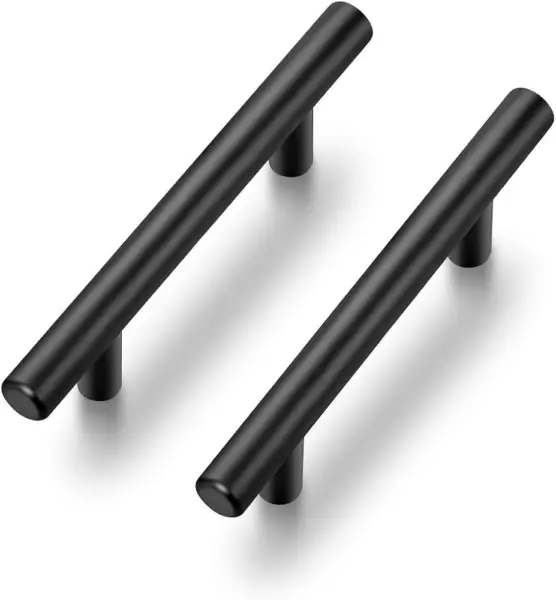
Ravinte Matte Black 30-Pack
Key Features
- Pack count: 30 pulls
- Projection: 1-1/4 inches
- Overall length: 5 inches
- Hole center spacing: 3 inches
- Price: Budget
Thirty pulls, 3-inch hole centers, and a matte black finish: the first of those numbers is what decides whether this set is right for you. Three inches between holes is the spacing on an enormous number of existing cabinets, and matching it turns a hardware swap into a screwdriver job instead of a drilling one. Thirty pulls covers a standard run of doors and drawers with a few left over for the vanity.
The round T-bar is the shape we keep coming back to for a first refresh. It is a 1/2-inch bar on a 1-1/4-inch projection, which leaves enough room for a hand and reads modern without visibly trying. Matte black here is flat rather than glossy, so it does not flare under under-cabinet lighting, and against white or light oak it makes the whole room look considered rather than updated.
One thing we noticed installing a full box at a stretch: lay them out and pair them up before you start. Overall length varies slightly from pull to pull, and matching similar ones onto doors that sit side by side keeps a run from looking slightly uneven. Five minutes of sorting buys you a sharper install.
Where these stop being the right answer is a kitchen where feel matters more than look. The solid zinc set below costs more and has genuine mass, and if you open the same cabinet fifty times a day, that money is well spent. For a rental, a flip, or a refresh you want finished this weekend, this is the box to order.
Pros
- 30 pulls cover a full kitchen
- Standard 3-inch spacing reuses existing holes
- Flat matte black suits white and wood cabinets
- Two screw lengths included for doors and drawers
Cons
- Hollow steel feels light in the hand
If your cabinets are already drilled at 3 inches and you want the whole kitchen done in one order, this is the set we point people to first.
Best for Solid, Weighty Feel
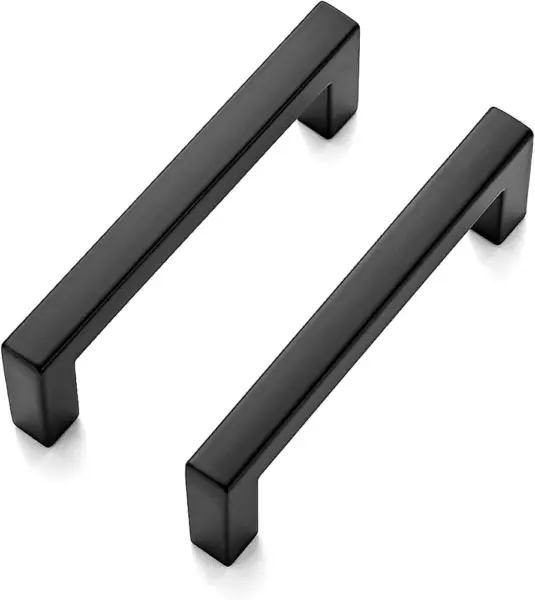
Ravinte Solid Zinc 30-Pack
Key Features
- Pack count: 30 pulls
- Bar material: Zinc alloy
- Overall length: 3-5/16 inches
- Hole center spacing: 3 inches
- Price: Midrange
Weight is the whole story here, and you feel it before you install anything. The body is solid zinc rather than folded steel, so the bar has mass and the threaded holes are cut into something substantial instead of a thin wall. On the same 3-inch spacing as our top pick, that makes this the upgrade for anyone who has grabbed a hollow pull and quietly disapproved.
The shape is a slim square bar, 3-5/16 inches overall with a 1-3/32-inch projection, and that shorter projection is the detail we appreciate most. It sits closer to the door than the round pulls in this guide, which looks sharp on flat-slab and Shaker fronts and keeps knuckles from catching as you walk past a drawer bank. On a raised-panel door that tighter stance can look a little spare; this one is happiest on a clean modern face.
Matte black over zinc is a more forgiving finish than matte black over painted steel. The color is flat and even, it does not pick up a shine where hands land, and it wipes clean with a damp cloth. The thirty in a box match one another, which counts for something when every door in a kitchen sits within sight of every other.
What you give up is money and a little visual length. This bar runs under three and a half inches overall, so on a wide drawer it can read as a small handle on a big front, and the 5-inch sets here fill that space better. On standard upper doors the proportion is close to ideal, and it is the set we keep recommending to people who plan to stay in the house.
Pros
- Solid zinc body with real heft
- Tight 1-3/32-inch projection sits close to the door
- Even matte black that resists showing wear
- 30 pulls stay consistent across the box
Cons
- Short bar looks small on wide drawers
- Costs more than hollow stainless sets
This is the set we hand to anyone who picks up a hollow pull and grimaces: solid zinc, standard 3-inch spacing, and a tighter, squarer look that suits flat doors.
Best for Tight Budgets
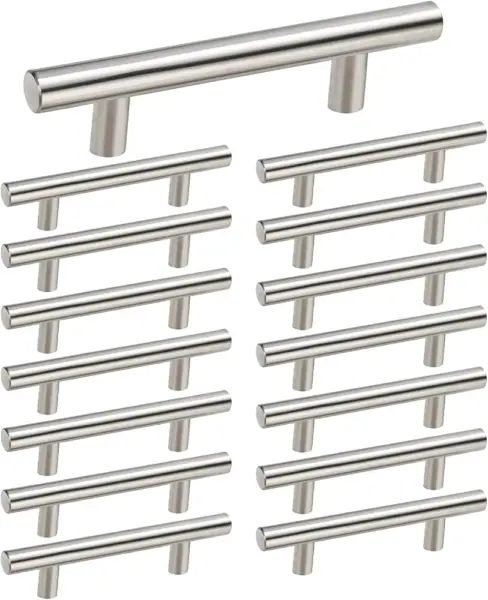
homdiy Brushed Nickel 15-Pack
Key Features
- Pack count: 15 pulls
- Overall length: 5 inches
- Included screws: 1 in and 1.57 in
- Hole center spacing: 3 inches
- Price: Budget
Fifteen is a number worth thinking about before anything else. It is exactly enough for a galley kitchen’s doors and drawers, a double vanity, or a dresser you are dragging back to life, and it is the smallest outlay in this group, which is why this set earns a place in the guide at all.
The brushed nickel is a true satin rather than a chrome look-alike, so it settles in beside stainless appliances without competing with them. At 5 inches overall on 3-inch centers, the proportion is the classic one: long enough to look deliberate on a drawer, short enough not to overwhelm a narrow cabinet door.
We treat this as the cosmetic option, and we say that without apology. The finish is doing most of the work, and installed on a vanity these look like the money went further than it did. What matters more here is the screws: the box includes 1-inch and 1.57-inch lengths, enough for standard 3/4-inch fronts, but a thick drawer box can leave the short screw with barely a thread’s worth of bite. Check your panel thickness first and use the longer screw wherever there is room.
Where this set wins is coverage per dollar: fifteen pulls, two screw lengths, and a finish that sits comfortably next to almost any appliance package. If your kitchen runs past fifteen fronts, buy both boxes in the same order. A second order months later can land on a slightly different shade of nickel, and that is hard to unsee once the doors are on.
Pros
- Lowest cost per pull in this guide
- 15 count fits a small kitchen or double vanity
- Satin nickel blends with stainless appliances
- Two screw lengths included
Cons
- Hollow steel body feels light
- Joint can loosen on heavily used doors
This is the set we recommend when the budget is the whole point: fifteen brushed nickel pulls on 3-inch spacing that make a small kitchen look redone.
Best for Wide Drawers
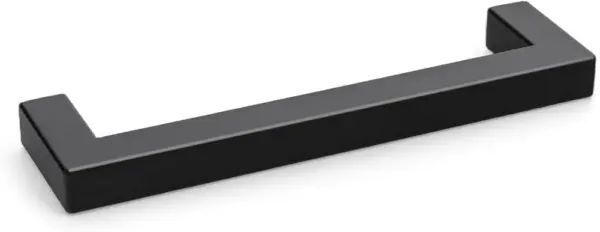
Goldenwarm 5-Inch 10-Pack
Key Features
- Pack count: 10 pulls
- Overall length: 5-1/2 inches
- Included screws: 1 in and 1.77 in
- Hole center spacing: 5 inches
- Price: Midrange
Ten pulls will not do a kitchen, and that is the honest place to start. What ten will do is finish a run of wide drawers, replace mismatched hardware on a double vanity, or let you live with a 5-inch bar on a few doors before you commit to thirty.
Five inches between holes changes more than the number suggests. A 5-1/2-inch bar gives a wide drawer a handle proportional to its front instead of a small pull stranded in the middle, and the square profile carries the eye along the drawer’s width in a way round bars do not. We like it most on deep pot drawers and on anything wider than about two feet, where a 3-inch pull starts looking lost.
The build is hollow stainless, rigid once it is tightened down, with a smooth matte black that does not hold every fingerprint. Screws come in 1-inch and 1.77-inch lengths, enough for standard fronts and for the thicker rail on a drawer box.
Measure twice here, because nothing about this set adapts: five-inch centers mean five-inch centers. Where the spacing is right, they mix cleanly with the 6-1/4-inch Goldenwarm pulls below, long bars on the wide fronts and shorter ones on the uppers, with the same finish across both.
Pros
- 5-inch bar gives wide drawers proportion
- Smooth matte black resists fingerprints
- Two screw lengths included
- Same finish as longer Goldenwarm pulls
Cons
- Only 10 pulls per box
- Hollow stainless feels light before install
For wide drawers that want a longer bar, or a partial update of ten fronts, this 5-inch set is the one we keep coming back to.
Best for Warm-Tone Kitchens
homdiy Champagne Bronze 15-Pack
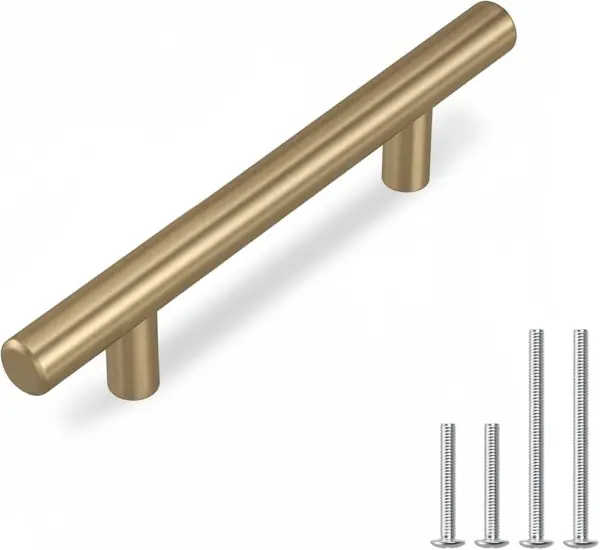
Key Features
- Finish: Champagne bronze
- Pack count: 15 pulls
- Included screws: 1 in and 1.77 in
- Hole center spacing: 3 inches
- Price: Budget
Champagne bronze is the finish that makes white cabinets look expensive and honey-oak cabinets look current again, and this is the least costly route to it in this group.
It is a muted warm gold, closer to the brushed brass on good plumbing than to a bright polished brass, and on a round bar with a 3-inch spread it stays quiet. That is the trick with a warm finish: put it on a simple shape and the color does the talking instead of competing with everything else in the room.
We are fond of this set for the small spaces, a powder room, a laundry, a built-in, where a finish change is the entire renovation. Fifteen pulls is the right count for a double vanity plus a linen cabinet, and the box includes 1-inch and 1.77-inch screws for both door fronts and thicker drawer boxes. The bronze sits on the surface of stainless rather than running through it, so skip abrasive cleaners and it keeps its tone.
It also handles mixed metals better than most warm finishes, sitting comfortably next to stainless appliances or black hardware in the same sight line. That flexibility is worth more than it sounds in a kitchen that is already carrying a faucet, a hood, and a light fixture in three different tones.
Pros
- Muted warm gold without a brass price
- 3-inch spacing fits standard cabinets
- Two screw lengths for doors and drawers
Cons
- Hollow body, so it feels light
- Best suited to lower-traffic cabinets
The warm-metal pick: fifteen champagne bronze pulls on standard 3-inch spacing, and the least expensive route to this color we cover.
Best for Extra-Long Pulls
Goldenwarm 6-1/4-Inch 30-Pack
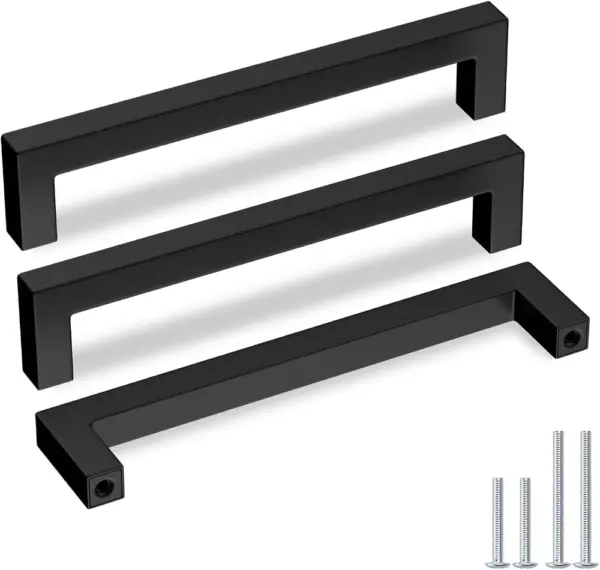
Key Features
- Bar width: 1/2 inch
- Pack count: 30 pulls
- Overall length: 6-13/16 inches
- Hole center spacing: 6-1/4 inches
- Price: Midrange
Six and a quarter inches between holes puts a 6-13/16-inch bar across a drawer front, and at that scale a wide drawer finally looks designed rather than left over. This is the set for new cabinetry or a full re-drill, where the drawer banks are the main event and a short pull would look undersized.
Thirty at this length is a serious order. The square bar is a half-inch wide, the matte black is even from pull to pull, and each one is individually wrapped with 1-inch and 1-3/4-inch screws, so a deep drawer box and a standard door front both get the right length without a trip to the hardware store.
Long hollow bars behave differently from short ones, and it is worth knowing before you order. There is more leverage at the end of a six-inch pull, so the bar has a little give if you grab it at the tip. Screwed down it is perfectly serviceable, but this is the length where we noticed the hollow construction most, and the one place in this guide where solid metal would be worth paying for.
Pairing is where this set shines: the same matte black runs alongside the 5-inch Goldenwarm pulls above, so a kitchen can carry long bars on the deep drawer stacks and shorter ones on the uppers without the finish shifting. That is how a mixed-size kitchen ends up looking intentional instead of pieced together.
Pros
- Long 6-13/16-inch bar suits wide drawer stacks
- 30 individually wrapped pulls in one order
- Uniform matte black across the set
Cons
- Requires 6-1/4-inch hole spacing
- Hollow bar has some flex at this length
When a drawer is wide enough that a 3-inch pull looks lost, this is the set we order: 6-1/4-inch centers, thirty long bars, one even matte black.
How We Tested the Cabinet Pulls
We started with specs rather than photos: hole center spacing, overall length, finish, material, how many pulls came in a pack, and whether screws were in the box. That narrowed a crowded field to 14 sets we ordered and installed over five months in a kitchen, a bathroom vanity, and a bedroom dresser — rooms where pulls get grabbed with wet hands, yanked when a drawer sticks, and wiped with a damp cloth most Saturdays.
Before anything went onto a cabinet, I measured each pull’s hole spacing and overall length against the holes already drilled in the door, noting where the gap between those two numbers would have tripped up an order. Installation was timed pull by pull. I checked whether the included screws were long enough for a standard door but not so long they poked through a thin drawer front, whether the heads sat flush, and whether the slots stripped under a screwdriver.
In hand, we weighed and flexed each one — a hollow pull gives under a hard tug, a solid one doesn’t — and ran a thumb along the bar to catch seams or sharp edges that would snag a sleeve or a dish towel. Every pull in a set was laid out side by side in daylight to spot sheen or color mismatch between pieces. Five months in, we went back to look for scratches at the finger contact point, finish wearing thin at the edges, and any pull that had worked loose, and we tallied what a pack actually gives you for the money.
How to Choose Cabinet Pulls
This purchase comes down to one measurement you can take in two minutes with a tape measure and no tools: the distance from the center of one mounting hole to the center of the other.
Measure Hole Centers First
Center-to-center spacing, usually written CC, is the only specification that can rule a pull out completely. Measure from the middle of one hole to the middle of the other on a door you already have. Three inches is the most common pattern on standard American cabinetry, 5 inches turns up on drawers and wider fronts, and 6-1/4 inches belongs to big drawer stacks and pantry doors.
A pull cannot be adapted from one spacing to another, and drilling a second hole in a finished door is a job worth taking on deliberately. If you are ordering for new cabinets, choose the spacing that suits your drawer widths, then drill to match.
Decide How Much Heft You Want
Nearly every budget cabinet handle in this category is hollow stainless: a folded shell with threaded posts. It feels light in the hand, it is perfectly rigid once installed, and it is how a 30-pack lands at the price it does. Solid zinc costs more and feels like a different object, because the mass is real and the threads have more material to bite into.
For a rental, a flip, or a powder-room vanity, hollow is a fair trade. For the cabinets you will open all day for the next decade, we put the money into solid.
Count Fronts, Then Buy a Pack
Count doors and drawers, add appliance panels and any furniture you want to match, then add a few spares. Fifteen covers a galley kitchen or a double vanity, ten handles a partial update, and thirty does a full kitchen with room left over.
Buy the whole quantity at once. Finish can shift slightly between production runs, and a second box ordered months later is the usual reason a matched kitchen ends up with two blacks that do not quite agree.
Screws, Projection, and Finish
Most packs include two screw lengths, typically 1 inch and something near 1-3/4 inches: the short ones suit a 3/4-inch door front, the long ones a drawer box with a thicker rail. Check your panel thickness before you start, since a screw that is slightly too long is easier to deal with than one barely catching a thread.
Projection matters more than it sounds. Around 1-1/4 inches is standard and comfortable, while a tighter 1-inch pull sits close to the door and looks sharper on a flat slab. On finish, matte black forgives smudges best, satin nickel hides fine scratches, and warm bronze is usually a coating, so keep abrasive cleaners away from it.
Frequently Asked Questions
Can I replace cabinet knobs with pulls without drilling?
Not usually. A knob uses one hole, while a two-point pull needs a second hole 3 or 5 inches away, depending on the model. The good news is that the existing hole often becomes one of the pull’s mounting points, so you are drilling once per door rather than twice.
Hold the new pull against the door, line one post up with the old hole, and mark the second hole through the other post before you drill. A strip of painter’s tape under the bar catches the shavings and protects the finish.
Will new pulls cover the marks from my old hardware?
If you keep the same hole spacing, the posts land in the old holes and cover them. What can still show is the ghost of the old bar, a slightly different sheen where the previous pull shielded the finish from light and cleaning.
Going to a bar at least as long as the old one covers most of that outline; going shorter can leave the ends of it visible. Wipe the door with a wood-safe cleaner before installing and you will see exactly what you are dealing with.
Can I mix pull sizes in one kitchen?
Yes, and it is the usual approach when a kitchen has deep drawers: longer bars on the wide fronts, shorter pulls on the doors. Keep every pull in the same finish and buy the sizes together, because two different matte blacks rarely match exactly.
Work with the holes already drilled rather than re-drilling to standardize. A 5-inch pull on a 24-inch-wide pot drawer and a 3-inch pull on the door above it read as a deliberate pair, not a mismatch.
Do I need a drilling template?
Templates are usually sold separately, and for a whole kitchen they are the difference between a straight row and a visibly wandering one. For a few doors, tape the pull in place, mark through both posts with an awl, and drill pilot holes before driving screws.
For a bigger job, make a cardboard template from one door and reuse it, or buy a jig. A jig pays for itself somewhere around the tenth door, when your marks start drifting.
Final Verdict
The Ravinte matte black 30-pack is what we hand most people: standard 3-inch spacing, a flat black that flatters white and wood alike, and enough pulls to finish a whole kitchen in one order without a second shipment.
Step up to the solid zinc set if you want real weight in your hand, take the homdiy 15-pack when the budget is fixed, and go long at 5 or 6-1/4 inches only when your drawers are wide enough to need the length. Everything else is finish.