This post contains affiliate links. We may earn a small commission when you buy through our links — at no extra cost to you.
The first cold week of January is what finally did it: my kitchen sat at 64°F and my sourdough starter went from bubbly to sulking in three days. A fermentation heater holds the jar, carboy, or bucket in the 70s to low 80s so yeast and bacteria keep working at the pace a recipe assumes, whether you’re baking bread or brewing kombucha.
The trouble is that these heaters are small, inexpensive, and uneven. Some wrap around the vessel, some slide underneath, some are plates with a probe you drop into the dough, and a few let you dial an exact temperature and a timer. Fit and steadiness ended up mattering far more than wattage.
Over the past five months we’ve run 14 of them through real ferments — daily starter feedings, gallon jars of kombucha, a beer bucket in a chilly basement — checking each against a thermometer we trust, not the number printed on the dial. The picks below are the ones that held steady overnight and were still working months later.


Best for Kombucha Year-Round
Hemlock Home Brewing Kombucha Heating Wrap
Key Features
- Fits: 1-gallon brewing vessels
- Cycle: First and second fermentation
- Splash resistance: Yes
- Temperature settings: 3
- Price: Midrange
Most heaters in this category have one job and one setting: plug in, add heat, hope the room holds steady. Three settings is the small difference that changes ownership. When the house drops ten degrees overnight, you move up a notch instead of relocating the jar, and when summer arrives you drop back down. The wrap is built around a 1-gallon brewing vessel, so it goes on and stays on.
This is the one we point a new kombucha brewer toward first. The settings land where they should: low holds a gallon in the low 70s, medium sits just under 80, which is squarely inside the 75-85°F window the culture wants. Splash-resistant construction is another detail we appreciate, because brewing day involves hot tea, a funnel, and at least one near miss.
Two more things worth knowing. The mat leaves the temperature strip visible, so checking the jar doesn’t mean peeling the wrap off and re-taping it every few days. And it’s designed to stay on through both the first and second fermentation, which means bottling day doesn’t reset the whole setup.
The boundary is the vessel. A 1-gallon jar gets full coverage; a 2-gallon jar leaves a gap, and a carboy was never going to work — that’s the flat pad’s job. For the standard kombucha setup, there’s nothing here we want changed.
Pros
- Three settings for seasonal swings
- Splash-resistant wrap for brewing days
- Leaves the temperature strip readable
- Runs through both fermentation stages
Cons
- Sized around 1-gallon vessels
Our default pick for kombucha: three settings give you somewhere to go when the kitchen cools off, and the wrap fits the gallon jar most brewers already own.
Best for Larger Kombucha Jars
The Kombucha Shop Kombucha Heating Wrap
Key Features
- Fits: 1/2 to 2 gallons
- Strap: Adjustable hook-and-loop
- Thermometer: Adhesive gauge included
- Temperature settings: 4
- Price: Midrange
An adjustable strap is the reason to pick this wrap over our top pick. It opens to fit a half-gallon jar and closes down around vessels up to about 2 gallons, which covers the brewer keeping a small test jar going beside the main batch. Four settings give you one more notch than most wraps here, and an adhesive temperature gauge comes in the box so you can read the jar instead of guessing.
At the gallon size these two wraps do the same work for the same money, and the strap is where they part company. This one is more adaptable and slightly less certain, because a hook-and-loop band at full extension is only as snug as the jar’s shape lets it be. Two gallons is the edge of the range; wide, square-shouldered vessels are where the fit turns questionable.
Our take: if every batch goes into the same gallon jug, the fixed wrap is the safer buy. If you ferment in half-gallon jars, odd-shaped crocks, or a 2-gallon vessel you’re willing to measure before ordering, the strap is worth the trade. That extra setting also helps in a room that runs hot, where you want the lowest level rather than the only level.
Pros
- Adjustable strap spans small to large jars
- Four temperature settings
- Adhesive temperature gauge included
Cons
- Strap reaches its limit at 2 gallons
Choose this one if your brewing jars aren’t all the same size — the adjustable strap earns its keep across half-gallon to 2-gallon vessels.
Best for Budget Kombucha Brewing
Propagate Pro Wrap Around Kombucha Heater Belt
Key Features
- Fits: 1-gallon jars
- Settings: None; adjust by position
- Heat rise: 5-20°F above ambient
- Thermometer: Adhesive strip included
- Price: Budget
The least expensive heater in this group is also the simplest: no dial, no timer, no display. You plug it in, wrap the belt around the jar, and it lifts the vessel 5°F to 20°F above room temperature. Adjustment is physical — slide the belt higher or lower on the jar, or gather it around a smaller vessel — and an adhesive thermometer strip comes in the box so you can see what you actually got.
We like it for a first batch and for anyone brewing in a cool room who doesn’t want to think about settings. There is nothing to misconfigure, and the belt isn’t hot to the touch, which matters when you’re moving a full jar around on a Sunday morning. The catch is that your room is the thermostat. A fixed-output belt is only as good as the air it works against, so in a cold kitchen it can leave you short of the 75-85°F range kombucha wants. Insulate the jar with a towel and it gets there; leave it bare on a cold counter and it may not.
Pros
- Lowest price in this group
- No settings to get wrong
- Adhesive thermometer included
- Not hot to the touch
Cons
- Room temperature sets the result
- Position is the only adjustment
The heater we hand to someone brewing a first batch: nothing to set, nothing to misconfigure, and a thermometer strip in the box.
Best for Carboys and Buckets
Propagate Pro Round Brewing Heat Pad
Key Features
- Format: Round pad under vessel
- Wattage: 25 watts
- Heat rise: 5-20°F above ambient
- Safety shutoff: 100°F
- Price: Premium
Not every fermentation happens in something you can wrap. A carboy, a brewing bucket, a wide crock — for those the heater goes underneath, and a flat round pad is the honest way to do it. This one is 25 watts and sits on the counter or the closet floor with the vessel on top, so heat moves up through glass or plastic instead of pressing against one side of it.
Two features we rate: a thermal shutoff at 100°F, which is real peace of mind for something running unattended in a basement, and the fact that it’s completely silent and light enough to move one-handed. The shutoff also sets the ceiling. This warms fermentation; it doesn’t run a proofing cabinet, and it won’t push a culture that wants to sit above 100°F.
The trade-off is evenness. Heat from below is lopsided by nature — the bottom of the vessel runs warmer than the shoulder, and a carboy with a hot base and a cool top ferments unevenly. A towel or an old sweatshirt over the vessel fixes most of it, and that’s the routine we settled into. There’s no setpoint either, so the room still does the steering; this pad gets the shape right, not the control.
Pros
- Fits carboys, buckets, and crocks
- Thermal shutoff at 100°F
- Silent and easy to move
- 25 watts of gentle heat
Cons
- No setpoint; the room sets output
- Bottom-up heat is uneven
For carboys, buckets, and crocks, a flat pad beats any wrap — just expect to insulate the top of the vessel.
Best for Big Plastic Fermenters
FastRack Brew Fermentation Heating Belt
Key Features
- Fits: 6-8 gallon plastic fermenters
- Holds: 75-80°F
- Continuous use: Up to 8 days
- Price: Budget
This belt exists for one vessel: the 6- to 8-gallon plastic fermenter that nothing else here will circle. If you brew beer or wine in a bucket, that’s the whole recommendation. It holds 75-80°F, and the maker rates it for up to 8 days of continuous use — roughly a primary fermentation, so you strap it on and come back to a finished job.
A bucket sitting on a cold concrete floor will stall, and a belt around the outside is the least expensive way to keep the yeast working through the lag phase. It’s also the least fussy thing on this list: no straps to thread through a handle, no pad to line up, nothing to program. The belt is unfussy at the other end too, since there’s only one heat level and what you get depends on the room.
Our one real complaint is the missing thermometer. The wraps here come with a stick-on strip and this one doesn’t, and without a readout you’re guessing whether the belt is holding 78°F or 84°F. Buy a strip when you buy the belt. For a bucket brewer working in a cool garage, it’s still the right shape at the right money.
Pros
- Sized for 6-8 gallon plastic fermenters
- Holds a steady 75-80°F
- Rated for 8 days continuous
- Nothing to program
Cons
- One fixed heat level
- No thermometer in the box
If your fermentation happens in a 6- to 8-gallon plastic bucket, this belt is sized for it and holds the 75-80°F band.
Best for Sourdough Proofing
SourKeeper Sourdough Starter Warmer Pro
Key Features
- Probe: Stainless steel dough probe
- Timer: Up to 24 hours
- Precision: 1°F
- Temperature range: 70-110°F
- Price: Midrange
The probe is why this warmer costs more than a plain mat, and why it’s the sourdough pick we trust. Instead of heating a plate and letting you infer what the jar is doing, a stainless probe goes into the starter and the base controls on that reading. You set 70-110°F in 1°F steps, choose a timer of up to 24 hours, and the plate cycles to hold your number.
That gap between plate and starter isn’t academic. Warmers of this shape tend to run ahead of their setpoint, and a plate controlling on its own sensor can leave the starter cooler than the number on the display. The probe closes that loop by measuring the thing you actually care about. The 6.5-inch square base takes mason jars and most containers you’d proof in, and it’s small enough to stay out on the counter between bakes.
The caveat is reliability. Some units stop heating within a few months, and the plate can run hotter than the setpoint you typed. The two-year manufacturer warranty is why this stays on the list: if yours quits, you’re covered, and the probe design is still the best answer here for a cold kitchen.
Pros
- Probe measures the starter, not the plate
- 1°F steps from 70-110°F
- 24-hour timer and auto shut-off
- Two-year manufacturer warranty
Cons
- Plate can run hotter than the setpoint
- Some units quit heating within months
The sourdough warmer we trust most, because the probe measures the starter instead of guessing from the plate.
Best for Small Counters
NICOFPHY Sourdough Starter Warmer with Glass Dome

Key Features
- Timer: Up to 12 hours
- Wattage: 10 watts
- Precision: 1°F
- Temperature range: 70-100°F
- Price: Midrange
A thick glass dome over a 10-watt warming base is a different approach from a flat mat. Instead of heating from below and letting the warmth drift off the top, the cover holds it around the jar. It also looks like something you want to leave out — the rose-under-glass comparison writes itself, and for a starter you feed every day, that isn’t nothing.
The controls are straightforward: 1°F steps from 70°F to 100°F, a timer up to 12 hours, automatic shut-off, and enough base area for a quart mason jar or a Weck tulip jar. Ten watts means it’s cheap to leave running, and the whole unit is small enough to sit beside the coffee maker without crowding it.
What it won’t do: 100°F is the ceiling, so yogurt and anything warmer is out, and the dome has to clear your jar, which rules out a tall crock. The display reads the plate rather than the starter, so expect the jar to trail behind it, especially in the first hour of a cold morning.
Where it earns a place: a small kitchen, a starter you want visible, and a household that likes the look of the thing. Where it doesn’t: a baker who wants one warmer to handle starter, dough, and yogurt, or anyone whose jar is taller than the cover.
Pros
- Glass dome holds warmth around the jar
- 1°F settings from 70-100°F
- 12-hour timer and auto shut-off
- Small and good-looking on a counter
Cons
- 100°F ceiling rules out warmer cultures
- Dome limits which jars fit
Buy this one for the dome and the small footprint; a 100°F ceiling and a jar-specific fit keep it from being the everyday choice.
Best for Timed Proofing
MENGBEI Sourdough Starter Warmer Mat
Key Features
- Timer: Up to 24 hours
- Wattage: 12 watts
- Precision: 1°F
- Temperature range: 70-110°F
- Price: Midrange
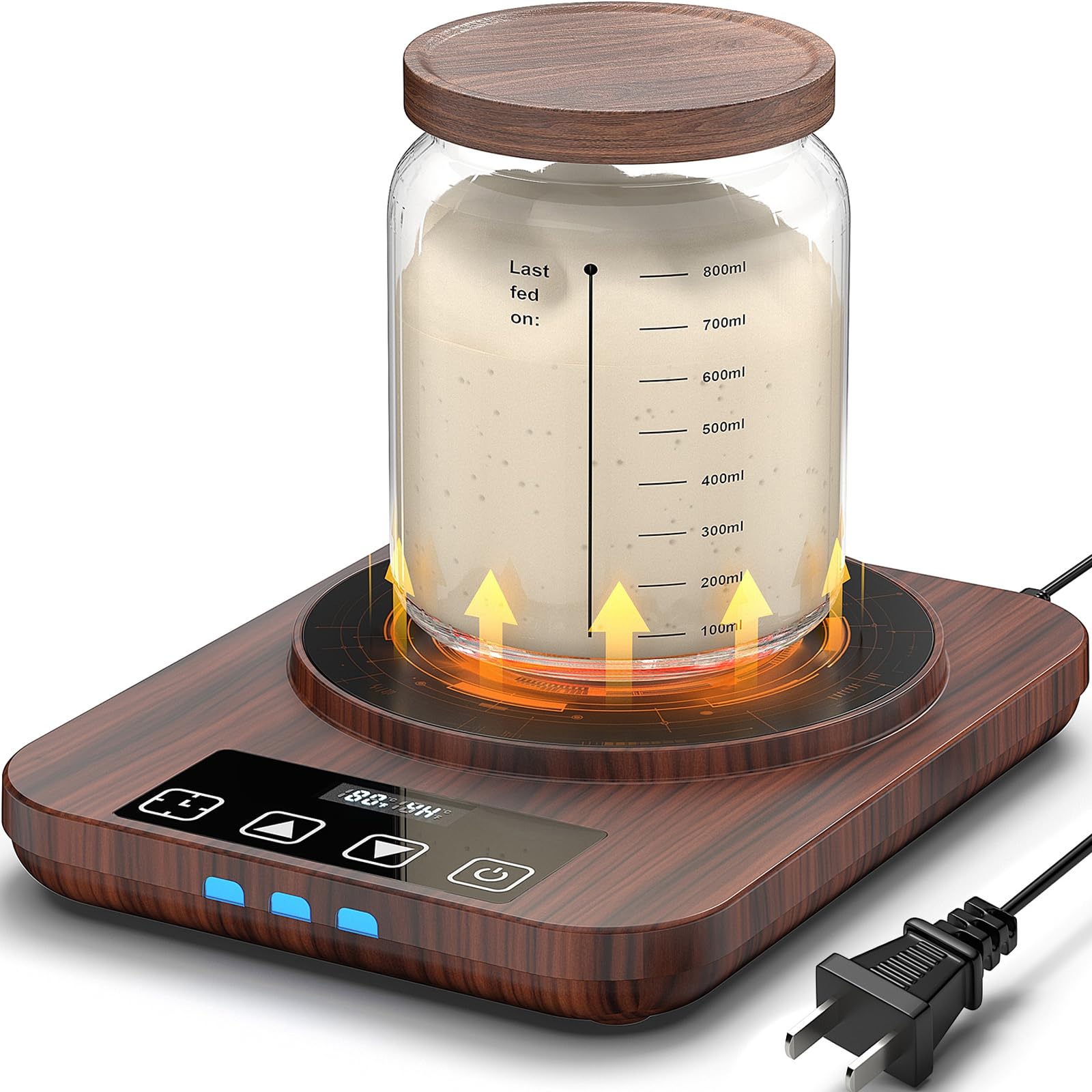
Seventy to 110°F in 1°F steps, a timer that runs to 24 hours, and a memory function that picks up after a power interruption: on paper this is the most flexible warmer in the group. It’s a flat 12-watt mat with a wood-grain top that reads warmer than the usual black plastic, and it takes a jar or a bowl without complaint.
The 110°F ceiling is what sets it apart from the dome warmer. It reaches the range where yogurt cultures, and it gives you room to push a sluggish starter in a cold kitchen without maxing out the only setting you have.
The distance between the spec sheet and the counter is the story here. Warmers in this shape turn in uneven results — some hold steady for months, others never warm properly, and there’s no telling which you got until it has run for a day. This one lands in the middle of that spread: the controls are genuinely good when the heater is doing its job.
Our take: it’s a reasonable second warmer, or a low-risk way to try timed proofing, especially if the wood grain suits your counter. If it’s going to be the only warmer you own and you bake every week, the extra money for the SourKeeper’s probe buys you a measurement instead of a guess.
Pros
- 70-110°F range in 1°F steps
- 24-hour timer with memory
- 12 watts with a wood-grain finish
- Inexpensive for the feature set
Cons
- Heating results vary from unit to unit
- No probe; the plate is the only sensor
A flexible, inexpensive warmer with a timer and a wide range — worth a try if you can live with the variability that comes with it.
How We Tested Fermentation Heaters
I started by pulling every fermentation heater I could find that stated an actual temperature range, then cut the list down by form — wrap, belt, round pad, heated plate with a probe — so the final 14 covered the ways people actually ferment at home. Each unit ran for five months, most of them plugged in continuously from the first week.
In testing, every heater went onto the vessel it was built for: a quart jar of starter on the counter, a gallon of kombucha in the pantry, a fermentation bucket in a 62°F basement. We set each to 75°F and read the real temperature with a separate probe thermometer — at the center of the jar, at the glass edge, and where the wrap touched it — then logged how far it drifted from the setting and whether the middle ran hot while the edges lagged.
We timed how long each took to lift a 65°F jar to temperature, then unplugged it to see how fast the heat fell, since a heater that holds its warmth coasts through a cold night and one that doesn’t cycles hard. Belts and wraps went onto both a wide gallon jar and a narrow quart jar to see where they bunched or gaped. Controls got handled with floury hands, timers got set and reset, and mats got wiped after spilled starter dried on them.
Reliability came down to months of continuous use: warm cords, hot spots under a folded edge, a thermostat that stopped holding after a few weeks. On value, we asked whether the extras — probe, stick-on thermometer, timer — actually earned their place or just added a step.
How to Choose a Fermentation Heater
An inexpensive heater that wraps the vessel you already own beats a fancier one that does not, and the temperature you actually care about is inside the ferment, not on the dial.
Start With the Vessel, Not the Heater
Almost every disappointing purchase in this category comes down to shape. A wrap or a belt circles a jar; a flat heat mat sits under a carboy, a bucket, or a crock. Neither substitutes for the other. Measure the vessel you actually ferment in — its circumference and the height of its straight side — before you shop, because a band a few inches tall on a tall jar leaves the top of the ferment cool while the bottom runs warm.
If you rotate between a half-gallon jar and a gallon jug, an adjustable strap earns its keep. If you brew in a plastic bucket or a glass carboy, only a belt or a pad will do it, and no amount of wrapping gets you there.
Fixed Output Versus Settings
A plug-in belt adds somewhere between 5°F and 20°F over room temperature, which means your kitchen decides the result. That’s fine in a steady apartment and frustrating in a house that swings twenty degrees between October and April. Stepped settings — three on the Hemlock wrap, four on The Kombucha Shop version — give you somewhere to go when the weather turns.
A thermostat with a probe goes further, holding a number rather than a level. Pay for adjustment if your room isn’t stable; in a climate-controlled kitchen, a cheaper fixed belt does the same job.
The Display Isn’t the Ferment
Every heater here warms a surface, and the starter or brew inside the vessel takes hours to follow. A plate set to 78°F can sit under a jar that is still at 70°F an hour later; a wrap that feels barely warm to the hand can hold a gallon steady at 78°F. Trust the adhesive strip or the probe, give a new setting a full day to settle, and check at the coldest point of the night rather than the warmest.
Timers, Footprint, and What You’ll Live With
Sourdough bakers get more from a timer than brewers do: you want warmth during a bulk rise, not necessarily overnight, and auto shut-off means you can start a levain before bed without leaving a plate running until noon. Think about where the thing lives, too. A wrap stays on the jar and moves with it; a flat pad needs counter or shelf space and a vessel light enough to lift off it.
Also check the ceiling. A unit that shuts off at 100°F is a comfort for unattended brewing and a wall if you were hoping to culture yogurt in the same appliance.
Frequently Asked Questions
Can I use a seedling heat mat for fermentation?
It will warm a jar, but a seedling mat is built to sit under a tray of soil and it usually comes with no way to read the ferment, so you’re adding heat blind. If you already own one, stick a thermometer on the vessel and check the jar rather than the mat before you trust a batch to it. A purpose-built heater costs about the same and arrives with the thermometer in the box.
How much does it cost to run a fermentation heater?
Very little. The units here draw 10 to 25 watts, which comes to pennies a day even running around the clock. A stalled batch costs more in ingredients and time than a month of electricity does. The exception is a cold room, where a heater runs continuously and still may not reach the temperature you want.
Will a heater keep up in a cold garage or basement?
Do the arithmetic first. A heater rated to add 5°F to 20°F over ambient, sitting in a 55°F basement, tops out near 75°F — the very bottom of the 75-85°F range kombucha wants, and only at full output. Insulate the vessel with a towel or a sweatshirt, keep it off the concrete, and pick a unit with settings. If your overnight low is well below 55°F, nothing here is a sure thing.
Can I drape a towel over the heater to hold heat in?
Cover the vessel, not the element. A towel around the jar insulates the ferment and evens out the temperature; a towel over the heater traps warmth against the element and pushes the vessel past the setting you picked. Leave the heater exposed to room air, since its output is rated against ambient, and put the blanket on the glass.
Final Verdict
Our pick for most people is the Hemlock wrap. Three settings turn a heater from a gamble on room temperature into something you can steer, and it is shaped for the gallon jar most kombucha brewers already own.
If your fermentation happens in a carboy, a bucket, or a 6-gallon plastic fermenter, choose by shape instead — the Propagate Pro pad or the FastRack belt. For sourdough, the SourKeeper’s probe is what separates a real setpoint from a hopeful one.