This post contains affiliate links. We may earn a small commission when you buy through our links — at no extra cost to you.
Steam is the quiet reason a day-old baguette comes back to life: a quick burst of moisture keeps the crust from drying out while the elements do the crisping. The trouble is that steam means very different things in this category — a five-second puff from a thimble-sized tank, or a true combi oven that also cooks rice and sous vides a steak.
I’ve been cycling countertop ovens through my kitchen for years, and the steam models are the first that got me to stop babysitting toast. Over the past eight months, we cooked through 10 of them, running the same roster — toast, leftover pizza, roasted vegetables, frozen fries, a from-scratch loaf — and the real differences showed up in the things spec sheets bury: how much water the tank holds, whether the steam arrives before or after preheat, and how much counter you surrender for the capacity you get. Preset counts are the least useful number on the box.
What follows earned permanent counter space, including a couple that could retire your toaster and your microwave altogether.
Best for Family Meals
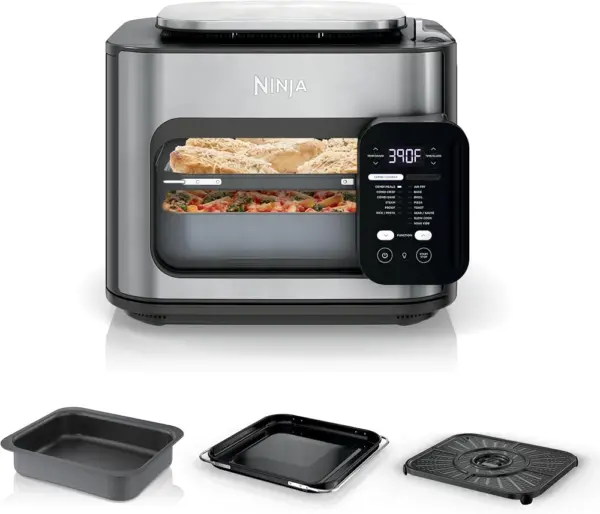
Ninja Combi SFP701
Key Features
- Fits: 6-lb chicken, 10-inch pizza
- Modes: 14-in-1
- Steam: HyperSteam plus air fry
- Footprint: 15.4 × 14.9 × 13.1 in
- Price: Midrange
A frozen chicken going straight into the oven, no defrost step, is the demo that sells this thing, and it holds up. Super-heated steam thaws and cooks the meat through, then the air fryer element moves in to crisp the skin. The same design lets a protein, a tray of vegetables, and a pot of rice or pasta cook together in one session — which is the real argument for a combi steam oven over a toaster that merely toasts.
Range and price are what earn it the top spot. Fourteen modes cover steam, toast, bake, air fry, pizza, slow cook, sous vide, and rice or pasta, and the pan takes a 6-pound chicken, a 10-inch pizza, or 24 ounces of pasta. Of the full-size ovens here it is the least expensive, and it is the one that most credibly replaces both a toaster oven and an air fryer on the same stretch of counter.
The learning period is real: fourteen modes on a knob means a week or two of consulting the guide before the presets become shortcuts, and hitting manual settings directly is faster at first. Reliability is the other thing to weigh — the control panel, not the cooking, is what goes wrong when a combi does fail — so register the warranty and keep the receipt. If bread and pastry matter more than dinner, the Balmuda is the better tool; if steam baking is the point, the CIARRA’s bigger cavity earns the upgrade.
Pros
- Steam and air fry work in one pass
- Cooks protein, vegetables, and rice together
- Fits a 6-lb chicken or 10-inch pizza
- Least expensive full-size combi here
Cons
- Interior corners collect steam residue
We recommend the Combi as the default steam oven here: it steams, air fries, and toasts in one pass, feeds a family, and costs less than the premium combis.
Best for Steam Baking
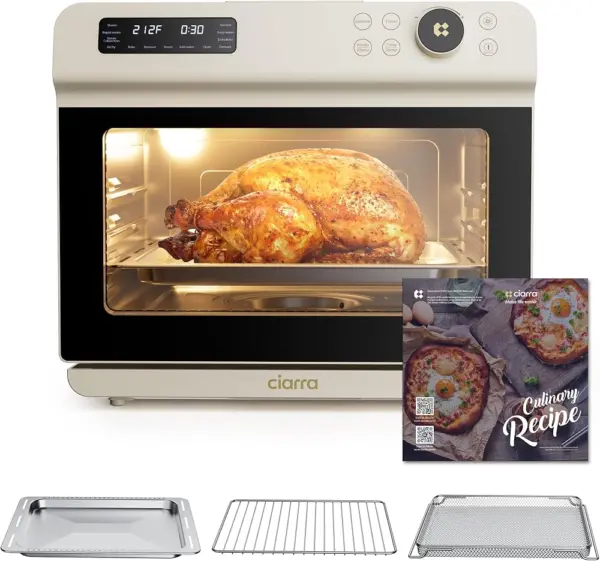
CIARRA Nosh Oven Pro
Key Features
- Capacity: 25.4 quarts
- Footprint: 16 × 14 × 17 in
- Steam modes: Rapid steam and steam bake
- Temperature range: 85 to 430 °F
- Price: Midrange
Twenty-five and a half quarts is the largest cavity in this group, and it is the reason this oven gets picked when a whole chicken and a pan of vegetables need to go in at the same time. What we appreciate more is that steam is a cooking method here rather than a finishing touch: rapid steam, steam bake, and steam convection are their own modes, and the ferment setting takes dough from proof to bake without moving it to another appliance.
The package is unusually complete. CIARRA includes the air fry basket, baking pan, oven rack, and a pair of mitts, so nothing has to be bought on top, and the 85 to 430 °F range covers proofing and dehydrating at the bottom and pizza at the top. A self-clean cycle and delay start round it out — conveniences we did not expect at this price.
Two ownership details decide whether it fits your kitchen. At 17 inches tall with a drop-down door it needs open air above and clear counter in front, so measure the gap under your cabinets before you commit. And there is only one rack position, which means a cavity this large cannot be split into two levels the way a bigger oven can. Buy it for bread, sheet-pan dinners, and family portions; a two-slice household will find it more oven than it needs.
Pros
- Largest interior here at 25.4 quarts
- Real steam and steam bake modes
- Accessories and self-clean included
- Straightforward enough for weeknights
Cons
- Single rack level limits batch cooking
Our pick for steam baking: the Nosh Oven Pro has the biggest cavity here, a real steam bake mode for bread, and a self-clean cycle at a midrange price.
Best for Small Kitchens
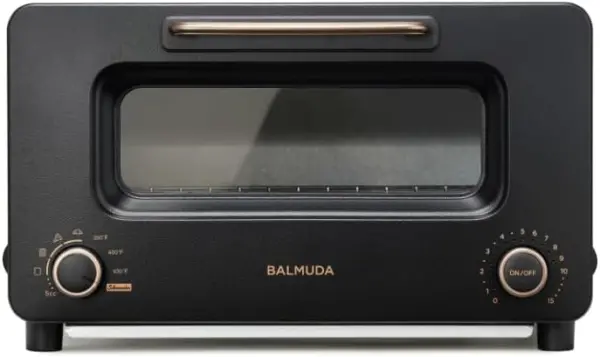
Balmuda The Toaster Pro
Key Features
- Modes: 6
- Weight: 9.7 lb
- Footprint: 14.1 × 12.6 × 8.2 in
- Steam dose: 5 cc water
- Price: Premium
Balmuda’s The Toaster Pro is not trying to be a second oven, and the first thing you notice is how little room it asks for: 8.2 inches tall and under 10 pounds, so it tucks under a cabinet or onto a shelf that nothing else here would fit. If your kitchen has one spare foot of counter and a good bakery nearby, that shape is the feature.
The steam is a 5 cc shot of water poured in before each cycle, and it is not a gimmick. The moisture keeps the crust from drying while three heating zones brown the surface, which is why a slice comes out crisp outside and soft through the middle. Six modes cover shokupan, golden toast, croissant, pizza, oven at 350, 400, or 450 °F, and a salamander grill; the salamander is the one we came back to most, because top-down heat melts cheese or finishes a piece of fish without waking up the range.
Whether it earns its place depends entirely on what you ask of it. As a bread and pastry machine it is the most interesting oven here; as a general countertop oven it is the least useful, with one slot and no room for a casserole. One thing to do in the first week: toast a full batch and check how evenly the slices color across the slot, while you can still change your mind.
Pros
- Steam keeps crust crisp and crumb soft
- Fits under a cabinet at 8.2 inches
- Salamander grill gives real top-down browning
Cons
- Baking tray sold separately
- Highest price for the smallest oven here
Buy the Toaster Pro if toast and pastry are the whole point and your counter is short; it is a specialist, not a second oven.
Best for Moisture Control
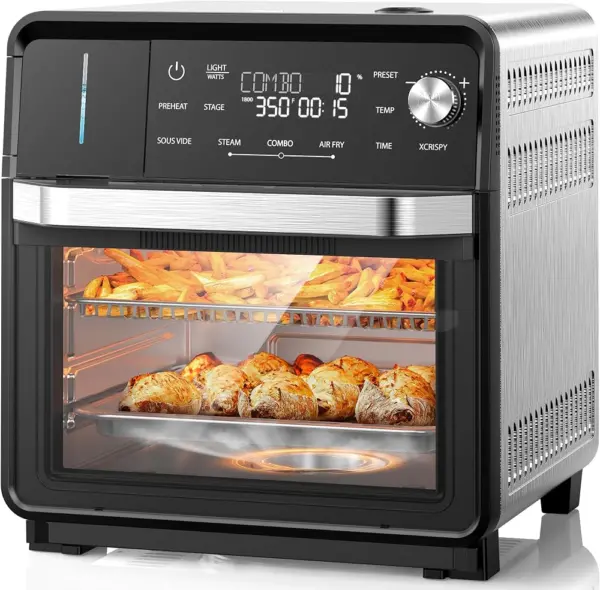
Nuwave Combi Steam Oven
Key Features
- Wattage: 1,800 watts
- Capacity: 16 quarts
- Moisture control: 10 to 90 percent
- Temperature range: 50 to 450 °F
- Price: Premium
Most ovens in this group treat steam as a switch. The Nuwave treats it as a dial: you set moisture anywhere from 10 to 90 percent and temperature anywhere from 50 to 450 °F in one-degree steps. That combination is what makes it worth the money for anyone who cooks by feel — roast a chicken at moderate heat with steam on, then drop the moisture for the last stretch to crisp the skin, all without changing appliances.
It backs the control up with real capability. Combo mode runs steam and air fry at once, the stainless interior avoids a nonstick coating, and sous vide happens in the cavity rather than a water bath. Sixteen quarts is enough for a family dinner, and the accessories — tray, basket, rack, drip tray, recipe book — arrive with it. Steamed dumplings and hard-cooked eggs without a pot of water are the small wins that keep it in rotation.
The interface is where it stumbles. Saving your own settings takes more steps than it should, and the preset list is long enough to get lost in. Sous vide is the mode to test in your first week if it is why you are buying, because it is the one that behaves least predictably. This is also the priciest oven here, which is a fair amount to pay for adjustability if you mostly want toast.
Pros
- Moisture adjustable from 10 to 90 percent
- 50 to 450 °F in one-degree steps
- Steam and air fry run together
- Stainless interior, no nonstick coating
Cons
- Preset programming is cumbersome
- Most expensive oven in this group
For cooks who want to set an exact moisture level instead of pressing a steam button, the Nuwave is the most adjustable oven here.
Best for App-Guided Cooking
Tovala Smart Oven Pro
Key Features
- Modes: 6-in-1
- Control: Smartphone app with barcode scan
- Wattage: 1,525 watts
- Footprint: 18.5 × 12.3 × 11.8 in
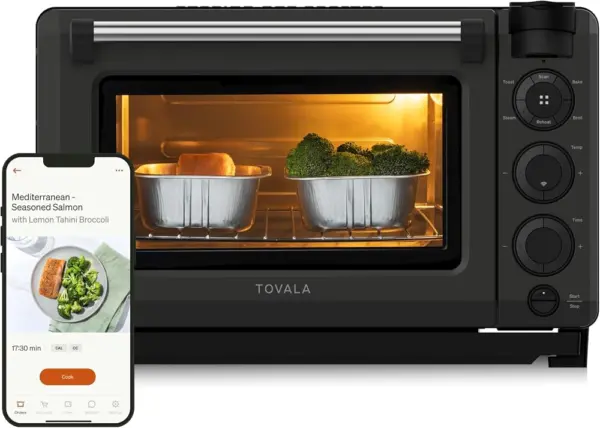
The scanner is the whole idea. Point the Tovala at the barcode on one of the company’s meal kits and the oven sets its own mode, temperature, and time — no thinking, no guessing, and the same result every time. For a household that eats pre-portioned meals, that is a genuine convenience and the best-executed version of it in this group. For anyone who wants an oven to cook with, it misses the point.
Strip the app away and you have a six-mode convection oven: steam, toast, air fry, bake, broil, and reheat, run from a touch panel with notifications on your phone. The steam setting is the part to understand before buying. It adds moisture so bread and meat do not dry out, but it will not steam rice or cook a piece of fish — if that is what you are after, the CIARRA and the Nuwave both do it properly.
Toast is slower here than on the compact Balmuda, and the recipes, grocery ordering, and one-tap cooking all assume you live inside Tovala’s ecosystem. Without the meal plan you own a competent six-mode oven and leave the features that justify it sitting idle. With the plan, it is the most hands-off cooking appliance on this page.
Pros
- Barcode scan sets mode, time, and temperature
- Six modes including steam and air fry
- Consistent results on the company’s meal kits
Cons
- Steam adds moisture but cannot cook food
- Best features require the meal subscription
If you want dinner decided for you, the Tovala’s scan-and-cook routine is the most hands-off here; buy it for the meal plan, not the steaming.
Best for Small Budgets
Ounin Steam Infusion Oven
Key Features
- Weight: 12 lb
- Wattage: 600 watts
- Capacity: 12 liters
- Footprint: 10 × 10 × 15 in
- Price: Budget
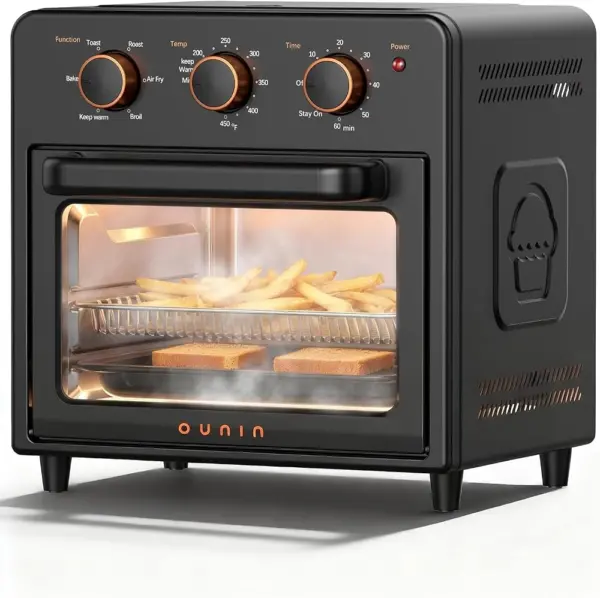
Six hundred watts is the number to start with. Every other oven in this group draws 1,300 to 1,800, and the gap shows up as slow preheating and gentle browning — this is not the oven you buy for a blistered pizza crust or crisp chicken skin. Expect it to warm through while you finish prepping, not before.
What it does offer is steam infusion during air frying, six modes, and two knobs instead of a menu tree. There is a 60-minute timer, a recipe book in the box, a one-year warranty, and nothing to connect to a phone. The body measures 10 inches wide by 10 deep, so the cavity is smaller still — a couple of portions of vegetables, a few pieces of chicken, or last night’s dinner reheated, rather than a family meal.
As a first steam oven it makes a certain kind of sense. It costs the least of anything here, the controls need no explanation, and a month of use will tell you whether steam cooking is something you actually do. If you already know the answer is yes, the Ninja does far more for a modest step up in price and will not leave you waiting on preheat.
Pros
- Cheapest steam oven in this set
- Knob controls with no app or menu
- Compact 10-inch footprint
Cons
- Small cavity suits single portions only
- Only 600 watts, so browning is slow
A first steam oven for a small kitchen or a dorm room: the Ounin is the cheapest way in, as long as you keep batches small.
How We Tested Steam Toaster Ovens
We started with about 30 steam-capable countertop ovens pulled from retailer listings and narrowed that to 10 using three practical filters: footprint (would it sit under a standard cabinet with the door swung open?), water delivery (a real reservoir versus a token spritz), and whether the modes were genuinely different cooking functions or the same one with new names. Price factored in too, but a higher price only earned a spot if the specs backed it up.
Each oven then lived in a home kitchen for eight months, working through weekday-morning toast and bagels, reheated takeout, roasted vegetables, air-fried frozen fries, and weekend baking. We parked an oven thermometer in the center of the cavity and logged preheat time along with how far the temperature drifted over 20 minutes. Four slices went in cold, then four more right after, to see how quickly the oven recovered. For steam, we weighed bread before and after a steam-toast cycle and noted whether the crust came out crackly or leathery, and whether leftover pizza reheated crisp or limp. We also handed the controls to someone who had never seen the oven and counted the taps it took to start plain toast.
Cleaning got its own pass: we deliberately baked cheese and chicken fat onto the floor and walls, then followed each maker’s instructions — steam-clean cycle, self-clean, or hot soapy water — and counted the wipes it took, including the drip tray, gasket, and the corners behind the elements. Tanks were filled with ordinary tap water so we could watch for scale. For texture, we compared a sandwich loaf’s crumb and a cake’s rise against the same recipes in a full-size oven. Hinges, door seals, and tank fittings were checked at the start, middle, and end of the eight months to catch wear.
How to Choose a Steam Toaster Oven
The first thing to settle is not size or price — it is what you want the steam to do, because the word covers two very different jobs.
Decide What the Steam Is For
In some ovens, steam is a moisture assist: a small dose of water that keeps a crust from drying out while the heating elements do the browning. In others it is a cooking method in its own right, with a reservoir, a named steam mode, and enough output to cook dumplings or a piece of fish. Both are useful and they are not interchangeable. The Balmuda’s 5 cc cup is the first kind; the CIARRA’s rapid steam and steam bake modes and the Nuwave’s 10-to-90-percent moisture setting are the second.
If steamed fish, dumplings, or rice are on your list, look for a dedicated steam or steam-cook mode plus a water tank. A listing that only promises steam infusion during air frying is describing moisture, not a steamer. The Tovala Smart Oven Pro is the useful cautionary example: its steam keeps food from drying out but cannot cook rice.
Measure the Counter, Not Just the Cavity
Capacity numbers describe the inside; the figures that decide whether you can live with an oven are on the outside. This group runs from an 8.2-inch-tall Balmuda that slides under a cabinet to a 17-inch-tall CIARRA that needs open air above it. Every one of them has a drop-down door, so you need clear counter in front as well as space behind for the cord.
Measure the gap under your upper cabinets with the oven sitting on your counter, then measure again to the coffee maker or faucet. Steam has to go somewhere, so keep the space above and beside the oven clear instead of boxing it into a shelf.
Count the Modes You Will Actually Use
A 14-in-1 oven is not automatically better than a 6-in-1. Every extra mode is another menu to learn, and the three that decide whether you use the thing daily are toast, bake, and a real steam or combi setting. Dehydrate, ferment, sous vide, and sterilize are bonuses that earn their keep only if you already do those jobs.
Controls matter more than the count. Knobs are quick to set and easy to live with; touch panels with long preset lists ask more of you, and saving your own settings is clumsy on at least one oven here. Pick the model whose controls you could operate half asleep, then read the mode list.
Plan for Cleaning Before You Buy
Steam plus fat is the hardest combination a countertop oven has to handle, and the bigger combis have corners, rails, and a door gasket that collect the residue. A removable drip tray, a pull-out crumb area, and a self-clean cycle all help; none of them removes the need for a wipe-down after a greasy cook.
Look at the door seal as closely as the cavity. A gasket that sits loosely is the first thing to give trouble on a steam oven, and it decides whether the door closes squarely. Check that the seal is seated firmly and that replacement parts are sold before you commit.
Match the Wattage to the Job
Rated power across this group runs from 600 to 1,800 watts, and it is the clearest signal of what an oven is like to live with. A 1,500- or 1,800-watt model preheats quickly and browns properly. A compact 600-watt oven behaves like a small toaster with steam: fine for reheating and gentle browning, slow for anything that needs color.
If the oven is replacing your range for weeknight cooking, buy at the top of that range. If it is a second oven for reheating and small batches, the lower draw is not a penalty — it just narrows what you ask of it.
Frequently Asked Questions
Is a steam toaster oven worth it compared with a regular toaster oven?
If you eat bread, yes. The moisture keeps a slice from turning chalky and revives a loaf that is a day past its best, which is the whole reason bakeries use steam. A combi model adds roasting and air frying on top, so it can replace two appliances on the counter.
If you only ever make toast and never reheat, a plain toaster does the job for less money and less space.
Do steam toaster ovens need filtered or distilled water?
Tap water works, but it leaves mineral scale in the cup or reservoir, and scale is what eventually clogs the steam path. If your water is hard, use filtered water and descale on the schedule in the manual.
A removable, washable reservoir is easier to keep clean than a fixed tank, and a one-shot cup like the Balmuda’s is the easiest of all — it cannot build up unnoticed.
Do steam toaster ovens use a lot of electricity?
They draw a lot while they run and little overall, because a session lasts minutes rather than an hour. Rated draw here runs from 600 watts to 1,800.
The higher-wattage ovens heat faster, so they often run for less time. The 600-watt compact is the lightest draw but the slowest to brown, so match the rating to what you cook rather than chasing the lowest number.
Will a steam toaster oven make toast as good as a slot toaster?
Better, if you like a crisp crust and a soft middle, which is exactly what the steam is for. It is slower, though: a slot toaster wins on speed and handles two slices in a fraction of the time.
If toast is a daily ritual rather than an occasional thing, the compact Balmuda comes closest to a slot toaster’s rhythm while still baking pastry properly.
Final Verdict
We recommend the Ninja Combi for most kitchens. It is the widest-ranging steam oven here at the lowest price of the full-size combis, and the one that turns a bag of frozen chicken into dinner without a defrost step or a second pan.
Buy the CIARRA instead if bread and steam baking are the point — its 25.4-quart cavity and steam bake mode do things the Ninja cannot. Buy the Balmuda if the best possible slice of toast matters more than dinner, and your counter is the size of a cutting board.