This post contains affiliate links. We may earn a small commission when you buy through our links — at no extra cost to you.
A good biscuit starts with one clean cut. A dull edge or a flared rim presses the layers together before the dough reaches the oven, which is how two batches from the same bowl end up one fluffy and one flat.
I learned that on a Sunday morning when a flimsy plastic ring sealed every layer shut and produced biscuits that rose about half an inch. So I’ve gotten picky. Over the past four months, we’ve pressed 16 sets into cold butter dough — plain rings, handled versions, squares, big nesting sets — to see which ones release cleanly and which ones you have to peel the dough out of. Size variety and price matter, but so does something shoppers rarely think about: a thin, straight wall and a grip that keeps your knuckles out of the flour.
Etched size markings are worth a small premium, since eyeballing "about two inches" is how you end up with a pan of mismatched biscuits. The picks below earned their drawer space.
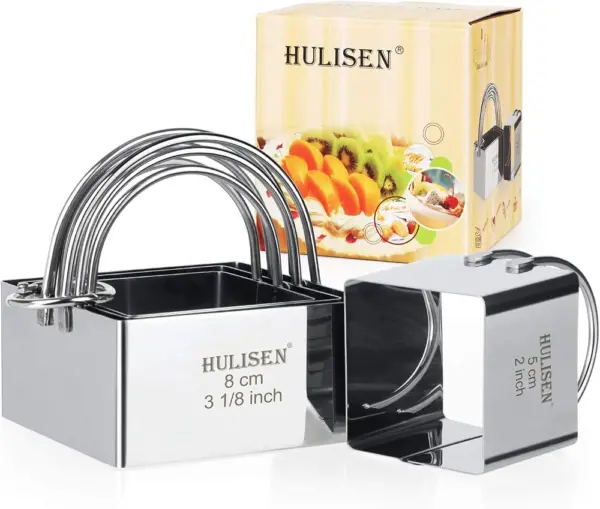
Best for Everyday Biscuits
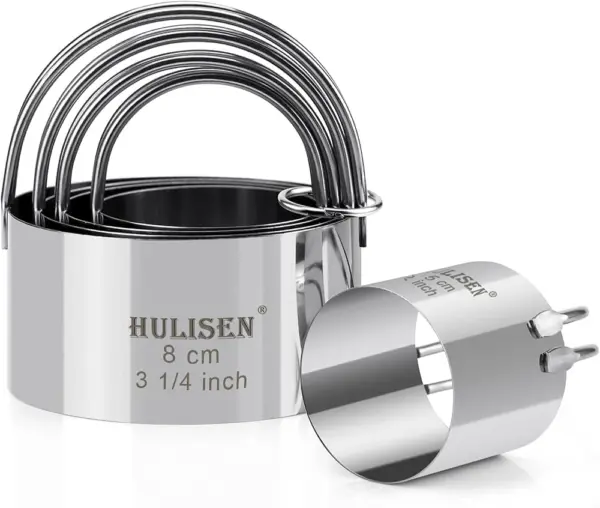
HULISEN 5-Piece Biscuit Cutter Set
Key Features
- Sizes: 1 3/4, 2, 2 1/4, 2 3/4, 3 1/4 in
- Handle: Arched
- Material: Stainless steel
- Marked sizes: Etched inches and centimeters
- Price: Midrange
Each ring in this set carries its diameter stamped into the outside — 1 3/4, 2, 2 1/4, 2 3/4, and 3 1/4 inches, written in both inches and centimeters. That sounds like a small thing, and it stops being small the third time you’re standing at the counter holding two rings that look identical. With these, the ring you used last batch is the ring you grab this batch, and a recipe that specifies a 2-inch cutter stops being guesswork.
The arched handle is the reason this set takes the top spot. It bridges the ring instead of sitting off to one side, so your palm lands over the center of the circle and the pressure travels straight down through the walls. That’s the whole trick with biscuits: a level push shears the layers cleanly and the dough lifts as one cylinder, while a crooked press gives you a biscuit that rises lopsided. The rim is rolled where your fingers sit and thin where it meets the dough, so there’s nothing sharp to press against and nothing thick crushing the edges shut.
The steel is polished stainless, dishwasher safe, and stiff enough that the rings come out of the wash still circular. That last part is what we care about most in a cutter. A ring that has gone slightly oval is why a batch of biscuits comes out with a couple of odd-shaped ones in the middle of the pan, and it’s a slow, silent failure — nothing breaks, the cutter just stops being a circle.
Size is the limitation. Three and a quarter inches makes a good sandwich biscuit and a generous shortcake, but there’s nothing here for cathead biscuits or a hand pie — the M JINGMEI set in this guide goes to 5 inches for that. For the rounds most of us cut on a Saturday morning, this is the best balance of marked sizes, grip, and wall stiffness in the group.
Pros
- Sizes etched in inches and centimeters
- Arched handle centers your press
- Five diameters from 1 3/4 to 3 1/4 inches
- Polished stainless steel, dishwasher safe
Cons
- No ring larger than 3 1/4 inches
We recommend the HULISEN to anyone who bakes biscuits more than twice a year: marked sizes, even pressure, and steel that stays round.
Best for Widest Size Range
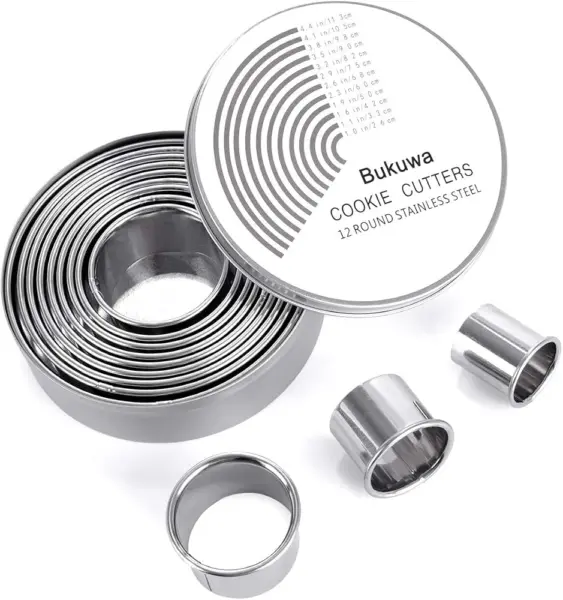
Bukuwa 12-Piece Round Cutter Set
Key Features
- Sizes: 1 to 4.4 in
- Pieces: 12
- Storage: Metal tin
- Material: 18/8 stainless steel
- Price: Budget
Twelve rings nested inside a small metal tin, running from a 1-inch circle up to 4.4 inches. The tin matters more than it sounds. Loose rings in a drawer get knocked against each other and go out of round, and once a ring is oval it cuts ovals — the tin is the storage that keeps the set accurate.
What the range buys you is not having to buy again. The little rings do donut holes, egg-in-toast, and the center cut of a tart; the 3-inch sizes handle standard biscuits and scones; the 4.4-inch ring makes a biscuit wide enough to split for a sandwich. Cutting three sizes out of one batch of dough, for a plate of mixed rounds, is exactly the job a twelve-ring set does and a five-ring set can’t.
The steel is 18/8 stainless, dishwasher safe, and rated oven safe to 500°F, so a ring can go around a biscuit and travel into the oven with it. The walls are thinner than the handled sets we recommend, and thin rings bend if you lean on one edge of the rim. Ours stay in the tin between batches, which is the habit that keeps them cutting true, and we haven’t had one go oval yet.
Pros
- Twelve sizes from 1 to 4.4 inches
- Metal tin keeps the set nested and round
- 18/8 stainless, dishwasher safe, oven safe to 500°F
Cons
- Thin walls can bend if pressed hard
Twelve rings from 1 to 4.4 inches in a tin: the widest range here, and our pick if you want every diameter on hand.
Best for Budget Handled Set
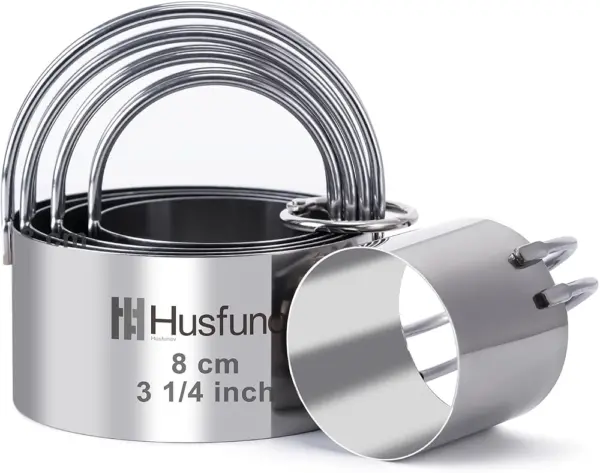
Husfunov 5-Piece Biscuit Cutter Set
Key Features
- Care: Hand wash only
- Sizes: 1 3/4 to 3 1/4 in
- Height: 1 3/4 in
- Pieces: 5
- Price: Budget
Same five diameters as our top pick — 1 3/4 through 3 1/4 inches — and the same arched handle bridging the ring, at the lowest price of any handled set here. What’s missing is the etched measurement on the side, so you’re back to holding two rings up against the light to tell them apart.
The rest of the build holds up. The handle is soldered to the ring rather than stamped from one piece, with the joints reinforced, and the cylinder stands 1 3/4 inches deep — enough depth to cut a thick, high-rising dough without the rim disappearing into it. In the hand the set feels like the more expensive one; the difference shows up in the finish rather than the build.
Where it lands for us: this is the set for a household that wants handles without paying for marked steel. The five diameters cover the same rounds as our top pick, the depth handles a thick dough, and the joints where a handle meets a ring — the place a cheap handled cutter gives out — are reinforced rather than spot-welded. If picking the right ring by eye is fine with you, these do the job for less.
Pros
- Same five diameters as our top pick
- Arched handles on reinforced solder joints
- Lowest price of the handled sets here
Cons
- Listed as hand wash only
If the marked sizes don’t matter, buy this one instead of our top pick: the same five diameters and grip for a good deal less.
Best for Jumbo Biscuits
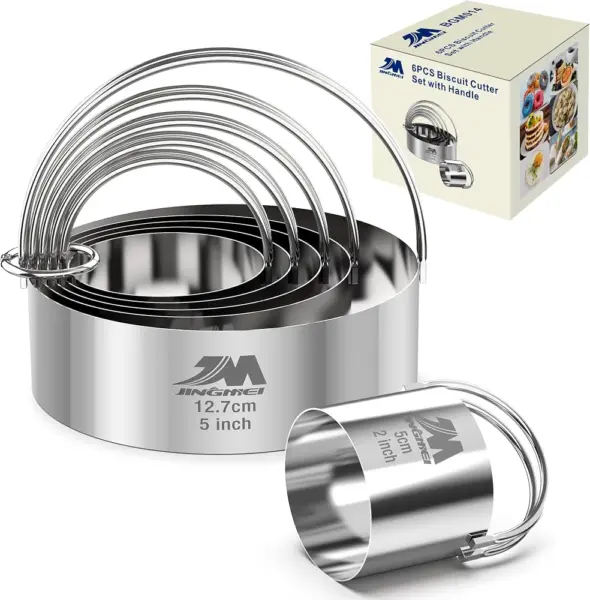
M JINGMEI 6-Piece Biscuit Cutter Set
Key Features
- Sizes: 2, 2 1/2, 3, 3 1/2, 4, 5 in
- Handle: Arched
- Pieces: 6
- Markings: Engraved inches and centimeters
- Price: Midrange
A 5-inch ring is a different tool from a 3-inch one. It’s the size for cathead biscuits, for a turnover or empanada that has to hold a filling, and for a shortcake wide enough to split and layer. Six sizes here — 2, 2 1/2, 3, 3 1/2, 4, and 5 inches — and the top end is why this set stays on our list at all, since nothing else in this guide reaches it.
The sizes are engraved on each ring in inches and centimeters, the handles are arched over the top, and the whole set nests into a stack that takes less room than six separate rings would suggest. Cutting with these is uneventful in the way you want: the rim is thin, the handle puts your palm over the middle of the circle, and a 3-inch ring pushed through stiff, cold dough goes where you aim it.
Weight is the trade — the set runs about 0.48 kg, heavier than anything else here, and most of that sits in the diameters where you want it. The largest ring is also the one that can warp if you lever it out of the dough by the handle instead of lifting straight, so press flat, lift up, and rock a stuck ring gently rather than pulling on it.
Pros
- Rings up to 5 inches
- Sizes engraved in inches and centimeters
- Nesting design with dishwasher-safe steel
Cons
- Heavier and bulkier than the smaller sets
For big, craggy biscuits and hand pies, this is the set we hand people: six rings up to 5 inches, sizes engraved where you can read them.
Best for Sandwich Biscuits
HULISEN Square Biscuit Cutter Set
Key Features
- Shape: Square
- Sizes: 2, 2.36, 2.8, 3.12 in
- Pieces: 4
- Material: Stainless steel
- Price: Midrange
Square rings solve a problem round ones create. Every circle leaves a scrap between cuts, and scraps get pressed together and re-rolled into a tougher biscuit; squares tile the sheet, so the same dough yields more biscuits with less handling. They also do jobs a round ring can’t — sandwich biscuits that stack flush, brownies and bars cut to one size, shortbread that fits a tin without gaps.
Four sizes: 2, 2.36, 2.8, and 3.12 inches, marked in inches and centimeters, with the same arched handle and ring clip as the round HULISEN set we recommend. Corners are harder to weld cleanly than a circle, and the corners are the first place a cheap square cutter rounds over. These hold theirs, and the shape stays square through repeated pressing, which is the whole point of buying a square set.
Two limits worth naming. There’s no size above 3.12 inches, so this is a sandwich-biscuit and bar-cookie set rather than a jumbo-biscuit one. And if most of your baking is round — biscuits, scones, donut rings — the shape is simply the wrong tool; start with a round set and add these when the square jobs show up.
Pros
- Squares tile dough with less waste
- Marked in inches and centimeters
- Sturdy corners that stay square
- Ring clip keeps the four together
Cons
- Only four sizes, topping out at 3.12 inches
Square biscuits, brownies cut to a matched size, and no scraps between rounds — we like these for baking that outgrew the circle.
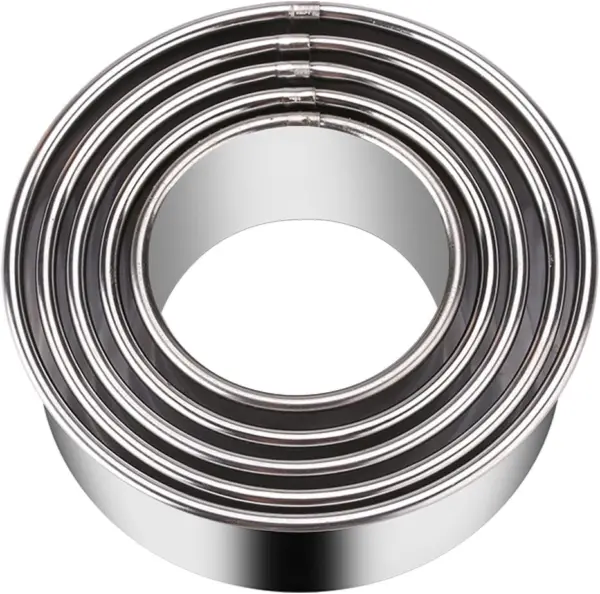
Best for Shallow Drawers
KSPOWWIN 5-Piece Biscuit Cutter Set
Key Features
- Care: Dishwasher safe
- Shape: Round
- Pieces: 5
- Material: Stainless steel
- Price: Budget
No handles, and that’s the entire argument. Five plain rings with rolled top edges stack down to almost nothing in a drawer, which is more than any handled set here can promise. The trade-off is pressure: with no handle to spread your palm, the force goes through the rim under your fingers, and a double batch of biscuits is noticeably more work than it is with a gripped cutter.
Otherwise these behave like good plain rings. The stainless is polished and dishwasher safe, the top edge is rolled so the pressing edge doesn’t bite, and the rim is thin enough that dough separates cleanly instead of being crushed shut. The five diameters graduate sensibly, and they nest into each other so the whole set takes up the footprint of the largest ring.
The place to be careful is the steel. Rings this thin can bend out of round, and once a ring is oval it cuts ovals; ours stay nested in their box rather than loose in a drawer with the spatulas. As a second set for small batches, or for a kitchen where drawer space decides what you own, they earn their spot. For weekly biscuits by the dozen, we prefer a handle under the palm.
Pros
- Nests flat in a shallow drawer
- Rolled top edges protect fingers
- Dishwasher-safe polished stainless
Cons
Flat, handle-free rings that nest in a shallow drawer and still cut clean circles — the one we reach for in a small kitchen.
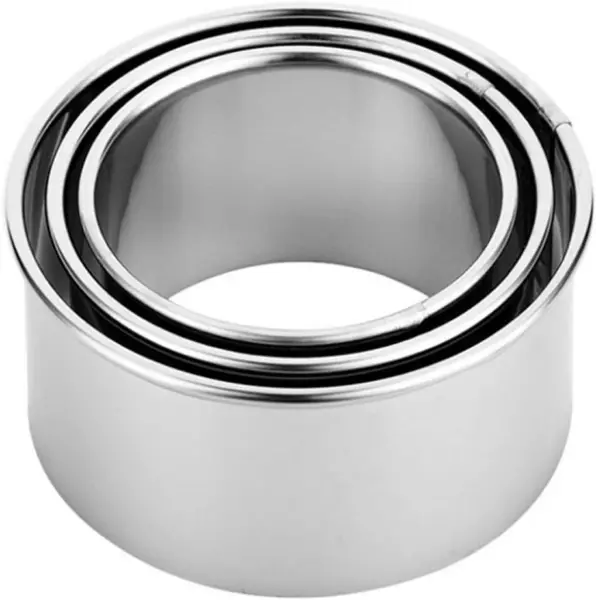
Best for First Set
ZDHSOY 3-Piece Biscuit Cutter Set
Key Features
- Sizes: 2.4, 2.8, 3.2 in
- Height: 1.4 in
- Pieces: 3
- Material: 304 stainless steel
- Price: Budget
Three rings — 2.4, 2.8, and 3.2 inches — in a small box, with 1.4 inches of depth. For someone who makes biscuits a handful of times a year, that’s the honest answer to the question. These are the diameters most recipes mean when they say to cut into rounds, and there’s nothing else in the box to figure out.
The steel is 304 stainless, the top edges are rolled, and the set is dishwasher safe. Cutting with them is unremarkable in the best way: a thin rim, a clean circle, a light tap on the counter to release the dough. They arrive in their own little box, which is the storage solved before you’ve thought about it.
The build is the compromise. Three rings at this weight feel light in the hand, and light rings dent when they’re stored loose or pressed hard on one edge. The box helps; keeping them in it is the difference between a set that lasts several seasons and one that goes oval in a drawer.
Small footprint, small commitment — that’s the case for these. If you already know you’ll bake through the winter, the twelve rings in the Bukuwa tin cover far more ground for a little more money. As a first set, or a set to leave at a rental, three rings and a box is plenty.
Pros
- Three standard biscuit diameters
- Dishwasher-safe 304 stainless steel
- Small box keeps the set together
Cons
- Not enough sizes for regular, varied baking
We keep this one on the list for occasional bakers: three standard diameters, a small box, and nothing to figure out.
How We Tested the Biscuit Cutters
We started by gathering every stainless steel biscuit cutter set with a substantial review history, then trimmed the pool to sets that offered genuinely distinct diameters instead of near-duplicates, that had straight walls and a thin cutting edge, and that sat in a reasonable range on price. That left 16 sets, which we used over four months in home kitchens.
Testing looked a lot like Saturday morning baking. We rolled chilled butter dough to a half inch, pressed each cutter down once without twisting, and lifted to see whether the biscuit came up inside the ring or stayed put on the counter. We counted how many presses it took before a cutter needed a dip in flour, and we compared how the dough released on the twentieth cut with how it behaved on the first.
Nothing on the packaging went unchecked. We measured every etched or stamped size against a ruler to see how close it landed, stacked each set in a drawer to judge whether the handle got in the way of nesting, and pressed down with the flat of a hand to check knuckle clearance and whether the grip dug into a palm after a dozen biscuits. Each set went through repeated dishwasher cycles so we could watch the seams for rust and the cutting edge for dulling.
Because value came up in nearly every review we read, we also counted the sizes we actually reached for. A 12-piece set with three useful diameters is worse value than a five-piece set where every ring earns a spot, and we judged the sets that way.
How to Choose Biscuit Cutters
A biscuit cutter only has one job — shear straight down through layered dough without sealing the edges — and nearly every difference between a set you keep and one you resent comes back to how well it does that.
What a Clean Cut Actually Requires
A sharp, thin rim slices through the butter layers; a thick or dull one presses them shut, and pressed-shut edges are why a biscuit climbs in the middle and stays flat at the sides. Press down once and lift straight up. Twisting the cutter seals the edges you just cut and gives you a lopsided biscuit, which is a fault of technique, not of the dough.
If the dough sticks, flour the rim of the cutter rather than the counter. Extra bench flour works into the scraps you re-roll and makes the second round of biscuits tougher than the first — the opposite of what you were trying to save.
Diameters, and Why Marked Sizes Pay Off
Two to two and a half inches is the everyday biscuit. Three inches and up makes a sandwich biscuit or a shortcake, and an inch to an inch and a half covers donut holes, small tarts, and the hole in egg-in-toast. Marked diameters save you from holding two rings up to the light at the exact moment your hands are covered in flour.
If you bake one recipe over and over, three fixed rings are plenty. If your baking is a spread — biscuits, scones, cookies, pastry — a graduated set covers more ground than buying singles one at a time; the Bukuwa tin spans 1 to 4.4 inches in one purchase, and the wider you go, the more often you’ll find a use for the odd sizes.
Handles or Flat Rings
A handle spreads your palm across the top of the ring, so the pressure travels down evenly and lifting off the dough is easier on your fingers. That’s a real advantage over a full batch, and more so with stiff, cold dough that fights back. The cost is height: handled sets don’t nest flat in a shallow drawer and they take up more room in a crock.
Flat rings win on storage and lose on comfort. Buy handles if biscuits are a weekend habit, buy flat rings if drawer space is the constraint or the cutters live loose with the spatulas. Both cut the same circle, so this is a storage decision as much as a baking one.
Steel, Depth, and Keeping Them Round
Thin steel is the quiet failure in this category. A ring that has been knocked out of round cuts ovals, and nothing about it looks broken — you just get a few misshapen biscuits in the middle of the pan. Buy the stiffest wall your budget allows and store the set nested or in its tin rather than loose in a drawer.
Depth matters less than diameter, but it isn’t nothing: 1 1/4 to 1 3/4 inches handles a standard biscuit, and the deeper rings are the ones to reach for when the dough is thick and rising high. And if your baking runs to sandwich biscuits, brownies, or bars, square rings tile a sheet of dough with almost no scrap between cuts, which is a different argument from anything a round set can make.
Frequently Asked Questions
Can biscuit cutters go in the dishwasher?
Most of the sets here can, including our top pick. The exception among these picks is the Husfunov set, which the maker lists as hand wash only. Whatever the label says, dry the rings before they go back into a drawer or a closed tin — stainless left damp and stacked is where spotting starts.
Can I cut biscuits with a drinking glass?
You can, and plenty of kitchens have, but a glass rim is thick and blunt. It presses the layers shut instead of slicing them, so the biscuits rise less and unevenly. If a glass is all you have, flour the rim and press down once without rocking; a thin-rimmed cutter gives you a taller biscuit from the same dough.
Is a biscuit cutter the same as a cookie cutter?
Practically, yes: both are rings that cut rolled dough, and many sets are sold under both names. The useful distinction is shape and depth. Biscuit cutters are plain rounds sold by diameter and often deeper, so they clear a thick dough; cookie cutters are usually shaped and shallower. For biscuits, buy round by diameter.
Final Verdict
Buy the HULISEN five-piece for everyday biscuits. Marked diameters and a handle that centers your press decide whether a batch comes out even, and no other set here puts both together.
If your baking runs to many sizes, the twelve-ring Bukuwa tin spans 1 to 4.4 inches in one purchase. If it runs to cathead biscuits, hand pies, or empanadas, only the M JINGMEI set reaches 5 inches.