This post contains affiliate links. We may earn a small commission when you buy through our links — at no extra cost to you.
A kitchen sink is the one purchase in a remodel you can’t easily undo. The counter gets cut to fit it, and then you live with that decision for a decade. So the questions worth asking aren’t about style — they’re whether the steel hazes over after a year of scrubbing, whether water runs to the drain or pools in the corners, and whether the bowl is deep enough for a stockpot yet still fits the cabinet you have.
Mounting style drives most of that. An undermount gives a clean sweep from counter into bowl, a drop-in is far friendlier to a weekend install, and an apron-front farmhouse is the heaviest and least forgiving of the three. Plenty of sinks now also come as workstations, with a ledge that holds a cutting board or roll-up rack over the bowl — useful, though the ledge eats usable depth and traps crumbs.
We’ve spent six months installing and living with 12 of them, from thin stamped bowls to 16-gauge stainless and fireclay. Here are the ones we’d put in our own kitchens.
Best for Double-Bowl Flexibility
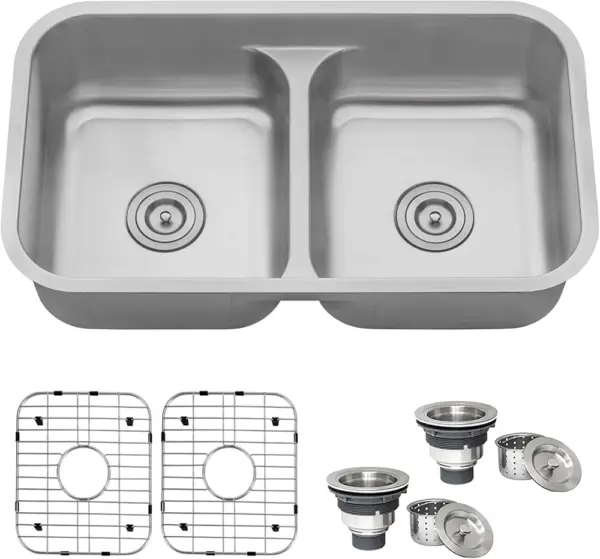
Ruvati RVM4350 Low-Divide Double Bowl
Key Features
- Bowl depth: 8-1/2"
- Installation: Undermount
- Exterior size: 32-1/4" W x 18-7/8" D
- Minimum cabinet: 36"
- Price: Midrange
The divider in this Ruvati sits three inches below the rim, which sounds like a small thing until you lay a half-sheet pan across both bowls and it drops in flat. That is the choice most double sinks force on you, two basins or room for the big stuff, and this one refuses to make it. Each side runs 14-1/2 by 16-7/8 inches, wide enough for a dinner plate to sit level, and the low saddle lets a roasting pan bridge the gap instead of wedging against a wall of steel.
We think it is the best all-around sink in this group because it gets the fundamentals right without charging extra for them. Sixteen-gauge T-304 steel, a brushed finish that softens everyday scuffs, sound-deadening pads underneath, and a box with two stainless rinse grids and two basket strainers rather than one of each. At 32-1/4 inches wide it needs a 36-inch cabinet, and the cutout template and mounting clips come with it.
The compromise is individual bowl size. A stockpot rides across the saddle rather than down inside one side, which is fine for washing but awkward if you want to soak something tall while the other bowl is full. That is the trade for having two basins at all, and it is one we make happily. If you never use a second basin, the 33-inch RVH7433 gives you one uninterrupted floor instead.
Pros
- Low divider fits sheet pans and stockpots
- 16-gauge T-304 steel at a midrange price
- Two grids and two strainers included
- Curved bottom and brushed finish wipe clean
Cons
- Bowls run 8-1/2 inches deep, the shallowest here
The sink we recommend to most people: two basins for the dishes, a low divider that still takes a sheet pan, and 16-gauge steel with grids and strainers included.
Best for Counter-Saving Prep
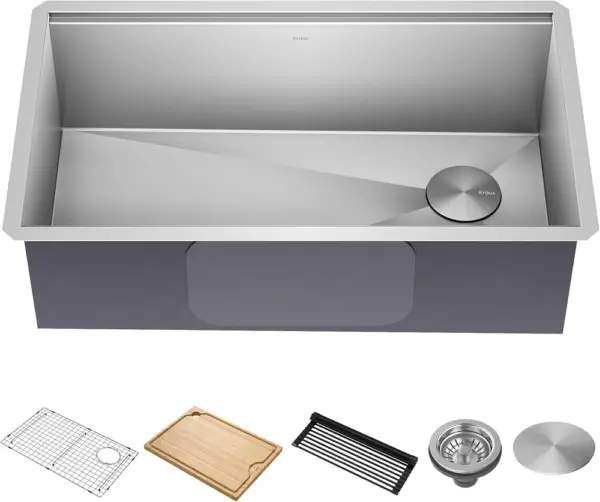
Kraus KWU110-32 Workstation Sink
Key Features
- Bowl size: 30" L x 16" W x 10" D
- Installation: Undermount
- Exterior size: 32" L x 19" W
- Minimum cabinet: 36"
- Price: Premium
A bamboo cutting board that slides over the basin is the whole reason to buy a workstation sink, and Kraus includes one here along with a roll-up drying rack, a bottom grid, a strainer, and a drain cover. We are sold on what that does to a tight kitchen: prep happens over the sink, so the counter stays clear for the plate you are actually building.
Underneath the accessories it is a serious 16-gauge sink. TRU16 steel, a 30-by-16-by-10-inch basin inside a 32-by-19-inch footprint, and NoiseDefend padding that takes the ring out of a dropped pan. It needs a 36-inch cabinet, mounts under the counter, and carries a lifetime warranty.
The ledge design costs you something. The 32-inch exterior gives up two inches of interior width to the tracks, and the board, rack, and grid all need a home when they are not in the sink. If you will not chop over the basin most nights, you are paying for a feature you will store in a closet.
Pros
- Chef’s kit includes board, rack, grid, strainer
- 10-inch basin swallows stockpots
- Prep moves off a crowded counter
Cons
- Satin finish shows scratches
- Water can pool before it reaches the drain
We think it earns its price if you will use the cutting board and rack most nights, because the basin underneath is big, quiet, and ready for a stockpot.
Best for Big Single Bowl
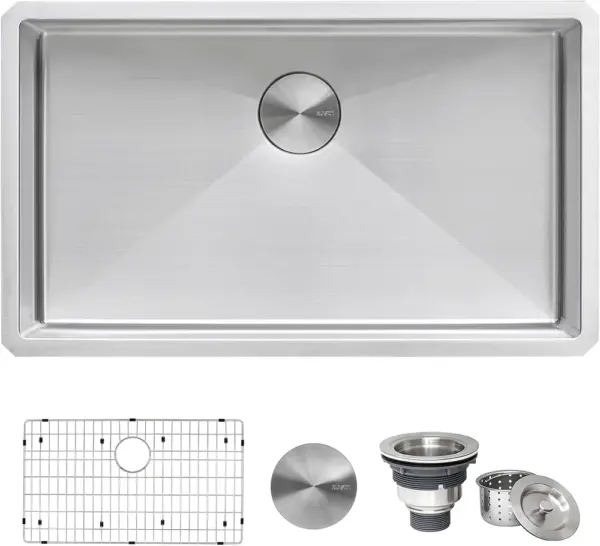
Ruvati RVH7433 Single Bowl
Key Features
- Material: 16-gauge T-304 stainless
- Bowl depth: 10"
- Installation: Undermount
- Minimum cabinet: 36"
- Price: Premium
Thirty-three inches wide, nineteen front to back, ten deep. Those dimensions do most of the persuading: a half-sheet pan lies flat on the bottom, a stockpot sits below the rim, and there is no divider to scrape around when you are washing a roasting pan.
The corners are the detail we appreciate most. They are tight enough to look modern against a straight run of countertop, but rounded enough that a sponge follows them instead of catching. Sixteen-gauge T-304 steel, a brushed finish, a rinse grid, a basket strainer, a decorative drain cover, the template, and the mounting clips all come in the box, and the sink needs a 36-inch cabinet.
This is the one for a cook who would rather have one big basin than two small ones, and who does not need the sink to double as a prep station. The brushed steel will collect fine scratches with daily use; keep the included grid in the bottom and let it take the wear instead of the basin floor. If you want to soak a pot while you rinse vegetables, the low-divide RVM4350 does that without giving up the room.
Pros
- Wide, deep single basin takes sheet pans
- Rounded tight-radius corners wipe clean
- Grid, strainer, and drain cover included
Cons
- Modest bottom slope leaves water standing
For anyone who cooks in volume and wants one uninterrupted basin, this is the pick: deep, quiet, and wide enough to lay a sheet pan flat.
Best for Small Kitchens
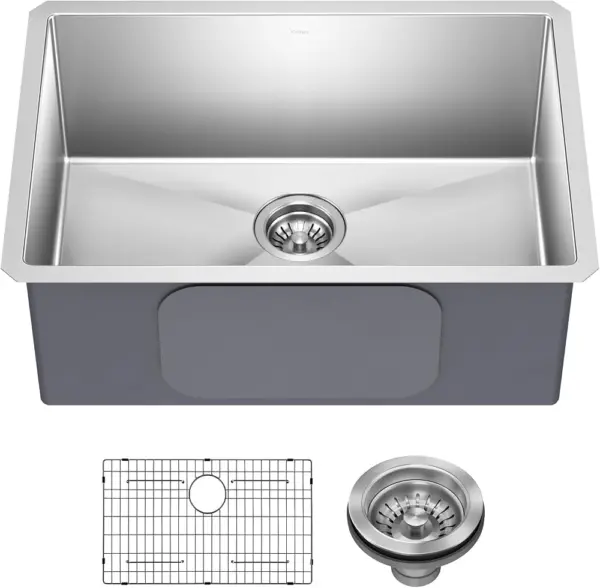
Kraus KHU100-26 Undermount Sink
Key Features
- Bowl depth: 10-3/8"
- Installation: Undermount
- Exterior size: 26" L x 18" W
- Minimum cabinet: 30"
- Price: Premium
Thirty inches of cabinet is all this Kraus asks for, and we think that is the number that matters. It still gives you a 26-by-18-inch basin that is 10-3/8 inches deep, the same depth as sinks a third wider. In a galley kitchen, a condo, or the narrow base of an island, that is the difference between a real sink and a bar sink pretending.
Sixteen-gauge T-304 steel, a commercial satin finish, sound pads covering more than 80 percent of the shell, and 21.9 pounds, light enough that one person can hold it in place while the other sets the clips. The box includes a stainless bottom grid, a three-piece basket strainer set, a towel, mounting hardware, and the cutout template.
What it does not do is take a full-size sheet pan, which is a job for the 33-inch Ruvati; a half-sheet pan still fits. The deep bowl also hides a sinkful of dishes from the doorway, which is either the point or the problem depending on your household.
Pros
- Fits a 30-inch cabinet
- 10-3/8-inch bowl hides a sinkful of dishes
- Grid, strainer set, and towel included
Cons
- Can show rust spots if the basin stays wet
Our choice for a 30-inch cabinet: a genuinely deep single bowl, well padded, with the grid and strainer already in the box.
Best for Farmhouse Look
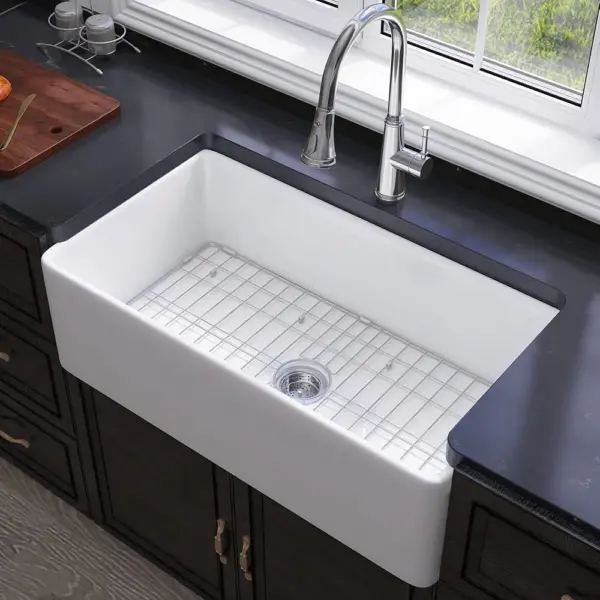
Miuara 33-Inch Fireclay Farmhouse Sink
Key Features
- Material: Glossy white fireclay
- Bowl depth: 9"
- Installation: Farmhouse apron front
- Minimum cabinet: 32.5"
- Price: Midrange
The apron is the whole point, and this one is a glossy, bright white that reads as more expensive than it is against a dark cabinet run. The fireclay body can be fitted as a proud farmhouse front or as an undermount, and the basin inside measures 31-1/4 by 16-1/2 inches with 9 inches of depth.
It is fired above 2,600 degrees for 26 hours, which is what gives fireclay its heat and stain resistance, and the flat floor slopes gently to a center drain so water does not argue on the way out. A stainless grid and a drain assembly come with it. At 73 pounds, plan on two people and a dry fit before anyone reaches for adhesive.
We think it is the best way into the farmhouse look in this group. The practical trade is the finish: a white glaze shows every water spot, and a pan dragged across it will leave a mark, so the grid stays in the bottom. Give the install a full day, and have the cabinet opening sorted before the sink arrives on the porch.
Pros
- Glossy white apron front with a versatile body
- Fireclay resists heat and staining
- Grid and drain included
Cons
- No cutout template in the box
- Three-year warranty, not lifetime
If the farmhouse look is the goal, we point you here: a glossy fireclay apron at a midrange price, as long as your installer will work without a template.
Best for Budget Drop-In
VEVOR 33-Inch Drop-In Workstation
Key Features
- Material: 304 stainless steel
- Bowl depth: 9"
- Installation: Drop-in
- Exterior size: 33" W x 22" D
- Price: Budget
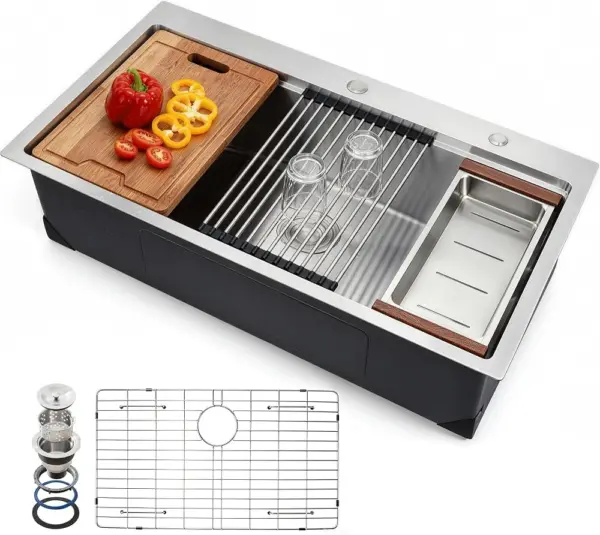
This is the least expensive full-size sink here, and it is the one that asks the least of your kitchen: no countertop work beyond the existing opening, no clips under the deck, no fabricator. A 33-by-22-inch top-mount covers the cut edge and seals to the counter with a bead of silicone.
The basin inside is 32 by 21 inches, with a sloped floor and an X-groove pushing water toward the drain, plus sound pads and an anti-condensation coating on the underside. At 31.8 pounds it is heavy enough to feel solid when you set it in the opening, and the 3mm rim does not flex under a hand.
The catch with any top-mount is the rim. Crumbs and water stop at the edge instead of wiping into the basin, and the silicone line needs redoing every few years. That is the trade for not cutting stone, and it is a trade we make willingly on laminate or butcher block.
Where it earns a place is the combination of a real 32-inch basin and a price that leaves room for a better faucet, the part of the setup you touch every day. It is the sink we recommend when the countertops are staying put and the budget has to stretch across the rest of the project.
Pros
- Cheapest full-size sink here
- Drops into an existing opening
- 32-by-21-inch basin with grooved floor
Cons
- Nine-inch basin is shallower than the undermounts here
The budget move that does not feel like one: a full-size top-mount with a big basin for a countertop you are not replacing.
Best for Deep Drop-In
Lordear 33-Inch Drop-In Workstation
Key Features
- Material: 16-gauge T-304 stainless
- Bowl depth: 10"
- Installation: Drop-in
- Minimum cabinet: 36"
- Price: Midrange
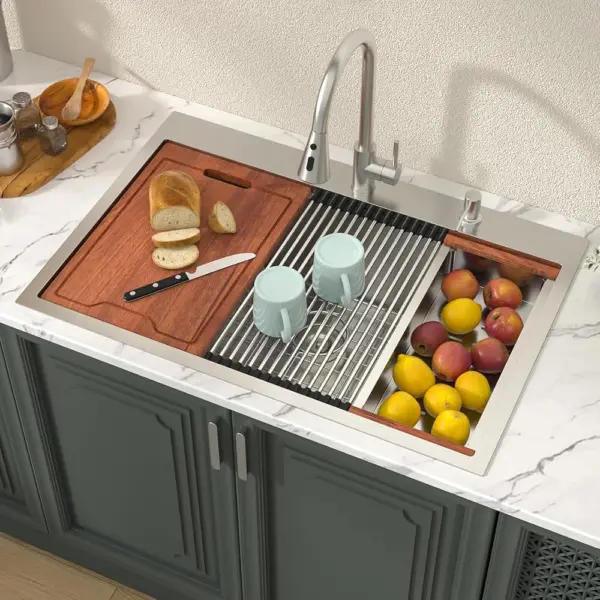
If nine inches of depth feels like a compromise, the Lordear adds an inch and a 16-gauge body to the drop-in formula. Same 33-by-22 footprint, same sit-on-top installation, one more inch of basin between your hands and the bottom.
We rate it above the VEVOR on materials and below it on value. Sixteen-gauge T-304 steel, a 10-inch basin, sound-deadening pads, and an accessory set that covers a colander, a roll-up rack, a bottom grid, a cutting board, and a drain assembly with clips and a template. Thirty pounds of sink that needs a 36-inch cabinet.
The ledges run front and back, so the board and colander slide along them instead of sitting on the counter, which is the same counter-space trick the Kraus plays with a different kit. Deep basins and top-mount installation do not always come together at this level, and that is the specific reason to look here rather than at the cheaper drop-in.
Pros
- 10-inch basin in a 33-inch top-mount
- 16-gauge T-304 body
- Colander, board, rack, grid, and drain included
Cons
We recommend it over the cheaper drop-in when you want undermount depth without cutting stone: 16-gauge steel, a 10-inch basin, and a full accessory kit.
Best for Black Finish
VAPSINT 33-Inch Black Drop-In
Key Features
- Finish: Gunmetal black PVD
- Bowl depth: 9"
- Installation: Drop-in
- Exterior size: 33" W x 22" D
- Price: Midrange
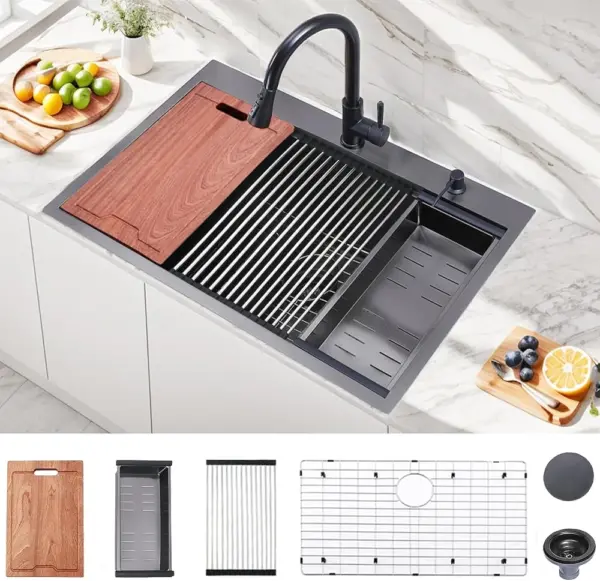
Almost every sink on this page is silver. This one is gunmetal black, a PVD finish bonded to stainless rather than painted on, and it changes the look of a kitchen more than any other upgrade here for the money.
The rest is a competent drop-in: 33 by 22 inches, a rear drain with an X-groove floor, 3mm sound pads, and an anti-condensation coating. The 3.5-inch drain opening takes a standard disposal, and the box includes a cutting board, a roll-up drying rack, a bottom grid, and a strainer.
One listing detail to ignore: the base width is given as 22 inches, which is the sink’s depth, not the cabinet it needs. Measure your cabinet against the 33-by-22 exterior before you order. And because it is a top-mount, it sits on the deck and seals with silicone, so there are no clips and no countertop removal.
The finish is the reason to buy this one, and we think it holds up its end: bonded rather than painted, even around the rim, and dark enough to read as black beside stainless appliances. Five years of warranty and a full accessory kit make it a fair package, as long as the look is the reason you are buying.
Pros
- Gunmetal black PVD finish
- Rear drain with a grooved floor
- Board, rack, grid, and strainer included
Cons
- Lightest of the drop-ins here at 18.7 pounds
Buy it for the finish, a bonded gunmetal black that reads modern against stainless, in a drop-in that installs over the existing opening.
How We Tested a Dozen Kitchen Sinks
The shortlist started with the constraints that actually limit a purchase — bowl dimensions, gauge, mounting style — and anything that wouldn’t fit a standard 33-inch base cabinet came off the list. That left 12 sinks across all three mounting styles, from thin stamped steel to hand-welded 16-gauge and fireclay. We spent six months with them, and every one went into a working kitchen rather than a showroom.
Before install, each sink went on a shipping scale; the difference between a stamped bowl and a hand-welded 16-gauge one is obvious the moment you lift it. We then measured true bowl width and depth against the listing instead of trusting the spec sheet, and filled each one with a stockpot and a half-sheet pan to see what actually fit under the faucet. After that came weeks of ordinary cooking — chili in a stockpot, a skillet set down wet, a sheet pan rinsed and left to drip.
Scratch resistance got its own pass: we scraped the bottom with a metal spatula and dragged a dry cast-iron skillet across it, then checked for haze in daylight and for water spots after a wipe-down. For rust, a wet steel-wool pad sat in the bowl overnight, and we looked for orange staining the next morning. Drainage was a quart of soapy water and a stopwatch — did it sheet toward the drain and leave the bottom dry, or stand in the low corners? We also noted where each drain sat and worked every included accessory on the ledge under running water, keeping track of which ones trapped crumbs and which boxes came with the strainer, rack, and cutting board included.
How to Choose a Kitchen Sink
Your countertop narrows the field faster than any feature list, so start there and work inward toward the basin you actually want to wash in.
Let the Countertop Pick the Installation Type
An undermount sink disappears below the counter and lets you wipe crumbs straight into the basin, but it needs a solid-surface, quartz, or stone top that a fabricator can cut and polish. If you are replacing a top-mount, that usually means new counters. A top-mount, or drop-in, sits on the deck and covers the cut edge, so it works with laminate and butcher block and can be a same-day swap when the opening matches.
A farmhouse apron adds a third requirement: a cabinet built or cut to accept the front, plus an installer willing to work from the sink itself. None of the three is better in the abstract; the counter decides, and everything else follows.
Measure the Cabinet, Then the Cutout
Check the inside width of the cabinet box, not the size of the old sink. The compact Kraus needs 30 inches, the 32- and 33-inch sinks here want 36, and the fireclay farmhouse sits on a 32.5-inch base. Exterior dimensions are not cutout dimensions, because the rim or the clips need material to sit on.
If the counters are staying, measure the existing opening and shop for a sink that covers it. Changing the size of the hole almost always means re-cutting the counter, which is the moment a simple swap turns into a project.
Pick the Bowl Layout You Will Work In
A 30- to 33-inch single bowl takes a half-sheet pan flat and gives a stockpot somewhere to sit. A double bowl gives you washing and rinsing at once, but pushes big items up over a divider. A low divide, like the Ruvati RVM4350, does both, which is why it anchors this guide.
A workstation sink adds sliding boards and racks over the basin. That buys counter space in a small kitchen and costs interior width, plus a home for the accessories when they are not in use. If you hand-wash, a low divide is the most forgiving; if you cook in volume, go single and wide.
Know What Gauge and Glaze Actually Buy
Sixteen-gauge stainless is thicker, quieter, and harder to dent than 18-gauge. Finish matters just as much: brushed and satin surfaces soften the scratches every stainless sink collects, while polished and dark finishes put them on display. No stainless basin here is scratch-proof, which is why each one ships with a bottom grid. Keep it in.
Fireclay buys a glossy white apron that shrugs off heat and stains, at 73 pounds and with a three-year warranty instead of a lifetime one. Weigh that against the stainless picks before the look decides for you.
Check the Drain, the Pads, and the Box
Drain placement and slope matter more than the drain’s finish. A rear drain frees up cabinet space underneath, and a floor with a real pitch is what keeps water from parking in a corner. Sound pads matter in an open kitchen; the quieter sinks here cover most of the shell.
Read the box carefully. Grids, strainers, cutting boards, and colanders add up when bought separately, and an included set is worth real money. Check the drain too: some sinks ship with a standard drain only and expect you to reuse the disposal flange you already own.
Frequently Asked Questions
Can I install a kitchen sink myself?
A drop-in, yes, if the new sink’s exterior matches the existing opening. It sets into a bead of silicone and clips from below in an afternoon. An undermount is a fabricator’s job, because the cut has to be routed and polished in stone and the sink bonded to the underside. A 73-pound fireclay farmhouse needs two people and a cabinet front cut for the apron.
Do I need a different faucet for a deep sink?
Check two numbers before you buy: spout height above the deck and reach into the bowl. Against a 10-inch basin, a low-arc faucet leaves you rinsing at arm’s length, while a pull-down with a hose reaches the bottom and clears a stockpot. Measure your tallest pot and add a couple of inches of clearance above the rim.
How do I keep a fireclay farmhouse sink white?
Wipe it down after washing, since the glossy glaze shows water spots as it dries. Mild dish soap and a soft sponge handle food residue, and abrasive powders and steel wool dull the surface. Keep the included stainless grid in the bottom so cast iron and sheet pans never drag across the glaze.
Final Verdict
Most kitchens are best served by the Ruvati RVM4350: two basins when you want them, one long stretch of room when a sheet pan shows up, 16-gauge steel, and grids and strainers already in the box.
If counter space is the scarce resource, the Kraus KWU110-32 and its sliding cutting board earn their keep. If the countertops are staying and the budget is tight, the VEVOR drop-in covers a 32-inch opening without a fabricator.