This post contains affiliate links. We may earn a small commission when you buy through our links — at no extra cost to you.
Fresh-milled flour has a smell that’s hard to describe and hard to forget: sweet, faintly grassy, closer to a wheat field than a pantry shelf. It’s also why my sourdough stopped tasting like everyone else’s. But the gap between a mill you use every week and one that ends up at the back of a cabinet has almost nothing to do with horsepower.
We’ve spent the past eight months with 11 grain mills — electric stone, high-speed impact, hand-cranked, and a stand-mixer attachment — grinding wheat, corn, and coffee. What we learned is that heat is the quiet enemy: the fastest mills finish in seconds but warm the flour on the way, and warm flour bakes unevenly. Stone burrs are slower, but they keep things cool and even.
Noise, cleanup, and how much of the work the machine actually does for you mattered just as much as wattage, and value had little to do with price. The picks below are the ones we kept refilling, the mills that made us want to bake again.


Best for Everyday Home Flour
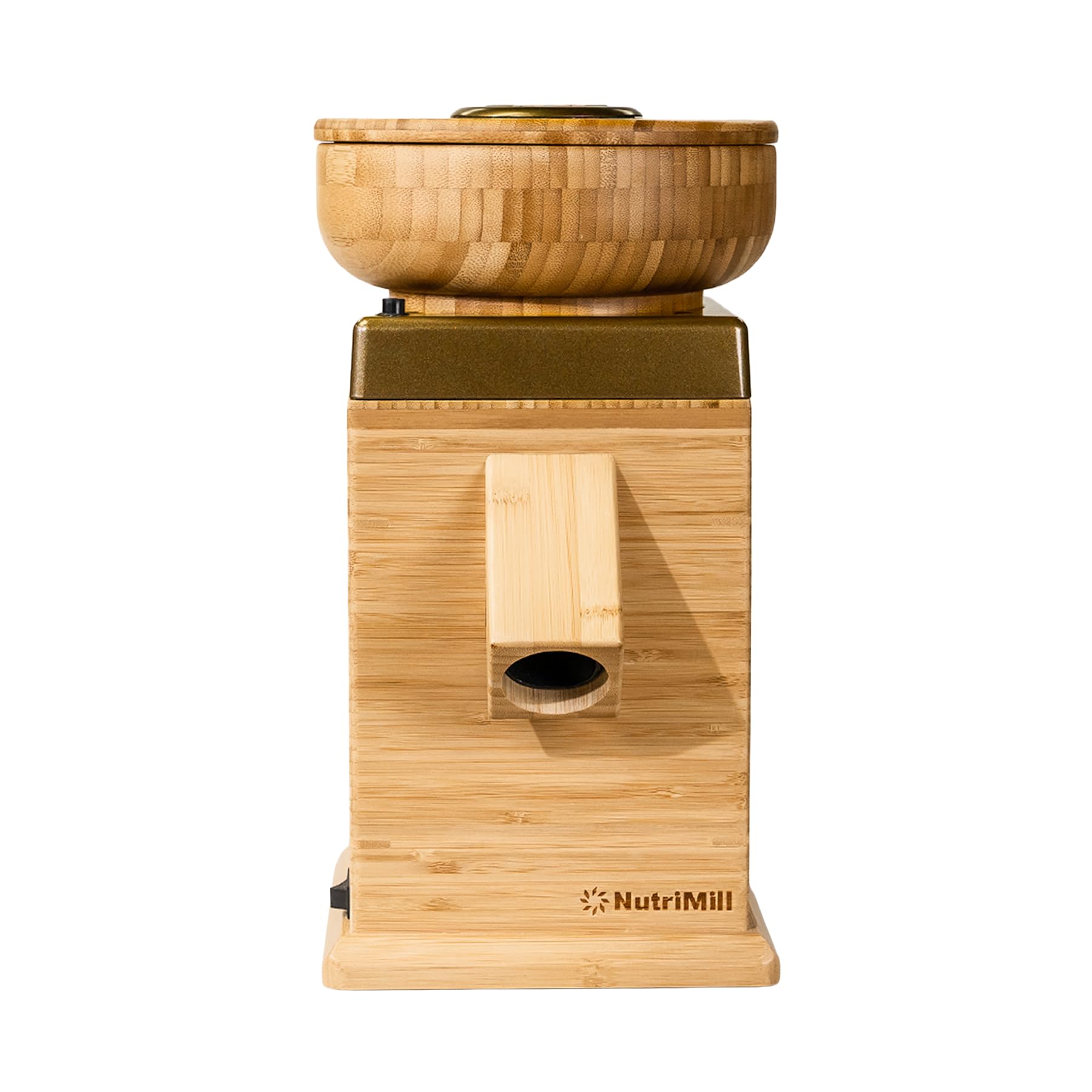
NutriMill Harvest Grain Mill
Key Features
- Motor: 450 watts
- Weight: 18.7 lb
- Capacity: 5 cups
- Milling stones: Corundum
- Price: Premium
Two corundum stones do the work here instead of steel blades or a hammering impact head, and that changes what lands in the bowl. The stones turn slowly, so a hopper of hard red wheat comes out cool rather than warm — the difference between flour that rises well and flour that has effectively been cooked once already. The 450-watt motor carries thermal shutoff, so a long session ends with a pause rather than a burnt-out winding.
The texture control knob is the part we kept coming back to. One twist takes the grind from cracked grain for cereal down to pastry flour for biscuits, and the setting holds where you leave it, so the second batch matches the first. A beginner gets a usable loaf on the first try, and that is not something we can say about every mill here.
It has two habits worth knowing. It walks: the whole machine creeps across the counter while it runs, so ours sits on a rubber mat. And it is brush-clean only — the spout empties well and a brush handles the rest, but nothing about it wants water. What you get in return is the best-looking appliance in this group, bamboo and brushed aluminum, sitting on the counter like it was meant to be there.
Thirteen inches tall and seven wide, it takes less room than a stand mixer and lives comfortably beside one. What we appreciate most is that it asks for no project: no bolting, no clamping, no assembly ritual. Fill the hopper, turn the knob, grind, brush out — which is why it is the mill we reach for on a Tuesday night rather than the one that waits for a free weekend.
Pros
- Corundum stones keep flour cool
- Texture knob spans cracked grain to pastry flour
- Brush-clean with an easy spout
- Good enough to leave on the counter
Cons
- Loud while it runs
- Five-cup capacity fills fast on baking day
For most home bakers, the Harvest is the mill to buy: corundum stones, a texture knob from cracked grain to pastry flour, and flour that never comes out warm.
Best for Big Bread Batches
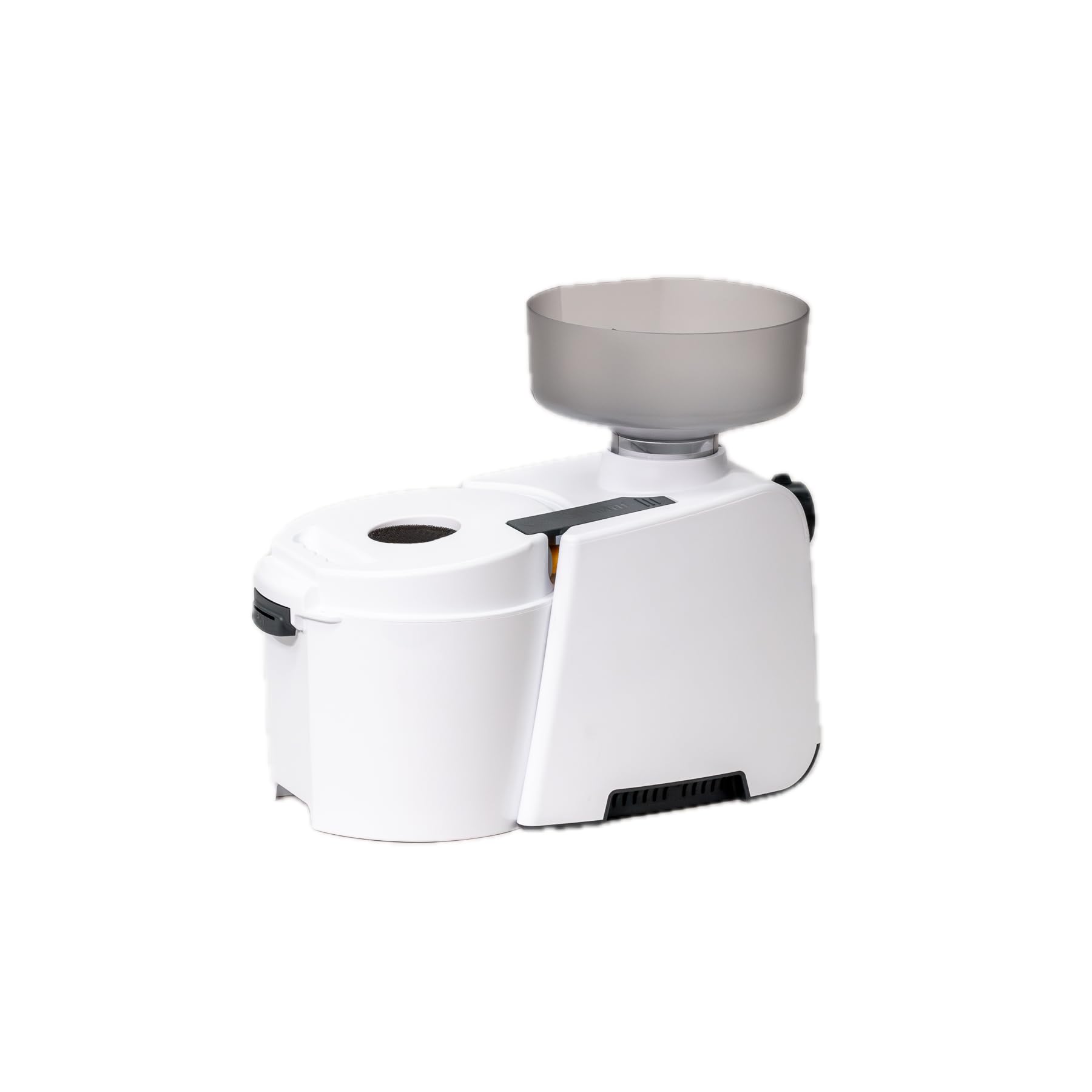
NutriMill Impact Grain Mill
Key Features
- Motor: 1,200 watts
- Hopper: 8 cups
- Milling heads: Stainless steel impact
- Flour canister: 12 cups
- Price: Midrange
About half the money of our top pick, a bigger hopper, and a 12-cup canister that catches the flour instead of a bowl you hold in place. That combination is the whole argument: on a Sunday with three loaves to bake, the Impact runs one session where a smaller mill runs three.
The mechanism is impact rather than stone. A 1,200-watt motor spins stainless heads at high speed and shears grain into bread flour, which it does quickly and evenly, and the dial takes a batch or two to learn. One thing the design doesn’t tell you: the hopper gives no view of the fill level, and overfilling is the fastest way to damage the heads. Fill it, stop, grind.
This is not a mill you leave out. Everything nests — hopper into canister, heads onto the base — so it stores flat in a cabinet, which is exactly where a machine this loud belongs while the house is awake. Cleaning means brushing out the top end, and the crevices take a minute. Next to the Harvest it is louder and plainer; next to a hand mill it is a different century.
Pros
- Fast on full batches of hard wheat
- Eight-cup hopper feeds a 12-cup canister
- Parts nest for cabinet storage
Cons
- Loud while it runs
Bake several loaves a week? The Impact turns a full hopper into bread flour in minutes, then nests away in a cabinet.
Best for High-Volume Hand Milling
Lehman’s Manual Grain Mill
Key Features
- Hopper: 6 cups
- Weight: 26 lb
- Flywheel: 12 inches
- Grinding burrs: Stainless steel
- Price: Premium
Twelve inches of cast-iron flywheel is the whole idea. Once it is spinning, momentum carries the burrs and you steer the crank instead of forcing it, which is what separates this from the small hand mills that leave your arm aching after a cup. Six cups of grain sit in the hopper above stainless burrs that were electrolytically polished smooth, and the mill weighs 26 pounds with four holes in the base because it is meant to be bolted down.
Hand milling is a decision about how much work you want in a loaf, and this mill makes the work reasonable. It takes any free-flowing dry grain down to pastry flour, though pastry flour needs a second pass with the burrs closed down — one pass gets you a good coarse meal. The flywheel is what we appreciate on the second and third cup, when a lighter mill starts to feel like a chore.
Bolt it to a board or a dedicated counter and it behaves; leave it loose on a tabletop and you fight it every turn. It can be motorized later, and that changes the effort more than the speed — the burrs set the pace, not the power source. This is the mill for someone who wants flour when the power is out, and wants more than a cup at a sitting.
Pros
- Flywheel makes hand grinding sustainable
- Grinds any free-flowing dry grain
- Can be motorized later
Cons
- Pastry flour needs a second pass
- Twenty-six pounds wants a permanent mount
The Lehman’s is the hand mill we recommend for real volume: a flywheel that does most of the work and a six-cup hopper that keeps going.
Best for Lifetime Hand Mill
Country Living Hand Grain Mill
Key Features
- Weight: 16 lb
- Capacity: 2 lb
- Warranty: Lifetime
- Grind range: Cracked grain to cake flour
- Price: Premium
The money is in two places: solid cast aircraft aluminum instead of cast iron, and double-sealed industrial ball bearings. The bearings are the part that matters. Flour dust is what ends a mill, sealed units keep it out of the one place it can grind things to a halt, and that is most of the difference between this and a cast-iron mill at a fraction of the price. The lifetime warranty backs the same claim.
It adjusts from cracked grain right down to cake flour and holds 2 pounds in the hopper, which is a serious session for a hand mill. At 16 pounds it wants a mounting spot rather than a shelf, and the crank turns smoothly enough that the weight is the bigger obstacle. If you grind every week and intend to still be doing it in twenty years, this is the one; if you grind for cornbread on Sundays, the Corona covers it for far less.
Pros
- Sealed bearings keep flour dust out
- Lifetime warranty on the whole mill
- Cracked grain through cake flour
Cons
- Costs the most of any mill here
- Sixteen pounds needs a permanent mount
It costs the most of any mill here and it is the only one with a lifetime warranty — for a baker planning decades of hand grinding, that is the trade.
Best for Budget Corn Grinding
Corona Manual Grain Mill
Key Features
- Capacity: 1.9 quarts
- Material: Cast iron
- Clamp fits: Up to 1.45 inches
- Dimensions: 11.4 x 6.7 x 16.1 inches
- Price: Budget
There is no cord, no timer, and no plastic: a cast-iron body, a crank with a wooden handle, and a C-clamp that grabs a table edge up to 1.45 inches thick. The clamp is the entire installation. The mill stands about 16 inches tall on the counter, grinds into whatever bowl you set underneath, and comes off the table and into a cupboard when you are done.
For corn it is the most convincing mill here for the money. Masa, coarse cornmeal, cracked grain for polenta, coffee, dried chiles — the white iron plates chew through all of it, and the adjusting screws move you from cracked to fine in a few turns. Fine wheat flour is the weak spot: the grind comes out uneven and wants sifting and a second pass. We treat this as a corn and coarse-grain mill that can make flour, not a flour mill that also handles corn.
The plating is worth a look on arrival. Tin-plated cast iron is food-safe and rust-resistant, but the coating can flake at the hopper edges, so wipe the mill down and run a throwaway handful of grain through before the first bake. Assembly takes a few minutes and breaks down the same way for storage, which matters in a kitchen that has no room for a permanent fixture.
Pros
- Convincing on corn, masa, and coarse meal
- Clamps on and comes off in seconds
- Cast iron at a budget price
Cons
- Uneven grind at fine settings
- Needs a clampable edge, not a flat counter
The Corona is the mill for corn, masa, and coarse meal on a small budget: cast iron, hand cranked, clamped to your table edge.
Best for Kitchenaid Owners
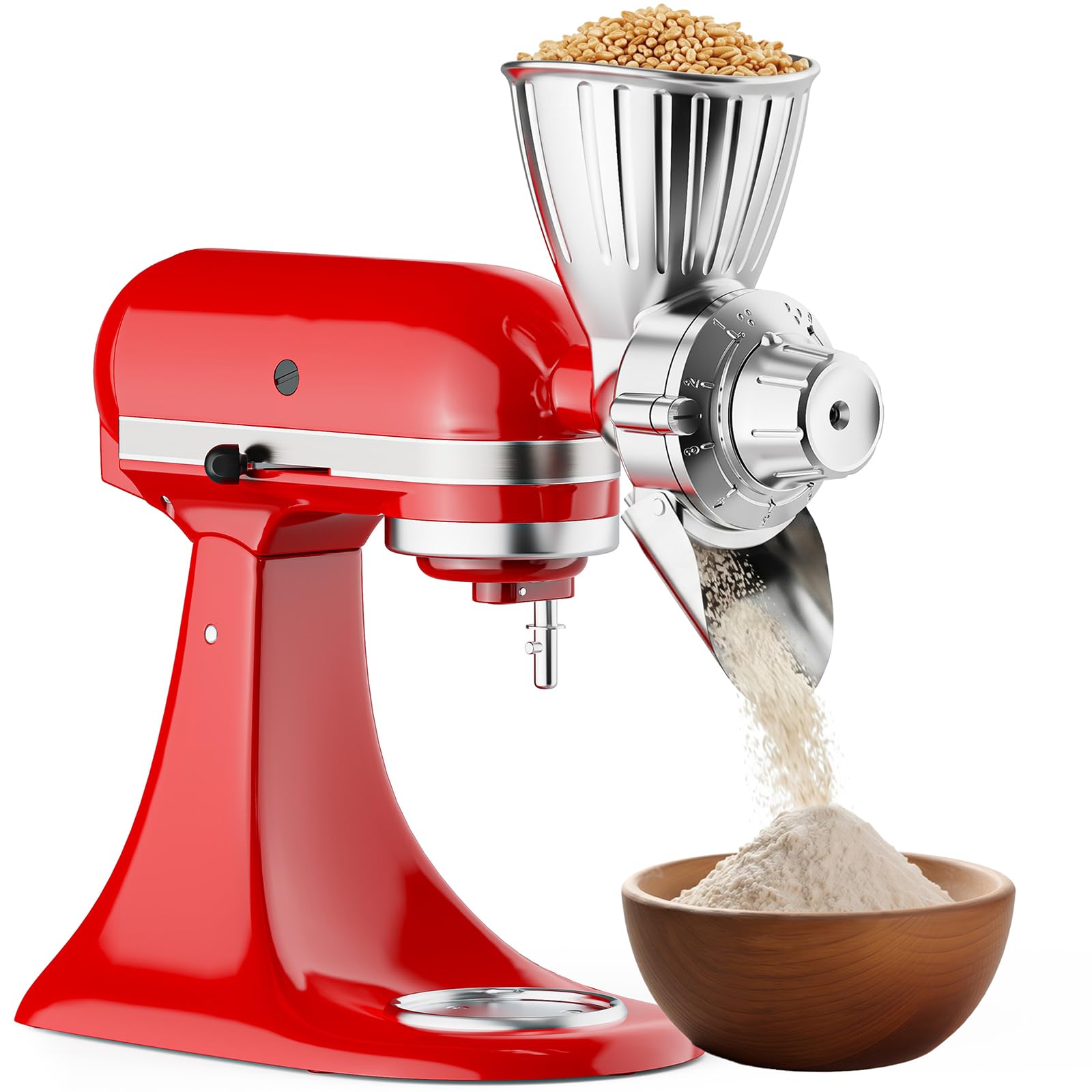
FOCOllK Grain Mill Attachment
Key Features
- Weight: 3.25 lb
- Material: Die-cast aluminum alloy
- Compatibility: All KitchenAid stand mixers
- Grind settings: 9
- Price: Midrange
If there is a stand mixer on your counter, you already own the motor. This attachment slides into the front hub, adds nine grind settings and a detachable grinding chamber, and turns the mixer into a flour mill for a fraction of what a standalone machine costs. For anyone baking a loaf or two a week, that arithmetic is hard to argue with.
It is die-cast aluminum rather than plastic, and the grind covers cracked grain at the coarse end through a genuinely fine powder at the other — start coarse and walk it down rather than jamming the burrs on the finest setting with cold grain. Wheat, corn, oats, buckwheat, millet, and coffee beans all go through. Peanuts, soybeans, and sunflower seeds do not, and no amount of hopeful loading changes that.
Fit is the thing to check before ordering. It is built for the KitchenAid hub, and on some mixers it seats looser than the brand-name attachment, which shows up as a squeal at the coupling under load. On the tilt-head mixer we tried, it seated firmly and stayed put through a grind; on a bowl-lift machine with a worn hub, it may not. The chamber detaches for brushing, which makes cleanup far less annoying than the design suggests.
Pros
- Uses the mixer motor you already own
- Nine settings from cracked grain to fine powder
- Detachable chamber makes brushing easier
Cons
- Can seat loose and squeal at the hub
- No oily seeds, nuts, or soybeans
If there is a stand mixer on your counter, this is the cheapest route to fresh flour — check the fit on your model before you order.
Best for Wet and Dry
VEVOR 3000W Grain Mill

Key Features
- Motor: 3,000 watts
- Grinding: Wet and dry
- Dimensions: 19.88 x 9.84 x 27.56 inches
- Milling discs: Cast iron and sand
- Price: Midrange
Most mills here do one thing: dry grain into flour. This one does two, because the kit includes a sand milling disc for wet grinding alongside a cast-iron disc for dry. Soaked soybeans, soaked rice, and nixtamal come out as pulp, which is how corn becomes masa without a second machine.
It is a commercial grinder dressed for a kitchen. Three thousand watts, a cast-iron body, 27.56 inches tall — which means it does not fit under standard upper cabinets and will not tuck into a pantry corner. The trade is throughput: a funnel that takes grain by the scoop, a tension knob that holds its setting, and a motor that keeps going long after a countertop mill would be resting.
Where it falls down is the paperwork and the finish. The instructions are thin, the fit and finish is industrial rather than kitchen-grade, and ours needed the plates seated and the tension dialed before the grind came out even. Once it is set, it stays set. If you make masa or grind corn by the bucket, it is the only machine here that does both jobs; if you bake two loaves a week, it is a lot of machine for the space it takes.
Pros
- Wet and dry grinding in one machine
- Holds a grind setting under volume
- Built for pounds of grain, not cups
Cons
- 27.56 inches tall limits where it fits
- Thin instructions and an industrial finish
The VEVOR is for cooks who grind wet and dry in volume — masa, rice paste, feed corn — and who can give a 27-inch machine permanent floor space.
Best for Fast Small Batches
LEJIEYIN 2000g Grain Mill

Key Features
- Power: 3,000 watts
- Speed: 28,000 rpm
- Capacity: 2,000 g
- Fineness: 50-300 mesh
- Price: Midrange
Thirty seconds is the pitch, and it is close to true. A 3,000-watt motor spins a stainless bowl at 28,000 rpm and turns wheat berries into powder faster than anything else here, with fineness running from 50 to 300 mesh depending on how long you let it run. The swing body tips 180 degrees to pour, which beats lifting a hot, heavy canister off a base.
The honest way to think about it is a spice grinder that also does grain. Cumin, star anise, dried chiles, coffee — seconds each, and fine enough to dust. Rice, barley, and wheat berries take more care: the flour comes out fine, but the machine works best in short timed bursts, and a big batch means several of them.
Heat is the trade. The bowl gets hot enough that you let it cool before you touch it, and the duty cycle — run, stop, run again — is part of the design rather than a fault. For a minute-long spice job the cycle never comes into play. It is the fourth batch of an afternoon where you feel it, and that is the point at which a stone mill starts looking reasonable.
So why is it here? Because nothing else at this size handles a cup of rice flour and a jar of chili powder with the same machine, and for that kind of cooking the speed is worth the cooldown. It is the wrong mill for a weekly bread bake and the right one for a cook who grinds a little of everything.
Pros
- Grinds in seconds, not minutes
- Swing body pours without lifting
- Covers spices as well as grain
Cons
- Loud enough to warn the house
- Flour lodges in the bowl corners
The LEJIEYIN suits cooks who want one fast machine for spices, rice, and small grain batches, and who can live with the noise and the cooldown.
How We Tested the Best Grain Mills
We started by gathering every mill we could find in four formats — electric stone, high-speed impact, hand-crank, and stand-mixer attachment — and narrowed them by the specs that change how a mill lives in a kitchen: burr material, hopper capacity, how fine and how coarse the adjustment actually goes, and which grains the maker says it handles. Anything that couldn’t produce both a coarse cornmeal and a fine pastry flour was cut before testing. That left 11 mills, which we ran for eight months.
Each one moved into a real cooking schedule: a Saturday sourdough bake, cornmeal for weeknight cornbread, small batches of rice and millet, coffee beans when a recipe called for them. We weighed the grain going in and the flour coming out so yield losses weren’t a mystery, and we ground back-to-back batches to see whether the second ran hotter or slower than the first.
Grind consistency got the sieve treatment — we sifted each batch and looked at what stayed on top versus what fell through, then checked whether the finest setting held there after the dial had been moved around. We pushed a thermometer into fresh flour straight off the spout to catch heat, timed output by weight for speed, and noted whether we could hold a conversation while it ran.
Cleaning happened at every grain change, and we watched for corn or coffee ghosting into the next batch. The mixer attachment went on and off a stand mixer repeatedly to check fit and wobble, and the countertop models got a deliberate nudge mid-grind to see if they walked. After eight months we went back through the burrs and moving parts to see which machines still held their setting.
How to Choose a Grain Mill for Home Flour
The milling mechanism matters more than the wattage: stones and burrs grind cool and slow, impact and high-speed machines trade heat for speed, and that trade decides which mill belongs in your kitchen.
Start With the Milling Mechanism
Stone mills run slowly and keep the flour cool, which is why they handle everything from cracked cereal to pastry flour in one machine; the NutriMill Harvest is the clearest example here. Impact mills shear grain with stainless heads at high speed, excel at bread flour, and warm the flour as they work. Cast-iron hand mills are the traditional corn and coarse-meal tool. High-speed swing grinders are pulverizers built for thirty-second bursts.
One trap: a 3,000-watt figure on a swing grinder is not six times the milling power of a 450-watt stone mill. It is a different kind of machine built to run for a minute at a time, and a burst rating tells you nothing about how it performs on a full batch of hard wheat.
Manual or Electric? Count Your Loaves
A loaf takes roughly three cups of flour, and a hand mill gives you those three cups a cup at a time. If you bake weekly, an electric mill earns its noise. If you bake occasionally, want flour when the power is out, or like the quiet, a hand mill is genuinely pleasant — especially one with a flywheel, like the Lehman’s, which can be motorized later.
The middle path is the stand mixer: if one already sits on your counter, a hub attachment is the least expensive way to try fresh flour before committing to a separate machine.
Capacity, Batch Size, and Heat
Capacity comes in two parts, and the second one is the one people forget. A 5-cup hopper is fine for one bake; an 8-cup hopper feeding a 12-cup canister is what a three-loaf Sunday looks like. On a hand mill, a 6-cup hopper is the difference between grinding and refilling.
Heat is the other limit. Fast mills build it and need a rest, and both the flour and the motor feel it. Match the batch to the machine rather than pushing through a fourth round, and buy the canister size that matches your biggest baking day, not your average one.
Noise, Cleanup, and Where the Mill Lives
Every electric mill here is loud, and none of them can be rinsed. Cleanup is a brush, a few minutes, and a dry cloth; water is what kills a mill. Look for a grinding chamber that detaches, which turns an awkward job into a short one.
Then decide where it lives, because that decides how often it runs. A 26-pound mill with bolt holes wants a permanent board; a mill that nests into a cabinet is a compromise you make twice a week. A flour mill you have to unpack is a flour mill you stop using.
Dry, Low-Oil Grain — and What That Rules Out
Stone, burr, and impact mills want free-flowing, low-moisture, low-oil grain. Peanuts, soybeans, and sunflower seeds clog the works and can damage stones; wet material is out unless the machine specifically includes a wet disc, as the VEVOR does. Read the grain list on the machine you are considering against the grain in your pantry.
Warranties vary widely across this group, from 90 days on a cast-iron hand mill to a lifetime on the Country Living, and a warranty claim on a mill that has been fed oily seed is not going to go well.
Frequently Asked Questions
Will a grain mill fit under my kitchen cabinets?
Measure the gap first. Most upper cabinets sit about 18 inches above the counter, which clears a countertop mill like the NutriMill Harvest at 13 inches tall but not the VEVOR commercial mill at 27.56 inches. If your only free counter is under a cabinet, choose a mill whose parts nest for storage, like the NutriMill Impact.
Do I need to sift home-milled flour?
For sandwich bread, cake, and pastry, yes. Sifting out the coarser bran gives a lighter crumb, and the bran you pull out can go into muffins or hot cereal. For rustic loaves and whole-wheat sandwich bread, skip it. Sift before you measure, too: fresh flour settles differently than bagged flour, so weigh it when your recipe lists weights.
How long does freshly milled flour keep?
Days, not months, at room temperature — the oils in the germ go rancid quickly. Seal it and freeze it if you aren’t baking within a week, and let it come to room temperature before you mix. That is the case for milling to order: whole berries keep far longer than the flour they become, so grind what the week’s baking needs.
Final Verdict
Our pick for most kitchens is the NutriMill Harvest. Cool-running corundum stones, a texture knob that covers cracked cereal through pastry flour, and a footprint small enough to leave out make it the mill that actually gets used on a weekday.
If speed and volume matter more, the NutriMill Impact is the better buy for a household baking several loaves a week, and it costs less. If your grain is corn and your budget is small, the Corona does that job by hand for a fraction of either.