This post contains affiliate links. We may earn a small commission when you buy through our links — at no extra cost to you.
A vegetable brush looks like the most self-explanatory tool in the drawer, and it is — right up until you attack a ripe tomato with a brush built for potatoes and watch the skin split. Bristle firmness is the whole ballgame: stiff nylon scours the dirt out of a russet’s eyes, while that same stiffness bruises a mushroom or tears the skin off a peach. The quieter problem is abrasion. Some bristles are rough enough to take off more peel than dirt, which is a strange thing to do to a carrot you’re about to eat raw.
I scrub something under the tap almost every night, and the brushes that survive in my kitchen are the ones that stay grippy once my hands are wet and soapy. Over the past four months, my team and I put 14 vegetable brushes through that same routine, from palm-sized scrubbers to long-handled ones, and the differences were not subtle. A comfortable handle you can actually hold onto turned out to matter more than bristle count, and the two-packs weren’t automatically the better deal once the bristles started splaying.
The picks below cover both ends of the firmness spectrum — the ones that scour and the ones that coddle — so you can match the brush to what’s actually in your crisper drawer.
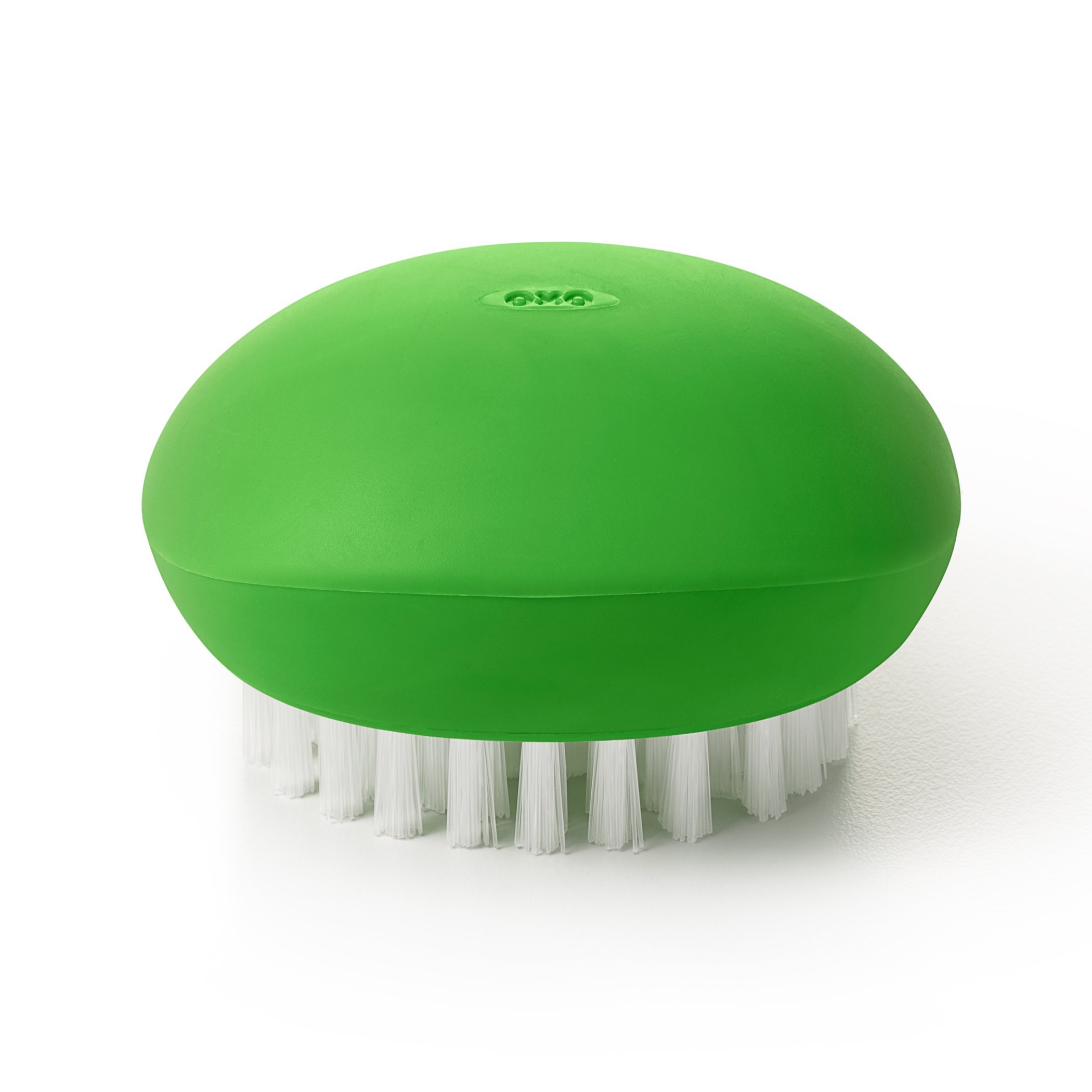


Best for Firm Everyday Produce
OXO Good Grips Vegetable Brush
Key Features
- Pack: 1 brush
- Handle: Non-slip grip
- Bristles: Nylon
- Dishwasher safe: Yes
- Price: Midrange
Potatoes come out of the bag with grit packed into the eyes and a skin worth saving. The OXO handles that job with a short, dense nylon head that scrubs hard enough to lift soil from firm produce without turning a potato into a peeled one. Carrots, sweet potatoes, and winter squash get the same treatment: a few passes under running water, then a rinse of the brush and back into the drawer. The head is broad enough to cover a medium potato in a couple of strokes, yet compact enough to follow the curve of a carrot.
What makes it our top pick is the balance. The bristles are stiff enough to feel purposeful but not so stiff that they gouge thin skins, and the flexible non-slip grip stays secure when your hand is wet. It is also dishwasher safe and simple to rinse, which matters because a produce brush that needs a project to clean is a produce brush that stays dirty.
The flexible grip takes pressure without digging into your palm, which is the part we notice when a bowl of new potatoes turns into a whole sinkful. It is not a knife-block showpiece, but it is the brush we leave by the sink because it earns its place every day.
Pros
- Stiff nylon bristles lift grit without peeling
- Non-slip grip stays secure when wet
- Dishwasher-safe for easy cleanup
- Sturdy enough for daily scrubbing
Cons
- Bristles feel soft for heavily soiled potatoes
The OXO is the brush we point to first for everyday potatoes and carrots: firm nylon bristles, a secure wet-hand grip, and dishwasher cleanup in one simple tool.
Best for Mixed Produce
MR.SIGA Fruit and Vegetable Brush
Key Features
- Pack: 2 brushes
- Handle: TPR non-slip
- Bristles: Dual nylon
- Dishwasher safe: Yes
- Price: Premium
Where the OXO gives you one well-judged bristle, MR.SIGA gives you two on the same oval head: angled gray bristles for mushrooms and tender produce, straight white bristles for potatoes and carrots. That sounds like a gimmick until you have a sink with both kinds of food in it, and then the second surface earns its keep.
We like the two-brush format for the way it separates jobs without taking up two drawers. The TPR-covered handle fits the palm, stays put when wet, and has a low enough profile that you can scrub with your fingertips rather than a fist. One brush can live by the sink while the other waits in reserve, which is more useful than it sounds when the first one is drying.
The head is compact, so a cook with very large hands may want more real estate on a big russet. That is the trade for a brush that tucks into a crowded drawer, and it is easy to accept when the same brush can switch to mushrooms without tearing them.
Pros
- Dual bristle zones handle roots and tender produce
- TPR grip stays put when wet
- Two brushes keep one at the sink and one in reserve
- Dishwasher safe for easy cleanup
Cons
- Soft side needs extra passes on caked soil
We reach for the MR.SIGA set when the sink holds both muddy potatoes and tender mushrooms, because the two bristle zones spare you from owning two separate brushes.
Best for Budget Handled Scrubbing
Joie Potato Scrub Brush
Key Features
- Pack: 1 brush
- Handle: 5.5 in easy-grip
- Bristles: Tough
- Material: BPA-free plastic
- Price: Budget
The Joie is the budget option in this group, but it does not feel like a disposable tool. You get a 5.5-inch handle, a compact head, and tough bristles for very little money, which makes it a sensible first produce brush or a second one for a vacation rental.
We think it is the best handled brush here for light daily washing: potatoes, carrots, zucchini, and other firm vegetables that need a quick scrub rather than a serious scouring. The longer handle gives a little more reach than a palm brush, and the BPA-free plastic body is easy to rinse.
The compact head slips around knobby ginger and small potatoes, and the handle stays comfortable through a bowlful. It is a simple potato scrubber with a handle, but simple is what gets used when you are standing at the sink with dinner half prepped.
Pros
- Very low cost for a daily brush
- 5.5-inch handle adds reach
- BPA-free plastic and firm bristles
- Compact head fits small produce
Cons
- Medium-firm bristles need extra passes on muddy roots
For a low-cost handled brush with a little more reach, the Joie is the one we choose for light daily scrubbing on firm vegetables.
Best for Deep Sinks
Fox Run Vegetable Cleaning Brush
Key Features
- Handle: 10.5 in rubber
- Storage: Hanging hole
- Bristles: Angled
- Dishwasher safe: Yes
- Price: Premium
If your sink is deep enough that scrubbing potatoes leaves your wrist at an awkward angle, or arthritis makes a short palm brush hard to hold, the Fox Run’s long handle changes the job. The 10.5-inch frame lets you stand more upright and keep your hand out of the spray, and the cushioned rubber grip is easy to keep hold of when everything is wet.
The angled bristles are shaped to follow the curve of a potato or carrot rather than just flatten against it, and the head has enough surface area for a big russet. The hanging hole at the base is another detail we appreciate: this is not a brush that disappears into a crowded drawer, and hanging it lets the bristles dry without sitting in a puddle.
The long handle is the whole point, so it takes up more room than a palm brush and needs a hook or a deep utensil crock. That is a fair trade for a cook who scrubs a sinkful at once and wants to keep their wrist out of the water. The hanging hole makes the storage side easier to live with.
Pros
- Long handle keeps hands out of deep sinks
- Cushioned rubber grip reduces cramping
- Angled bristles reach curved produce
- Hanging hole and dishwasher-safe cleanup
Cons
- Medium bristles need extra work on crusted soil
We recommend the Fox Run for cooks with arthritic hands or a deep farmhouse sink, where its long cushioned handle keeps scrubbing comfortable and your wrist out of the water.
Best for Root Vegetables
TAWASHI Vegetable Scrub Brush
Key Features
- Pack: 1 brush
- Shape: Round
- Handle: Palm-held
- Bristles: Firm
- Price: Budget
There is no handle on the Tawashi, and that is the first thing to understand about it. It is a compact palm block with very firm bristles, designed to be held in the hand and worked directly over a potato, carrot, or bunch of beets. If you like the idea of scrubbing instead of peeling, this is the most direct tool in the group.
Firm bristles are the reason it works. They bite into muddy root vegetables and loosen soil from crevices that a softer brush skates over, and the compact block gives you fine control around knobby ginger or the ends of a carrot. It also rinses clean quickly, which is more than you can say for every brush with a deep tufted head.
We like the Tawashi for roots and other hard-skinned jobs, and the compact block gives more control than a long handle when you are working close to the sink. The handle-free shape puts your fingers near the water, which is the trade for that control, but it is easy to rinse and air-dry.
Pros
- Very firm bristles tackle muddy roots
- Palm shape gives direct scrubbing control
- Compact block rinses and dries quickly
Cons
- Firm bristles can scuff tender produce
We like the Tawashi for firm root vegetables, especially when you want a handle-free block and very hard bristles that scrub without peeling.
Best for Countertop Storage
Lumkew Vegetable Brush Scrubber
Key Features
- Pack: 2 brushes
- Handle: Textured
- Bristles: Hard and soft
- Standing base: Yes
- Price: Midrange
The Lumkew set looks like a potato and a mushroom that wandered onto the counter, and the little feet are not just for show: they let each brush stand upright so water drains off the bristles instead of pooling around them. That is the kind of detail that makes a brush easier to keep clean between uses.
Each brush has a hard gray side for root vegetables and a soft white side for mushrooms, tomatoes, and other tender produce, so the pair covers more ground than a single-stiffness scrubber. The raised dots on the handle give your wet hand something to grip, and the two-brush set means one can stay by the sink while the other goes in a gift basket.
We keep the set out because the standing design turns a utilitarian tool into something you do not mind looking at, and because the two bristle grades are genuinely useful on a mixed dinner. The faces are fun, but the feet and the dual bristles are what keep them in daily rotation.
Pros
- Hard and soft bristles on each brush
- Stands upright to drain
- Two brushes cover roots and tender produce
- Textured handle stays secure
Cons
- Taller shape needs more drawer clearance
A pair that looks like a potato and a mushroom sounds like a novelty, but we choose it when we need both firm and soft bristles on the counter.
Best for Budget Two-Pack
PHYEX 2-Pack Vegetable Brush
Key Features
- Pack: 2 brushes
- Handle: Non-slip
- Bristles: PET
- Hanging hook: Yes
- Price: Budget
The second brush is the real feature here. PHYEX sells this as a two-pack, and that spare matters more than it sounds: one can live by the sink for potatoes and carrots, while the other stays clean for a rental, a camper, or the day the first one goes missing.
The PET bristles are on the firm side, which suits potatoes, sweet potatoes, and other root vegetables; they hold their shape and do not flatten out after a few scrubs. The compact handle fits neatly in the hand, and the hanging hook keeps the brush off the counter so it can dry.
This is not the set for delicate produce. The same firmness that cleans a russet will bruise a mushroom or tear the skin of a ripe tomato, so keep a softer brush or a cloth for those jobs. That is a clear boundary, not a flaw, for a brush built around roots.
We think the PHYEX is the practical budget buy for a household that wants a firm all-purpose brush and a spare without paying for extras. The hanging hook and compact body make it easy to keep within reach, which is exactly what a utility brush should be.
Pros
- Two firm brushes for a budget price
- Firm PET bristles suit root vegetables
- Hanging hook keeps it off the counter
- Compact handle fits most hands
Cons
- Small head takes more passes on large squash
We recommend the PHYEX when you want a firm, no-frills brush for root vegetables and a spare on hand; the two-pack is the value here.
Best for Spot Cleaning
yuntop Vegetable Brush

Key Features
- Size: 3.9 x 2.3 x 2 in
- Handle: Non-slip
- Bristles: Hard and soft
- Dot remover: Yes
- Price: Budget
The tiny tail on the yuntop is easy to overlook, but it is the reason this brush stays out on the counter. The pointed nub digs into potato eyes and small dark spots without gouging the flesh, so you can clear a defect instead of cutting around it.
The main head has a hard side for root vegetables and a soft side for mushrooms and other tender produce, and the plastic-and-silicone handle has enough texture to stay put in a wet hand. At 3.9 by 2.3 by 2 inches, it is small enough to keep in a drawer or a utensil crock without displacing anything.
The compact size cuts both ways: it is easy to control around small produce, but a big squash or a pile of potatoes takes more passes than with a broader brush. That is the trade for a brush that disappears into a crowded drawer and still has a soft side for delicate food.
What makes it useful to us is the combination: the hard side takes potatoes, the soft side takes mushrooms, and the tail handles the spots neither bristle reaches. It is not the brush for a whole harvest, but it is the one that solves the small problems.
Pros
- Built-in dot remover for potato eyes
- Dual hard and soft bristles
- Textured non-slip handle
- Compact for tight storage
Cons
- Sold as a single brush, so no spare
The yuntop earns its place in our drawer when a potato has deep eyes or a carrot needs a spot scrub; the built-in dot remover is the difference.
How We Tested Vegetable Brushes
We started by pulling every vegetable brush we could find from major retailers and reading the listings for bristle material, handle shape, dishwasher-safe claims, and whether it sold as a single or a multipack. From that pile we cut the field to 14 brushes that represented the real spread of what’s out there, then used them for four months — roughly a hundred dinners’ worth of produce.
Most of the work happened at my kitchen sink on weeknights, scrubbing russets, carrots, and radishes under running water. We added a Sunday produce haul every week, which gave us the messier stuff: muddy potatoes straight from a farm stand, mushrooms that needed a quick rinse rather than a soak, and tomatoes that had no business near a stiff brush. Each brush also went home with a tester, so it got used the way it would in a real kitchen — tossed in a drawer, left wet in the sink, run through the dishwasher.
Every brush got the same dirt test: we counted strokes to clear the eyes of a muddy potato and noted whether the bristles reached into them at all. For firmness, we pressed a thumbnail into the bristle bed, squeezed the head in a fist, and watched how far the tips bent against a carrot. Abrasion showed up quickly — we recorded when a brush stripped carrot skin in ribbons or scuffed a tomato instead of rinsing it. Grip was judged with soapy hands, holding each handle the way you would over a full sink.
Brushes whose makers claimed dishwasher safety went through repeated cycles, and afterward we checked for splayed tips, grit trapped at the base of the bristles, and handles that had gone chalky or slick. Value came down to how a brush held up over four months of daily use, not what it cost on the day we bought it.
How to Choose a Vegetable Cleaning Brush
The brush that suits your sink is the one whose bristles match the produce you scrub most and whose handle you can hold comfortably when everything is wet.
Start With Bristle Stiffness
Bristle stiffness decides whether a brush cleans or damages. Firm nylon is right for potatoes, carrots, beets, and winter squash, where you want to lift soil from tough skin; soft bristles are better for mushrooms, tomatoes, and tender fruit. A dual-sided brush is the compromise if you cook with both, but a single medium-firm brush is simpler and cheaper if roots dominate your kitchen. The trap is assuming firmer is always better: a brush that bites into a potato can scuff a peach or tear mushroom caps. Pick the stiffness for the food you handle most, then add a second brush only if your produce mix really splits.
Choose a Handle You Can Hold Wet
Handles matter most when your hands are wet and the sink is full. A palm brush gives direct control and fits in a crowded drawer, but your fingers sit close to the spray and the brush can turn slippery. A longer handle keeps your hand out of the water and gives more leverage for a sinkful of potatoes; it also helps if arthritis makes a tight grip painful. Look for a textured or rubberized surface, a shape that fills your palm without forcing a claw, and a hanging hole if drawer space is tight. A comfortable handle is worth more than an extra row of bristles.
Decide How It Will Live Between Uses
Storage is part of the purchase. A brush that stays wet against the counter or in a closed drawer can develop a musty smell, so choose a design that lets air reach the bristles: a hanging hook, a standing base, or a wide-open crock. Compact brushes are easier to tuck away, but very small heads take longer on big squash and can feel cramped in large hands. Measure the drawer or counter space you have before choosing a long-handled or character-shaped brush. The best storage is the one you will actually use every day, not the one that hides the brush most completely.
Plan for Cleaning and Replacement
Rinse the bristles as soon as you finish scrubbing; dried starch and soil are harder to remove later. Dishwasher-safe plastic brushes are the easiest to sanitize, while brushes with natural materials or assembled handles need more careful drying. Whatever the material, inspect the head every so often: splayed, loose, or broken bristles can end up in food, and a cracked handle traps water and debris. Replace the brush when it stops holding its shape or when the head separates. A produce brush is inexpensive enough that a worn one is not worth nursing along.
Frequently Asked Questions
Why use a vegetable brush instead of just rinsing produce?
Rinsing carries away loose dirt, but soil packs into potato eyes, carrot shoulders, and the ridges of squash. A brush loosens that grit without forcing you to peel, so you keep the skin and the nutrients that come with it. Use short strokes under running water and let the bristles work rather than pressing hard enough to bruise the surface.
Do I need a separate brush for vegetables and dishes?
Yes, if you scrub root vegetables. A produce brush picks up soil and food residue that you do not want on plates, and a dish brush can carry grease into the bristles you use on food. Keep the vegetable brush for produce, rinse it after each use, and let it dry with the bristles exposed. If you use one brush for both, clean and sanitize it between jobs.
Should I scrub potatoes before or after peeling?
Scrub before peeling or cutting, even if you plan to remove the skin. Dirt on the outside transfers to the knife and the cut flesh, so a quick scrub under running water keeps grit out of the rest of the dish. If you keep the skin, use firm strokes around the eyes and any dark spots, then rinse again before cooking.
Final Verdict
The OXO is the brush we point most cooks toward because it gets the everyday job right: firm nylon bristles, a grip that stays secure when wet, and dishwasher cleanup in one simple tool. If your produce mix runs to mushrooms and tomatoes as often as potatoes, the dual-bristle MR.SIGA pair is the better fit.
For a deep sink or arthritic hands, go long with the Fox Run. Those are the choices that change the purchase; the rest come down to storage and how much counter space you want to give a brush.