This post contains affiliate links. We may earn a small commission when you buy through our links — at no extra cost to you.
The question I hear about glass rinsers is always the same: how much of my kitchen do I have to take apart? Usually just one hole — sometimes one you already have, sometimes one you drill — plus a quick hookup to the cold line. In exchange, a small nozzle fires water up into an upside-down glass and knocks out the smoothie residue without filling the sink.
I was skeptical; a brush and hot water had handled my dishes for years. But my team and I have now installed and lived with 12 of these over six months, and the differences are real — spray force, the seat that holds the glass steady, how the finish survives hard water, and whether the base stays dry a week later.
The mistake first-time buyers make is shopping by finish and ignoring the hole: measure the opening and your deck thickness before you fall for a brushed nickel body. Price doesn’t guarantee a better rinse, either — several of the costlier models we tried sprayed weakly or dribbled at the base. The picks below are the ones that earned their spot.

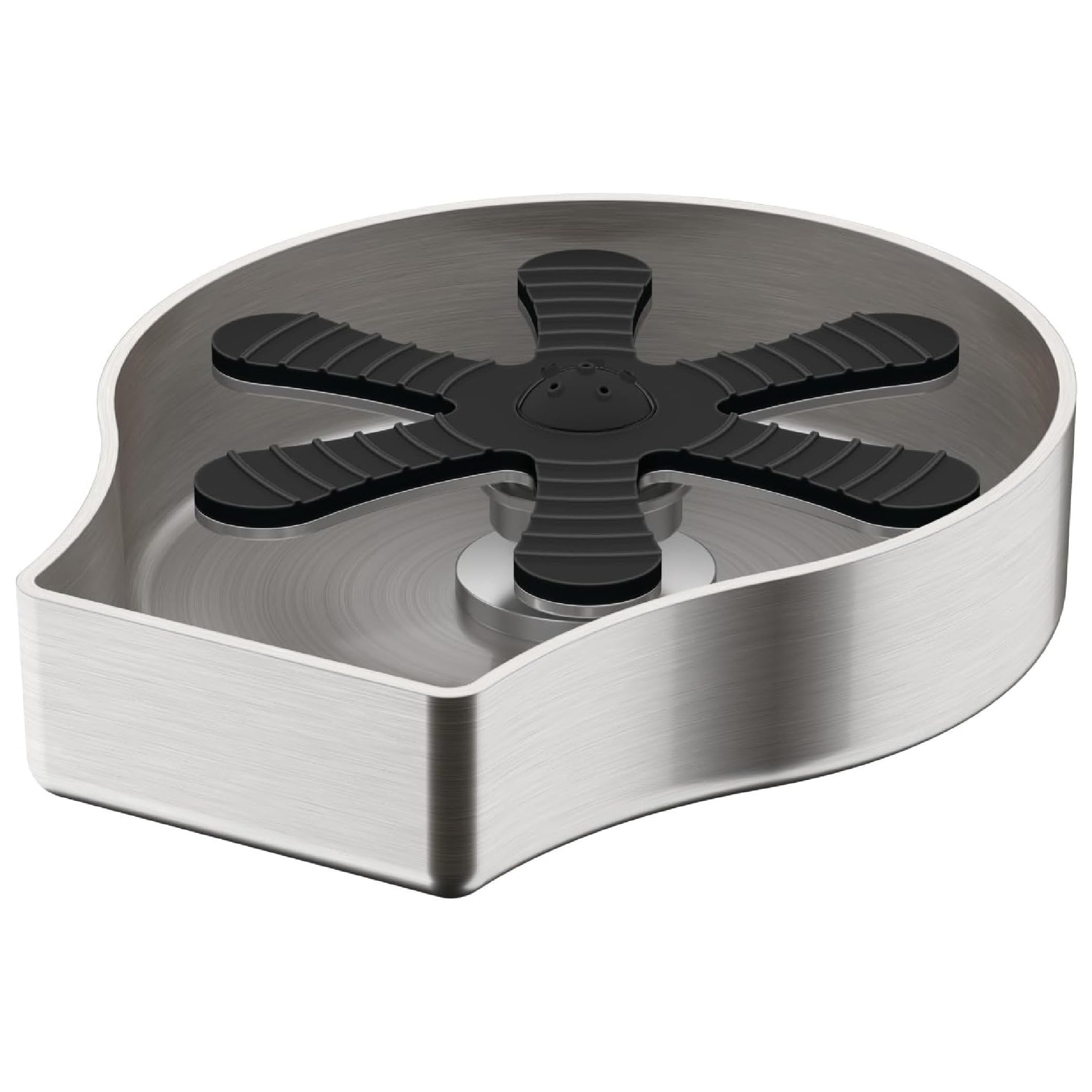


Best for Everyday Sink Rinsing
Delta GR150-SP
Key Features
- Finish: SpotShield Stainless
- Mounting: Single-hole deck mount
- Supply line: Included
- Deck footprint: 4 x 4 in.
- Price: Midrange
A glass left on the counter overnight is the whole reason to own one of these, and the GR150-SP handles that glass better than anything else in this group. We put it through a wine glass with dried sediment, a pint glass that held a smoothie, a baby bottle, and a 20-ounce travel mug, and the jets reached the bottom of each without us turning the glass. What separates the Delta is breadth: narrow stems, wide tumblers, and insulated bottles all sit on it and get a full spray.
The overhang is the small detail we kept noticing. It tips runoff into the basin instead of letting it run down the front of the counter, which is the difference between a rinser you use constantly and one you quit using because it makes a mess. Installation is a single-hole job in place of a soap dispenser, sprayer, or blank cover, and Delta includes the supply line. We ran ours on the hot side, and a rinsed glass comes out warm enough to air-dry on the rack.
The body is the compromise, and it is a real one: SpotShield is a finish name, not a metal, so what arrives is a coated unit rather than a solid casting. It does not change the rinse at all, and the brushed face blends into a stainless or nickel faucet well enough that guests read it as part of the fixture — more than we can say for the black plastic press pads on cheaper units.
Pros
- Rinses the widest range of drinkware here
- Overhang sends runoff into the basin
- Simple single-hole swap for a soap dispenser
Cons
- Coated body rather than solid metal
- Costs more than its materials suggest
We recommend the Delta to anyone who wants one rinser that handles wine glasses, baby bottles, and travel mugs without fiddling — it is the broadest, best-proven performer here.
Best for Budget Stainless Build
Homewerks GR001SS
Key Features
- Material: Stainless steel
- Mounting: Single-hole deck mount
- Supply line: Included, with extender tee
- Deck footprint: 4.38 x 5.63 in.
- Price: Budget
For well under what our top pick costs, the Homewerks gives you a stainless steel body — metal, not a finish name — and in a category this plastic-heavy that trade is more interesting than it sounds. It drops into the same spare hole, sprays hard enough to clear a coffee mug, and matches brushed fixtures closely enough that nobody has asked why there are two brands at our sink.
The value sits in the box as much as in the body. A supply line and an extender tee come included, the tee gives you enough slack to reach a stop valve, and a limited lifetime warranty backs a part that lives in a wet hole. We rate the finish and the warranty as the two things that make this feel like more than a budget part.
Seals are what need patience during the install. An o-ring seated slightly off will weep at the joint, so snug everything by hand first and add plumber’s tape if a joint keeps seeping; seated properly, the underside of ours has stayed dry. If that soap dispenser beside your faucet has been empty for a year, swapping it for this cup washer is the least expensive way to find out whether a rinser earns its hole.
Pros
- Real stainless steel body at a budget price
- Supply line and extender tee included
- Limited lifetime warranty
Cons
- Stainless face shows water spots quickly
We recommend the Homewerks to anyone who wants a real stainless steel body and a lifetime warranty without paying premium prices for a name.
Best for Wide-Mouth Bottles
Kraus CleanMate KGR-500SFS
Key Features
- Jets: 9
- Safety lock: 1/8-turn integrated
- Opening width: 5 in.
- Counter thickness: Up to 2-1/4 in.
- Price: Midrange
Five inches is the number that sets the CleanMate apart. That is the diameter of the opening a glass rests in, and it is wide enough to swallow a pint glass, a 32-ounce shaker bottle, and the wide-mouth water bottles that make narrower rinsers feel useless. Nine jets do the work, and the six prongs holding the glass are silicone-coated so a stemmed wine glass does not pick up a fresh chip on the way out.
The 1/8-turn safety lock is the feature we did not expect to care about. It keeps the unit from firing when something bumps the press head, which matters when the rinser faces a cabinet door or a painted wall instead of open counter. Kraus also includes a quick-connect line and an optional spacer for sinks with a ledge, and the install is built for counters up to 2-1/4 inches thick.
Two things to plan for. The stainless in the name is a finish, not a material, and the 5.5-inch footprint eats more deck than the Delta does. The tee is the piece most likely to mismatch your stop valve, so pick up a metal one if your supply line is not standard, and set the depth right so the press action stays smooth instead of gritty.
Pros
- 5-inch opening takes wide bottles and tumblers
- Silicone-coated prongs protect glass rims
- Safety lock prevents accidental spray
Cons
- ABS body under a stainless finish name
- Wide footprint needs more deck space
We recommend the CleanMate if your sink traffic runs to wide shaker bottles, 32-ounce tumblers, and anything with a mouth too big for a standard rinser.
Best for Premium Metal Finish
Delta GR250-AR
Key Features
- Finish: Arctic Stainless
- Material: Brass
- Warranty: Limited lifetime
- Supply line: Included with tee adapter
- Price: Premium
The GR250-AR is the premium play here, and it does not rinse any better than our top pick. What the money buys is the object itself: a brass body in Delta’s Arctic stainless finish, heavy enough that setting it into the hole feels like fitting a fixture instead of a gadget.
That weight does something practical. It sits flat and stays put while you press a glass down, with none of the flex a plastic chassis gives you, and the Brilliance finish is engineered to resist corrosion and spotting. Next to a brushed nickel faucet it looks like it came with the sink.
The mismatch is the lid. The cap that covers the jets is plastic on an otherwise metal unit, and at the top of this price range that is the detail you notice every day. Our read: worth it if the rest of your deck is already at this level, and hard to justify over the GR150-SP if it is not. What the box does give you is the complete install kit, supply line and tee included, backed by a limited lifetime warranty.
Pros
- Solid brass body with a corrosion-resistant finish
- Sits flat and stays put under pressure
- Complete install kit and lifetime warranty
Cons
- Plastic lid on an otherwise metal unit
- The most expensive rinser here
We recommend the GR250-AR to someone finishing a high-end kitchen who wants the rinser to read as part of the faucet rather than an add-on.
Best for Reaching Deep Pots
MQFORU Pull-Out Glass Rinser

Key Features
- Material: ABS and copper
- Rotation: 360 degrees
- Dimensions: 2.4 x 2.4 x 4 in.
- Spray reach: 80 cm pull-out hose
- Price: Budget
Nothing else here pulls out. The spray head rides on an 80-centimeter retractable hose, so you can lift it off the deck and use it like a small sprayer — down into a stockpot, around the corners of a big basin, or under the rim of a slow cooker insert. That is a different job from what a fixed rinser does, and it is the whole reason this one made the page.
As a glass rinser it is competent rather than outstanding. The 360-degree head throws a strong spray once a glass sits squarely on the press plate, but the plate is fussier than the Delta’s: set a tumbler down off-center and you get a partial stream instead of a full one. It is the pick here that makes you think about how you are holding the glass.
The plumbing is the weak point. The press basin is plastic, and the tee and hose coupling are where a drip shows up if the install is not square — fit a metal tee and check under the sink after the first few uses, and it settles down. There is also no stated warranty, which is the honest trade you are making.
Pros
- 80 cm pull-out hose reaches pots and deep basins
- 360-degree rotating spray head
- Easy install on an existing sink hole
Cons
- Plastic press basin
- No stated warranty
We recommend this one if you want a rinser that also pulls out to spray a stockpot or the far corner of a big basin.
How We Tested Sink Glass Rinsers
We started with about 40 rinsers from faucet brands and smaller accessory makers, then narrowed to 12 using three filters: whether the base would fit a standard sink hole and a thick deck, whether the body was metal rather than plastic, and whether replacement parts existed.
Each went onto a real kitchen sink in a working home. We timed the install with a basin wrench, then taped a dry paper towel under the sink and checked it again a week and a month later for leakage. In daily use we ran wine glasses, peanut butter jars, blender pitchers, baby bottles, and travel mugs through them, counting how many seconds of pressing it took before the water ran clear.
We noted whether the spray hit the bottom corners of a tall glass or just the sides, whether the glass sat steady or wobbled, and whether a wide jar mouth and a narrow bottle got equal treatment. Rinsing performance separated the field more than anything: a couple of models sprayed a weak, uneven cone and left film behind. We also watched finish, wiping hard-water spotting off stainless and spot-resistant coatings over months, and cycled each plunger hundreds of times to see which ones started to stick.
Value came down to what was inside the housing — an all-metal body and a serviceable valve held up, and anything that failed the leak check got cut regardless of looks. The disappointing ones failed the same way every time: a drip at the base or a spray too soft to earn the counter space.
How to Choose a Glass Rinser for Your Kitchen Sink
A glass rinser — often sold as a cup washer — is a small deck-mounted nozzle that takes the place of a soap dispenser or a blank hole cover, so the choice starts with your counter and ends with what you actually rinse.
Start with the hole and the counter, not the spray
Every pick here mounts in one existing hole, and the useful measurement is the one you already have. A standard accessory hole is 1-1/4 inches, and these units are built to replace a soap dispenser, a side sprayer, or a blank cover. Check counter thickness too: the Kraus tops out around 2-1/4 inches, generous for granite but not unlimited.
The tee that splits your supply line is the part most likely not to match. A metal tee from the hardware store is cheap insurance against a plastic one that cross-threads, and it is the single upgrade we make on almost any of these kits.
Opening width decides what you can rinse
Wide-mouth bottles, shaker cups, and 32-ounce tumblers need a wide opening, and a narrow one simply will not take them. A 5-inch opening like the Kraus’s swallows a pint glass, while compact units handle wine glasses, mugs, and baby bottles comfortably. Look at the prongs as well: soft silicone coating is what keeps a stemmed glass from picking up a chip.
Then think about the press. A plate that needs the glass perfectly centered is one you fight every morning, so a design that sprays well off-center is worth more than an extra jet.
A finish name is not a material
Stainless, spot-free, and Arctic are color and coating names, not promises about what sits underneath. Read the material line: several units in this group are ABS or coated bodies, and only the Homewerks and the Delta GR250-AR are metal through the body. Metal costs more and feels better in the hand; a coated body rinses exactly the same and can be the smarter buy when the finish matches your faucet.
Runoff, splash, and the counter behind the sink
Water has to go somewhere, and the good designs send it forward into the basin. An overhang that tips runoff away from you, like the Delta’s, is the difference between a unit you use daily and one you stop using because it floods the counter. If the rinser faces a cabinet or a painted wall, a safety lock earns its place.
After install, run it once with an empty glass and watch the joint underneath. A weeping o-ring is the one failure here that damages something other than your patience.
Frequently Asked Questions
What if my sink doesn’t have a spare hole?
Then the swap has to come out of something else. These units are designed to replace a soap dispenser, a side sprayer, or a blank hole cover, so that is the hole you use. If your counter is solid and undrilled, cutting it is a fabricator’s job rather than a weekend project. Count the holes before you shop — a faucet with a built-in sprayer usually leaves exactly one spare.
Will a glass rinser actually clean a dirty glass, or just wet it?
It rinses; it does not wash. A glass you just emptied comes out clean, and a coffee mug or smoothie glass left overnight needs a drop of dish soap and a press or two, or a short soak first. Think of it as the thing that stops you filling the basin, not a replacement for a sponge.
Can I hook a glass rinser to the hot water line?
Either line works, and the choice is about what you are rinsing. Hot water cuts greasy residue and leaves a glass warm enough to air-dry quickly. Cold is the better call for milk, juice, and anything with protein in it, which can set in heat. The Delta units and the Homewerks all connect to either — check your stop valve before you start.
Do glass rinsers waste water?
Less than soaking does. A rinse runs for a few seconds at 1.2 to 1.8 gallons a minute, about what a kitchen faucet already delivers, and the saving comes from not filling the basin to soak a glass. The bigger saving is hot water and the ten minutes you were spending at the sponge.
Final Verdict
The Delta GR150-SP is the rinser we point most kitchens to. It takes the widest spread of drinkware in this group — stems, wide tumblers, baby bottles, insulated mugs — and it has the longest record of consistent rinsing behind it, which matters more than the coated body costs you.
If a metal body and a lifetime warranty matter more than the name on the box, the Homewerks does the same job in real stainless for considerably less. Count the holes under your sink first, then choose between them on finish.