This post contains affiliate links. We may earn a small commission when you buy through our links — at no extra cost to you.
A poacher pan is a simple piece of engineering: a skillet, an insert with shallow cups, and a lid, with an inch of water simmering underneath. Steam sets the whites while the yolks stay loose. What separates one pan from another isn’t the idea — it’s whether the eggs release cleanly, whether all four or six cups cook at the same rate, and how much scrubbing you’re in for afterward.
I spent years doing the vinegar-and-whirlpool routine, and maybe one egg in three came out presentable. My team and I tested 12 poacher pans over the past six months, and the gap between a good one and a fussy one shows up on the first try. Cup size is what nobody warns you about — deep, narrow cups give you something closer to a soft-boiled egg than a poached one.
The pans below earned their shelf space over six months of Sunday breakfasts.



Best for Everyday Poaching
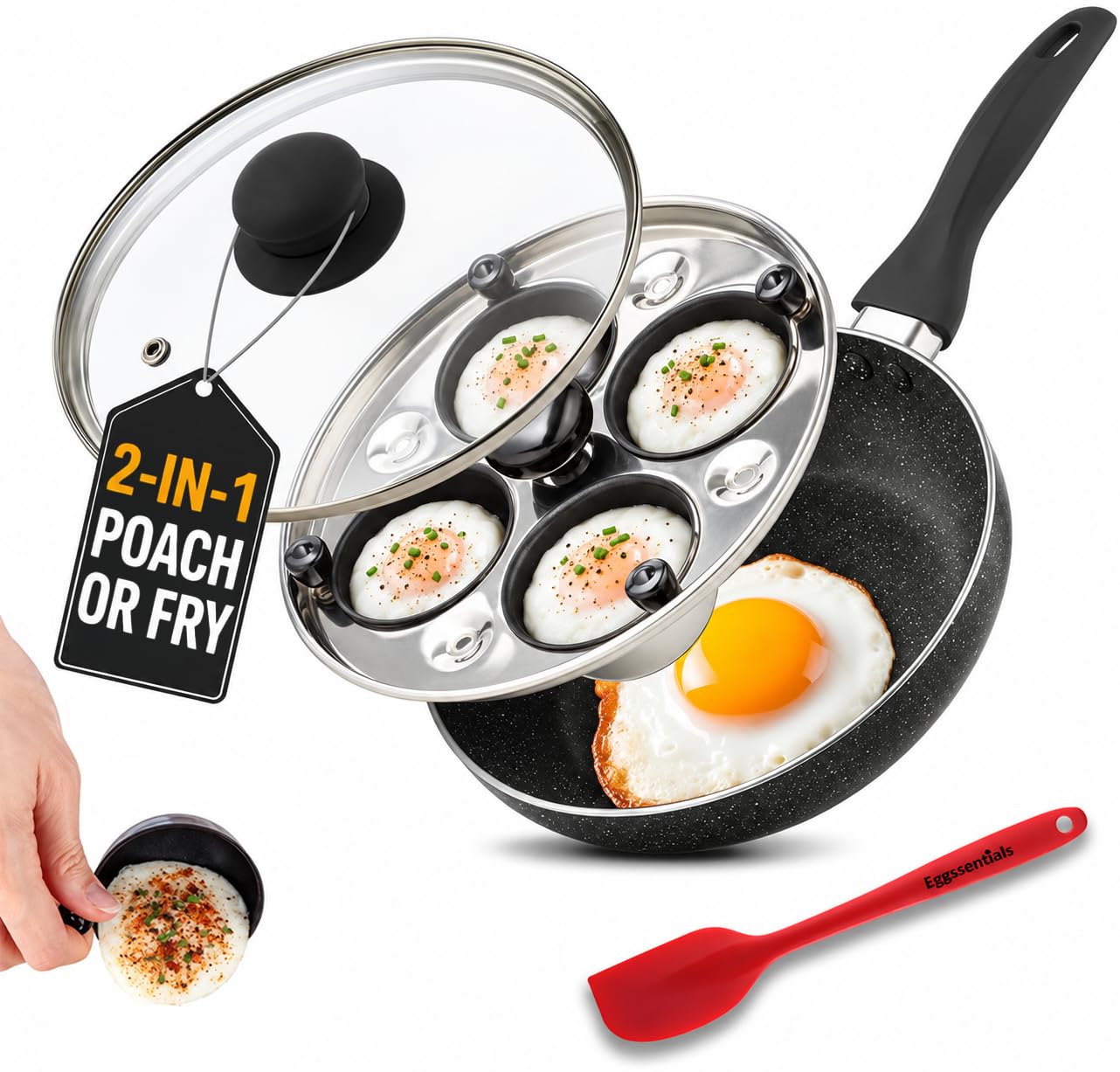
Eggssentials Stainless Egg Poacher
Key Features
- Lid: Tempered glass
- Cleaning: Dishwasher safe
- Cup capacity: 75 ml
- Body material: Stainless steel
- Price: Midrange
A jumbo egg plus an extra white cracked in beside it fits in these 75-ml cups with room left at the rim. That sounds like a small thing until a large egg crowds a shallow cup, spills over the divider, and sets into a flat sheet instead of a poached egg. The cups are PFOA-free nonstick rather than plastic or bare aluminum, the lid is tempered glass, and the body underneath is heavy stainless rather than the thin stamped metal a lot of poachers use.
Of everything we tested, this is the one we kept coming back to, and the release is why. A quick wipe of oil or a spritz of spray and the egg slides out in one piece, which is the single thing we judge a poacher on above everything else. The insert lifts out with all the cups seated in it, so you carry one piece to the sink instead of fishing hot cups out of a pan one at a time. Each cup also has its own Bakelite knob, and after a few minutes over steam that is the difference between plating breakfast and hunting for tongs.
The rest is ordinary but well done. The glass lid is thick and vents steam, everything is dishwasher safe, and a small spatula comes in the box for coaxing out a stubborn egg. Pull the insert and the base works as a stainless sauté pan — not nonstick, but deep enough for a frittata or a quick pan sauce.
One habit to build: grease the cups. The coating lowers the odds of sticking without erasing them, and an ungreased cup is where a torn white comes from. If the second job you have in mind for the base pan is frying eggs, the granite version from the same maker is the better fit, since a stainless surface will never release a fried egg the way a nonstick one does.
Pros
- 75-ml cups hold a jumbo egg and an extra white
- Eggs release in one piece after a light greasing
- Bakelite knobs on each cup for safe lifting
- Insert lifts out to leave a stainless sauté pan
Cons
- Cups still need greasing for a clean release
- Stainless base pan is not nonstick
The cups take a jumbo egg with room to spare, and a wipe of oil gets it out whole — this is the poacher most kitchens should own.
Best for Tight Budgets
EXCELSTEEL 4-Cup Egg Poacher
Key Features
- Cups: 4
- Warranty: 1 year
- Pan diameter: 7.5 inches
- Body material: 18/10 stainless steel
- Price: Budget
This is the least expensive pan here, and it is a real poacher rather than a compromise: 18/10 stainless steel, a 7.5-inch base, four nonstick cups on a lift-out tray, a glass lid, and a one-year warranty that none of the others in this group carries. For a first poacher or a two-person kitchen, that is a lot of pan for the outlay.
It does the job without drama. The eggs set evenly, the clear lid lets you watch the whites go opaque without lifting it, and the cups come out one at a time so you can plate as each is ready. Watch your hands, though: over a live burner the handle gets hot enough to need a folded towel, and the cups themselves are hot to the touch after a few minutes of steam. We kept a mitt beside the stove whenever this one was out.
The coating is the part that ages. A nonstick layer over a stainless cup is thin by nature, and peeling cups and a tray that warps are what wear looks like on a pan built to this price. None of that stops it poaching well; it just means you are buying a good pan rather than an heirloom. For a rental kitchen, a first apartment, or anyone who wants to find out whether they like poached eggs before spending more, that trade is easy to take.
Pros
- Costs far less than every other pan here
- 18/10 stainless body with a one-year warranty
- Clear glass lid and dishwasher-safe parts
Cons
- Handle and cups get very hot in use
- Cup coating can peel and the tray can warp
Spend the least and still poach four eggs evenly; just plan on a mitt and a coating that ages.
Best for Poaching and Frying
Eggssentials 2-in-1 Poacher and Fry Pan
Key Features
- Cups: 4
- Cleaning: Dishwasher safe
- Pan diameter: 8 inches
- Base material: Granite-coated aluminum
- Price: Premium
This is our top pick’s sibling, and the difference is the bottom half. Where that pan’s base is stainless steel, this one is an 8-inch granite-coated nonstick skillet, two inches deep, with the insert dropped into it. The cups hold a jumbo egg with room at the rim, and each one carries a Bakelite knob so you can lift it without a towel.
In use the two halves behave like two pans. Poach four eggs, lift the insert, tip out the water, and the same vessel fries the bacon or the pancakes that go underneath them. The granite coating releases a fried egg as readily as the cups release a poached one, and clean-up is a sponge and hot water rather than a soak.
That is why this one stayed out on the counter in our kitchen: it is the poacher for a kitchen where the pan has to justify its shelf. Eggs first, then straight into service as a skillet, one dirty pan instead of two. The cost is weight — it is close to four pounds empty, and lifting it off a back burner with water and eggs in it takes both hands. The lid is thick tempered glass and the whole thing is dishwasher safe, though a nonstick surface lasts longer washed by hand.
Pros
- Base is a genuine 8-inch nonstick fry pan
- Cups hold a jumbo egg; knobs lift cleanly
- One pan covers poaching and frying
Cons
- Heavy to lift when full of water
- Lid can warp under high heat
Choose it over our top pick if the base pan has to double as a nonstick skillet; you trade weight for that.
Best for Big Brunches
RUNZI 6-Cup Egg Poacher
Key Features
- Lid: Tempered glass
- Cups: 6
- Weight: 3.31 lb
- Cup capacity: 75 ml
- Price: Midrange
Six eggs at a time is the entire argument for this pan. Two people who want a second egg each, or four people around a table, get plated in one pass instead of two rounds with the first batch going cold while the second steams. That is a real difference on a Sunday morning and worth a wider pan in the cupboard.
Underneath the capacity it is serious cookware: a heavy stainless body, a thick vented glass lid that holds steam without rattling, 75-ml cups that swallow a jumbo egg, and a silicone spatula in the box. Everything is dishwasher safe and the insert lifts out in one piece, which matters more with six hot cups than with four. For a household that poaches on weekends rather than Tuesday mornings, the extra width earns its space.
Two cautions. The handle runs hot, and ours needed a folded towel every time it came off the burner, so plan for that rather than fighting it. This is also a pan to dry promptly: rust can develop early on it, and it should not sit wet in a dish rack overnight. Neither issue touches the eggs, which come out round and evenly set, six at a time.
Pros
- Six 75-ml cups poach a whole batch at once
- Heavy stainless body with a vented glass lid
- Dishwasher safe, with a silicone spatula included
Cons
- Handle runs hot over a burner
- Can rust early if left wet
Six cups turn poaching into a batch job for a full table, provided you keep a towel on the handle and dry it after washing.
Best for Small Households
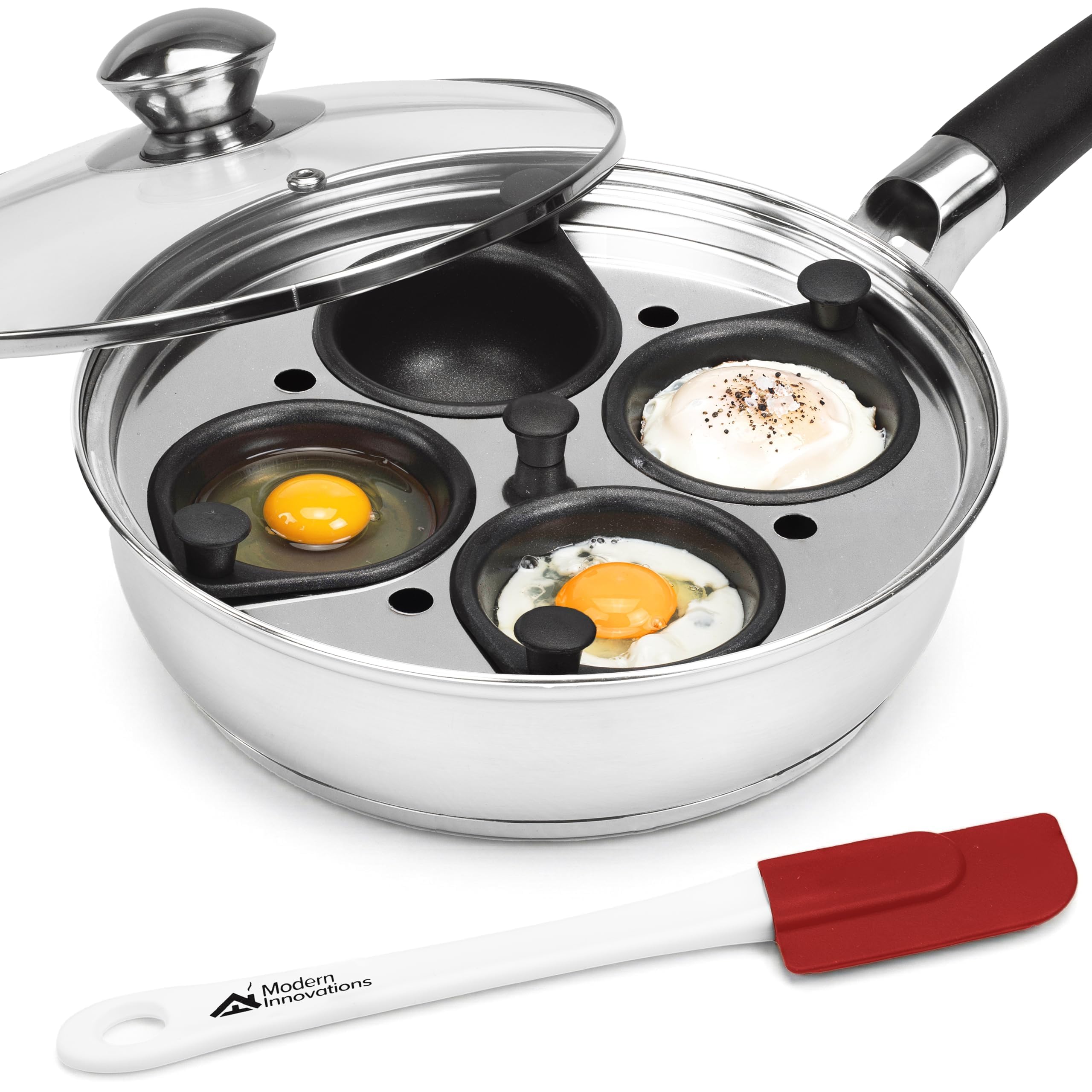
Modern Innovations Egg Poacher Pan
Key Features
- Cups: 4
- Cleaning: Dishwasher safe
- Cup capacity: 45 ml
- Pan diameter: 8 inches
- Price: Midrange
The nicest small touch here is the way the cups lift: each one has a knob you can pinch without hunting for tongs, and the pan they sit in is a proper 8-inch stainless vessel with a brushed finish that looks better than anything else in this group. It is the best-looking poacher we handled, and the easiest to pull a hot cup out of.
The cups are 45 ml, the smallest here. A large egg fills one to the brim and a jumbo egg sits proud of the rim, so if the carton in your fridge says jumbo, the 75-ml cups on our top pick are the better tool. The four cups sit in a lift-out tray with steam holes, the glass lid is tempered, and the pan, tray, cups, and silicone spatula are all dishwasher safe.
Where it loses ground is at the fittings. The little screws and knobs that hold and lift the cups can work loose, and once one goes you are back to tongs or to lifting the whole tray. The metal handle on the lid also gets hot enough to sting. Buy it for the wide pan and the deep insert, and give those cup holders a check and a tighten when the pan arrives — two minutes now saves a loose cup later.
Pros
- Sturdy 8-inch stainless pan with a brushed finish
- Cup knobs let you lift without tongs
- Dishwasher safe, silicone spatula included
Cons
- 45-ml cups crowd a jumbo egg
- Cup-holder screws and knobs can work loose
A handsome 8-inch pan with the easiest cups to lift here, though the small cups and loose fittings hold it back.
How We Tested 12 Egg Poacher Pans
We built the shortlist by reading listings and spec sheets, then filtering hard: we wanted a mix of four- and six-cup inserts, at least a couple of pans rated for induction, both stainless and nonstick bodies, and lids that vent rather than trap. Anything with cups that sat crooked in the insert or a handle that flexed under a full pan got cut before we ever cooked with it. Twelve pans made it to the counter.
Testing ran across six months of real breakfasts — Sunday eggs Benedict, weekday poached eggs on toast, and two brunches for eight that put every cup to work at once. We cooked on gas and induction, greased some cups and left others bare to see how much the coating was doing, and timed how long the water took to reach a simmer.
The most useful thing we tracked was the release: whether a spatula slid under the egg and lifted it out whole, or whether we had to dig around the rim and leave half the white behind. We watched for condensation dripping off the lid onto the setting whites, and whether the cup nearest the burner firmed up faster than the far ones. After each session we hand-washed everything, noting where yolk caught in the cup seams and whether the coating still felt slick after weeks of use.
Every few weeks we rechecked the hardware — loose handles, discolored rivets, lids that stopped sitting flat.
How to Choose an Egg Poacher Pan
A poached egg maker is really three parts — a base pan, a lift-out insert, and the cups — and the cups do most of the work, so that is where the money goes.
Start With Cup Size, Then Count
Cup volume decides whether you can cook the eggs you actually buy. A 75-ml cup takes a jumbo egg with room for an extra white; a 45-ml cup is generous for a large egg and tight for anything bigger, so the egg rides above the rim and sets unevenly against the lid. If your carton says jumbo, weigh cup volume above every other feature on the box.
Count is the easier number. Four cups suit a couple or a two-egg breakfast, and six is what you want when the table is full and you would rather not run two rounds with the first batch cooling on the plate. The six-cup RUNZI here is the only pan in this group that solves that problem.
How the Egg Releases
Every pan here uses a nonstick coating on the cups, and every one of them still wants a film of butter, oil, or spray before the egg goes in. That isn’t a defect. It’s how coated cups behave once the coating has seen a few dozen washings, and the breakfasts that go wrong are the ones where someone trusted the word nonstick and skipped the fat.
Treat the coating as the part that wears. Skip metal utensils and abrasive sponges on the cups, use a silicone spatula or a rubber one, and expect that the pans which stay easy to release are the ones whose owners greased them from day one.
Handles, Knobs, and Steam
The hottest surfaces on a poacher are the lid handle and the cups themselves, and what you grab makes the difference between a calm breakfast and a burn. Cups with their own Bakelite or plastic knobs lift far more safely than bare metal rims, and a lid handle that is metal rather than coated will sting through a quick grab.
Check the pan handle in the reviews rather than the bullet points. Stay-cool is a marketing phrase as often as a description, and a stainless handle over a gas burner gets hot no matter what the listing calls it. A dry folded towel beside the stove is not a workaround; it’s part of using one of these pans.
What the Base Pan Does Afterward
Each of these is really two pans: the base, and the insert that sits inside it. Pull the insert and a stainless base is good for sautéing, a pan sauce, or wilting spinach, while a granite or ceramic nonstick base is the one to pick if fried eggs, omelets, and pancakes are the second job in your kitchen.
That is the whole difference between our top pick and our two-in-one pick — similar cups, different bottom. Check the width against your smallest burner too; the pans here that list a diameter run 7.5 to 8 inches, and an 8-inch base is a lot of pan on a small burner ring.
Frequently Asked Questions
How long do eggs take in a stovetop egg poacher?
Bring about half an inch of water to a simmer in the base, set the insert in, add the eggs, cover, and start checking at four minutes. Four to five minutes gets a set white and a runny yolk in most of these pans. Cold eggs straight from the fridge need the longer end of that range.
Pull one cup at four minutes the first time you use a new pan and adjust by thirty seconds from there. Write the number down; the timing drifts with the water level and the burner more than it drifts with the eggs.
Is a stovetop poacher better than an electric egg cooker?
For most kitchens, yes. A pan stores in the cookware drawer, the parts go in the dishwasher, and there is no cord or dedicated appliance to fail. An electric cooker is more set-and-forget and can hold a programmed result, but it occupies counter space permanently.
If you make four eggs a few mornings a week and your counter is already crowded, the pan is the smaller commitment and the one that also works as a skillet when the insert comes out.
Can I use an egg poacher pan on an induction cooktop?
Only if the base is magnetic. Induction heats the pan rather than the burner, so a stainless base that a fridge magnet sticks to will work and one that doesn’t won’t. Test the underside before you buy, especially on a pan you already own.
The EXCELSTEEL pan here is sold as induction-compatible. For the others, check the listing for your specific model, because stainless bodies vary in how much magnetic steel they contain.
Final Verdict
Buy the Eggssentials stainless poacher. The 75-ml cups take the eggs people actually bring home, the knobs let you lift a hot cup without hunting for tongs, and a light greasing gets the egg out in one piece — which is the entire job. Nothing else in this group combines all three as cleanly.
If money is tight or you aren’t sure poaching will become a habit, the EXCELSTEEL pan costs a fraction as much and poaches just as evenly, provided you keep a mitt by the stove. Feeding more than four at a time, or cooking for a family that eats brunch together, is the one reason to go with the six-cup RUNZI.